
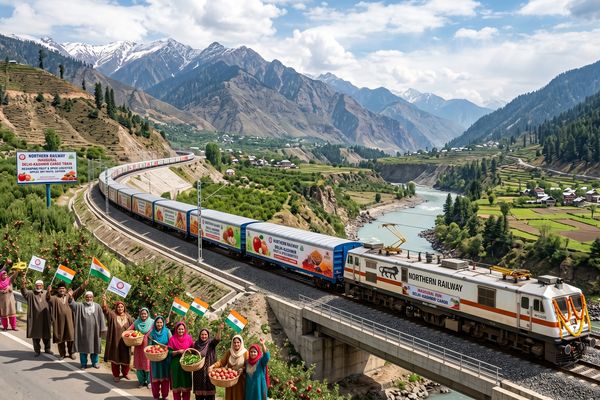
India’s Northern Railway has begun operating a dedicated Joint Parcel Product–Rapid Cargo Service (JPP-RCS) between Budgam in Jammu & Kashmir and Adarsh Nagar in New Delhi, offering fruit growers and handicraft exporters a rail-based alternative to highway-dependent road freight. Running daily on a trial basis until May 31, the service shortens transit to under 24 hours and is expected to materially reduce logistics costs for high‑value, time‑sensitive cargo.
The corridor directly links Kashmir’s central horticulture belt to one of India’s largest wholesale and distribution hubs, with scheduled halts at Bari Brahmana and Ambala Cantonment to facilitate regional loading and consolidation. If utilisation is strong, the train is likely to transition from trial status into regular service, with implications for price formation, market access and risk management in key Kashmiri agricultural commodities.
Headline
Delhi–Kashmir Cargo Train Set to Reprice Indian Fruit and Spice Supply Chains
Introduction
Northern Railway has launched a daily JPP‑RCS parcel train, numbered 00462/00461, between Budgam in central Kashmir and Adarsh Nagar in New Delhi, effective April 17 and running through May 31 on a trial basis. The train comprises eight parcel vans and a seating‑cum‑luggage coach, covering the roughly 845 km route in about 23–24 hours.
The service is explicitly targeted at fruit growers, saffron and walnut traders, and handicraft exporters seeking faster, more reliable and more economical transport options to north India’s consumption centres. It builds on earlier one‑off and seasonal freight initiatives introduced after lengthy closures of the Srinagar–Jammu highway, which left fruit‑laden trucks stranded and exposed structural vulnerabilities in Kashmir’s outbound logistics.
🌍 Immediate Market Impact
The new rail service offers a scheduled, rail‑based alternative to road haulage during the critical late‑spring and summer marketing window for cherries, stone fruit and early apple shipments. With sub‑24‑hour transit and fixed timetables, exporters gain more predictable delivery into Delhi’s wholesale markets, reducing spoilage risk and potential distress selling caused by highway disruptions.
Although official rail tariffs have not been published in recent reports, local estimates and past trials suggest logistics costs could be materially lower than current trucking rates once wagon utilisation improves. Combined with faster transit, this could support firmer farm‑gate prices in Kashmir while putting mild competitive pressure on truck freight rates along the corridor, especially during peak fruit movement weeks.
📦 Supply Chain Disruptions
The service directly addresses recurrent bottlenecks on the Srinagar–Jammu National Highway, which has faced multi‑day closures due to landslides and heavy rain, periodically cutting off truck movements to Delhi and other northern markets. During previous closures, growers incurred substantial losses from quality deterioration and market gluts once traffic resumed.
By diverting a portion of perishable flows onto rail, the Budgam–Delhi train can ease pressure on road capacity and provide a safety valve when the highway is constrained. Scheduled halts at Bari Brahmana and Ambala also allow aggregation of cargo from wider Jammu and Punjab catchments, potentially re‑routing some existing truck traffic onto rail and smoothing throughput at wholesale markets in Delhi.
In the near term, any disruption risk is more operational than infrastructural – limited parcel capacity and initial scheduling issues could constrain volumes if demand from growers outstrips available space. However, Northern Railway has signalled willingness to regularise and possibly expand the service if load factors remain strong through the May 31 trial window.
📊 Commodities Potentially Affected
- Apples and Stone Fruit (cherries, peaches, plums): High‑value, highly perishable exports from Kashmir gain faster, more predictable access to Delhi, potentially supporting better price realisation and reducing losses during peak harvest dispatches.
- Saffron: One of Kashmir’s premium exports may see improved domestic redistribution through Delhi, enhancing competitiveness into downstream export channels that source and consolidate in north Indian hubs.
- Walnuts and Dry Fruits: Bulk, high‑value but less time‑critical consignments can benefit from lower unit freight costs and reduced transit risk, improving margins for both domestic and export‑oriented traders.
- Fresh Vegetables and Niche Horticulture: As capacity permits, the train can carry other perishables from Kashmir and adjoining regions, providing an additional channel into Delhi’s wholesale vegetable and speciality produce markets.
- Non‑food agricultural inputs and packaging: Back‑haul movements may include fertilisers, farm inputs and packaging materials destined for Kashmir, improving supply reliability and potentially lowering inbound logistics costs. (Inferred from typical parcel‑train usage rather than explicitly reported.)
🌎 Regional Trade Implications
For Jammu & Kashmir, the service strengthens integration with India’s core consumption and aggregation centres, positioning Kashmiri fruit and spices more competitively against produce from Himachal Pradesh and Uttarakhand in Delhi’s markets. More stable and cheaper access could also encourage greater grading and packaging at origin, aligning with higher‑value domestic and export segments.
Downstream, Delhi and adjoining states stand to benefit from more consistent arrivals during periods when road disruptions previously caused supply spikes and gaps. Over time, sustained rail capacity could enable larger, contract‑based sourcing programmes from modern retail and processing industries, tightening Kashmiri supply linkages into pan‑India distribution networks.
Internationally, while the new service is domestic, more reliable inland logistics into Delhi – a key gateway for air and sea freight consolidation – may indirectly support export flows of saffron, walnuts and processed fruit. Exporters able to stage cargo more predictably in Delhi can optimise onward routing to ports and airports, enhancing Kashmiri-origin visibility in high‑margin overseas markets.
🧭 Market Outlook
In the short term, traders should expect incremental but not transformational shifts in physical flows and pricing: train capacity remains modest relative to total truck movements out of the Valley, yet it offers a critical hedge against highway‑related disruption risk. Any widening discount between truck and rail freight rates could influence modal choice, particularly for organised exporters and larger commission agents.
Key indicators to monitor over the next six weeks include average load factors on 00462/00461, rate differentials versus road transport, and any operational bottlenecks at intermediate halts. A decision by Northern Railway to extend or scale up capacity beyond May 31 would signal stronger long‑term confidence and could accelerate investment in cold‑chain, packing and aggregation infrastructure linked to Budgam and the new corridor.
CMB Market Insight
The Delhi–Budgam JPP‑RCS service marks a significant policy‑driven upgrade in Kashmir’s outbound logistics, directly targeting structural risks that have historically depressed returns for growers and traders. While the immediate volume impact is constrained by train capacity, the initiative introduces an institutionalised rail option into a corridor dominated by vulnerable road freight.
For commodity market participants, the new service functions as both a cost rationalisation tool and a risk‑management instrument, with potential to stabilise delivered supply, narrow seasonal price swings in Delhi and improve margin visibility for Kashmiri fruit, saffron and walnut exporters. If utilisation justifies post‑May 31 regularisation and eventual expansion, the corridor could become a core logistics spine underpinning more integrated domestic and export value chains for high‑value horticultural commodities originating in Jammu & Kashmir.
Related posts:
 Superplum’s InstaTrace™ Elevates India’s Fruit Traceability Standards, Recasting Compliance and Premium Market Access
 Greek Flooding Triggers Double-Digit Spike in Fresh Produce Prices, Reshaping Near-Term Import Needs
 Fragile US–Iran Ceasefire and Partial Hormuz Reopening Offer Limited Relief to India’s Dry Fruit Importers
 Polish Bakers Pivot to Direct Sourcing as Organic Flour Tightens, Reshaping Local Grain Trade