
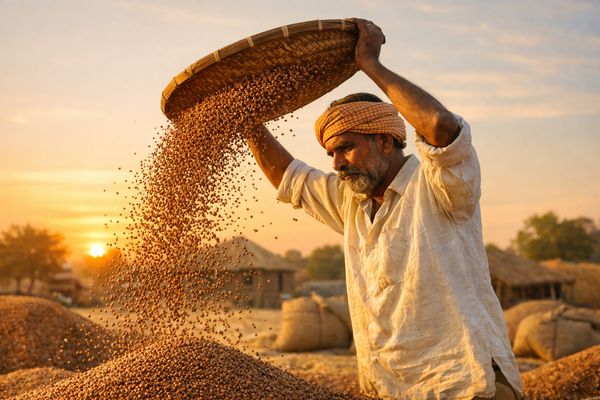
Indian lentil-equivalent pulse markets are locked in a consolidation phase, with green gram (moong) prices under pressure from ample stocks and expanded summer sowing, while international lentil offers from Canada and China remain broadly stable in EUR terms. Upside appears capped in the short term unless India accelerates procurement or weather disrupts the summer crop.
India’s wholesale moong market is structurally oversupplied versus the Minimum Support Price, curbing stockist interest and dampening mill demand. At the same time, FOB offers for Canadian and Chinese lentils have been flat in recent weeks, giving importers, especially in Europe, a tactical buying window to secure forward coverage before the new-crop supply picture becomes clearer.
[cmb_offer ids=245,244,243]
📈 Prices & Market Tone
Across key Indian mandis, green gram prices are stable to slightly weaker, reflecting a market in consolidation rather than in free fall. Bold moong in Indore is steady around USD 96.9–98.3 per 100 kg, while premium chamki grades in Jaipur have softened marginally, slipping by about USD 1.2 per quintal. Delhi and Akola quotes are largely unchanged, underscoring the absence of aggressive buying from either stockists or processors.
International lentil offers mirror this sideways tone. Converted at roughly 0.94 EUR/USD, recent Canadian FOB prices indicate red football lentils around EUR 2.44/kg, Laird green around EUR 1.66/kg and Eston green around EUR 1.57/kg. Chinese small green lentils are quoted lower, near EUR 1.16/kg for organic and EUR 1.08/kg for conventional, with only minimal week‑on‑week moves, pointing to a broadly balanced global trade environment.
| Origin / Type | Location & Terms | Latest price (EUR/kg) | 1-week change (EUR/kg) |
|---|---|---|---|
| Canada – Red football | Ottawa, FOB | 2.44 | ≈0.00 |
| Canada – Laird green | Ottawa, FOB | 1.66 | ≈0.00 |
| Canada – Eston green | Ottawa, FOB | 1.57 | ≈0.00 |
| China – Small green, organic | Beijing, FOB | 1.16 | ≈0.00 |
| China – Small green, conv. | Beijing, FOB | 1.08 | ≈+0.01 |
🌍 Supply & Demand Drivers
India’s green gram complex, which strongly influences regional lentil sentiment, is being shaped by two decisive supply‑side forces. First, summer moong sowing has accelerated, reaching 11.73 lakh hectares by 17 April 2026 versus 10.69 lakh hectares a year ago—an almost 10% gain that signals expectations of a larger upcoming crop. Second, the central government holds its highest moong stock level among pulses, providing ample capacity to release stock and prevent sharp price spikes.
On the demand side, dal mills remain strictly hand‑to‑mouth, purchasing only for immediate processing needs despite active MSP procurement in several states. With wholesale moong prices trading roughly 18–20% below the MSP of about USD 103.6 per quintal, the domestic market clearly indicates oversupply. This discourages aggressive stocking and reduces near‑term import pull for lentil substitutes, keeping global lentil trade flows orderly for now.
📊 Fundamentals & Policy Context
The structural gap between market prices and MSP is the key bearish anchor for India’s pulse complex. As long as open‑market moong remains significantly below support levels and government warehouses are comfortably stocked, policy incentives favour calibrated buffer releases rather than new, large‑scale procurement drives. This configuration caps rally potential in India’s pulse prices and indirectly dampens upside for imported lentils in destination markets sensitive to Indian offers.
Weather conditions across Indian summer pulse belts are currently supportive of steady arrivals, without major stress signals in the short term. That implies additional physical pressure on mandis before the benefits of expanded area translate into a clearer forward supply narrative. Globally, no acute production shock is yet visible in core lentil origins, so export‑side fundamentals are broadly neutral. Any abrupt change would most likely come from policy action—such as intensified procurement or export/import policy shifts—rather than from immediate agronomic threats.
📆 Short-Term Outlook & Weather
Over the next two to four weeks, India’s green gram market is expected to remain rangebound, constrained by high stocks, enlarged sowing and lacklustre mill demand. Traders in producing regions do not anticipate a pronounced price break, but equally see limited justification for a strong rally without a shock. As summer moong fields advance, comfortable crop conditions should sustain arrivals and reinforce the prevailing consolidation pattern in domestic pulse prices.
For international lentils, the key near‑term variable is demand rather than supply. With Canadian and Chinese FOB offers stable in EUR, buyers in Europe and the Middle East face little immediate pressure to chase prices higher. However, once more concrete yield and acreage signals emerge later in the season from major origins—and depending on how India manages its pulse stocks—current flat prices could look attractive in retrospect.
🧭 Trading Outlook
- Importers / Food companies: Use the current discount of Indian moong to MSP and stable Canadian/Chinese lentil offers as an opportunity to lock in part of Q3–Q4 coverage, especially for red and green lentils, while avoiding over‑commitment ahead of new‑crop data.
- European buyers of Indian green gram: The unusually wide gap to MSP suggests a tactical window to negotiate favourable forward contracts; consider scaling in over the next 2–4 weeks rather than waiting for potential policy‑driven rebound.
- Producers and exporters in Canada/China: With global demand steady but unspectacular, focus on flexible pricing structures and logistics reliability rather than outright price increases to defend market share.
- Risk watch: A sharp government procurement push in India or a significant weather event in key lentil‑growing regions could flip sentiment quickly and tighten available exportable surpluses.
📍 3‑Day Directional View (EUR-based)
- Canada FOB (Ottawa): Red football and green lentils expected to trade sideways in EUR, with only minor FX‑driven noise.
- China FOB (Beijing): Small green lentils, both conventional and organic, likely to remain stable with a slight firming bias if freight or currency costs edge higher.
- India (green gram, mandi equivalent): Local prices projected to hold within the recent band, modest downside risk but no sign of a disorderly sell‑off in the next few days.
[cmb_chart ids=245,244,243]
Related posts:
 Indian Lentil Market Holds Firm as Tight Domestic Supply Offsets Import Cap
 Pigeon Peas Under Pressure: Indian Oversupply Weighs on Global Pea Market
 Lentil Market Steady as Indian Green Gram Oversupply Caps Upside
 Lentil prices in China steady to slightly firmer as energy shock lifts costs
 Lentils market steadies as Indian green gram glut caps upside
 Green gram stocks anchor lentil prices in a narrow range