
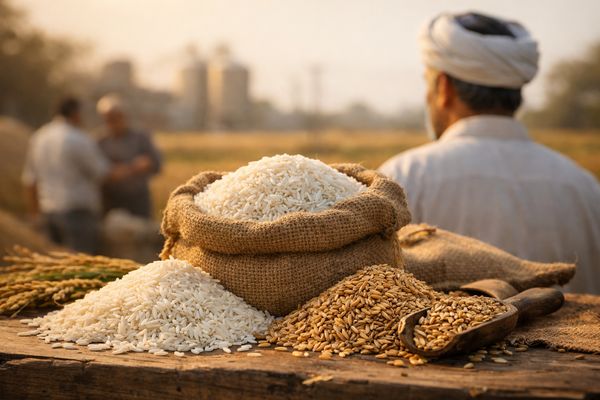
Indian basmati rice prices have slipped modestly on weak consumer demand, but the move looks like a short-lived correction rather than a structural downturn, with export demand and tighter future non-basmati supply likely to cap the downside.
India’s basmati market started the week under mild selling pressure as buyers stepped back at recent highs. Key premium grades in Delhi’s wholesale trade fell by roughly $1.18–$2.36 per 100 kg, even as wheat and barley strengthened, underscoring that the softness is highly segment-specific. At the same time, FOB offers in EUR for Indian basmati and fine non-basmati show a gradual easing since late March, improving export competitiveness. With summer rice transplanting lagging seasonal norms and structural import demand from the Middle East and Europe intact, the current dip offers a tactical procurement window rather than signaling a bearish shift.
[cmb_offer ids=502,501,500]
📈 Prices & Short-Term Trend
In Delhi’s wholesale grain market, premium basmati benchmarks have edged lower. The 1509 sela basmati variety now trades around $98.10–$99.28 per 100 kg, while 1509 steam basmati is quoted at $106.38–$108.74 per 100 kg. The longer-grain 1718 sela, popular with hotel and restaurant buyers, is assessed near $102.84–$103.97 per 100 kg. All three are down by about $1.18–$2.36 per 100 kg from the previous session, reflecting a modest correction rather than a sharp sell-off.
FOB price indications in New Delhi, converted to EUR, confirm a gentle easing over recent weeks for key exportable grades. Indian 1509 steam is currently offered near EUR 0.72/kg, down from about EUR 0.76/kg in late March, while 1121 steam is around EUR 0.77/kg versus roughly EUR 0.83/kg three weeks ago. Organic white basmati offers have softened only marginally to about EUR 1.70/kg, highlighting that the recent downward adjustment is more pronounced in mainstream export lines than in the highest-value niche segments.
| Origin / Type | Location & Terms | Latest Price (EUR/kg) | Price 3 Weeks Ago (EUR/kg) | Direction |
|---|---|---|---|---|
| India 1509 steam (basmati) | New Delhi, FOB | 0.72 | 0.78 | ⬇ softening |
| India 1121 steam (basmati) | New Delhi, FOB | 0.77 | 0.83 | ⬇ softening |
| India white basmati, organic | New Delhi, FOB | 1.70 | 1.76 | ⬇ slightly softer |
| Vietnam long white 5% broken | Hanoi, FOB | 0.40 | 0.43 | ⬇ weaker |
🌍 Supply, Demand & Trade Flows
The immediate driver of the latest basmati softness is a lack of buying interest at the consumer end. Retail and institutional clients are holding off at current wholesale levels, leaving stockists with more inventory than they would like. This temporary oversupply contrasts with a broadly firm undertone in Delhi’s grain complex, where wheat and barley have in fact risen, indicating that the weakness is concentrated in premium rice rather than symptomatic of broader grain deflation.
On the supply side, India’s new kharif season is off to a slightly slower start. By 17 April 2026, summer rice transplanting covered 30.64 lakh hectares, below last year’s 32.31 lakh hectares and the normal 31.49 lakh hectares. This suggests a mild area deficit for the upcoming monsoon-sown crop. While basmati is less dependent on the earliest summer plantings than some non-basmati types, any sustained acreage shortfall would tighten overall Indian rice availability later in the marketing year, offering indirect support to premium segments.
Export dynamics remain a key stabilizing factor. India is the dominant basmati supplier to the Middle East, Europe, and North America, and structural import demand from these regions typically absorbs domestic weakness once prices become attractive. Recent international benchmarks show global rice export prices trending sideways to slightly softer in March, with Asian parboiled and Vietnamese 5% broken quotations easing modestly, but still elevated by historical standards. Against this backdrop, the latest correction in Indian basmati improves competitiveness into GCC and European markets just as freight bottlenecks in the Strait of Hormuz begin to normalize and war‑risk premiums retreat.
📊 Fundamentals & Weather View
Fundamentally, there is no sign of a sudden surge in basmati supply or a collapse in demand that would justify a prolonged bearish phase. Stocks at the wholesale level have built up mainly because institutional and retail buyers are delaying purchases, not because of bumper arrivals. At the same time, recent global indicators show that the overall rice price index has eased from its early-2026 highs but remains well above pre-2023 levels, suggesting that downside for high-quality fragrant rice is limited by still-firm international benchmarks.
Weather is an emerging watchpoint. Early kharif-season conditions in India will hinge on the onset and distribution of the southwest monsoon from June onward. For now, the slightly lagging summer transplanting hints at some caution among farmers, potentially linked to uncertainty about input costs and rainfall timing rather than clear evidence of adverse weather. Global supply risks remain moderate: recent commentary highlights broadly adequate stocks in key exporting countries, but any negative monsoon surprise in India could quickly tighten the balance sheet for non-basmati, with spillover support for basmati later in 2026.
📆 Outlook & Price Scenario (Next 1–2 Weeks)
The short-term outlook for Indian basmati rice is cautiously neutral. Wholesale prices are likely to consolidate near current levels or ease slightly further as long as consumer demand remains subdued. However, the downside appears limited: export buyers are already seeing improved values in 1509 steam and 1718 sela, and a modest pickup in inquiries from the Middle East and Europe would be enough to stabilize the market.
Given the early signs of acreage slippage in summer rice and still-firm global benchmarks, the more probable path is a gradual basing pattern rather than a protracted decline. A recovery in domestic retail offtake, combined with renewed export bookings as freight conditions normalize through key shipping lanes, could trigger a mild rebound in premium basmati prices within one to two weeks.
💼 Trading & Procurement Recommendations
- European and Middle Eastern buyers: Use the current dip in Indian basmati, especially 1509 steam and 1718 sela, to secure forward coverage for Q3 deliveries while FOB New Delhi offers remain around EUR 0.70–0.80/kg.
- Importers with flexible blends: Consider selectively increasing basmati share in premium blends, as the recent easing has narrowed the price gap versus some fragrant non-basmati origins.
- Indian millers and exporters: Avoid aggressive destocking at current levels; focus on building export pipelines and hedge freight exposure rather than locking in further price discounts.
- Food industry users (retail brands, HoReCa): Lock in a portion of Q3–Q4 requirements now, but keep some volume open to benefit if demand-side weakness persists for another few weeks.
📉 3‑Day Directional View (EUR Basis)
- India – New Delhi FOB basmati (1509/1121): Slight downward to sideways bias; narrow range trade expected with a mild softening tendency as domestic demand remains quiet.
- India – New Delhi FOB non-basmati premium grades: Mostly steady; potential for small gains if early concerns about kharif acreage draw speculative interest.
- Vietnam – Hanoi FOB long white 5% and fragrant types: Sideways to marginally softer after recent gains, tracking global export benchmarks and shifting demand between Asian suppliers.
[cmb_chart ids=502,501,500]
Related posts:
 Indian Amaranth Seeds: Flat EU Prices as Weather Risks Build in India
 Rice Market Softens as New-Crop Supply and Strong Euro Cap Upside
 Rice market softens as CBOT retreats and Asian FOB offers edge lower
 Indian Basmati Rice Squeezed by Paddy Shortage as Prices Surge
 Indian Corn Softens on Bihar Harvest as US Planting Faces Weather Risks
 Indian Basmati Rice Firms as Paddy Tightens and Export Buying Returns
 Basmati Rice Rallies as Export Demand Recovers and Bangladesh Eyes Indian Supply