
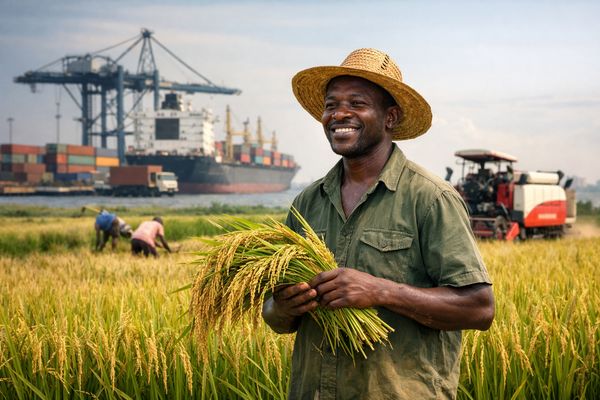
Regional rice output in West Africa is set to rise modestly in 2026/27, but the market balance remains firmly driven by imports as local rice struggles on cost competitiveness.
The rice sectors in Senegal, Mali, and Guinea are all expanding area and production, yet structural gaps between consumption and local supply keep import demand high. Senegal faces a growing imbalance, with rising output but unsold stocks and a widening price disadvantage versus imports. Mali is consolidating its position as the regional production anchor, easing its import needs through better harvests and lower domestic prices. Guinea continues a gradual expansion path but remains heavily reliant on Indian rice. Across the region, geopolitical risk to fertilizer flows and farmer liquidity strains underscore that policy support and global trade flows will remain decisive for the rice balance.
📈 Prices & Competitiveness
Regional milled rice production in 2026/27 is projected at about 3.74 million MT (+2% YoY), against imports of around 3.54 million MT, underlining how traded rice still sets the marginal price. Cost competitiveness is the dominant market driver: imported rice generally undercuts domestic product, shaping consumer and trader behavior.
In Senegal, imported Indian rice is around $0.55/kg (≈€0.52/kg), while local rice is about $0.69/kg (≈€0.65/kg), a gap of roughly 24%. This premium is too wide for most consumers in a highly price‑sensitive market, especially in urban areas, and it feeds directly into slower offtake of local rice and rising farm stocks. In Mali, by contrast, strong harvests have pushed farmgate prices lower from about $0.66/kg to $0.50/kg (≈€0.47/kg), improving affordability but also squeezing farmer margins.
| Country | Local rice price (EUR/kg) | Imported rice price (EUR/kg) | Competitiveness |
|---|---|---|---|
| Senegal | ≈0.65 | ≈0.52 (Indian) | Imports clearly cheaper |
| Mali | ≈0.47 farmgate | Not central driver | Local harvests dominate |
| Guinea | N/A | Indian rice benchmark | >90% of imports from India |
🌍 Supply & Demand Balance
The regional rice area in 2026/27 is estimated at about 2 million hectares (+2% YoY), supporting a modest production increase to ~3.74 million MT. Against this, imports are expected to edge up to ~3.54 million MT, confirming that trade remains structurally embedded in the balance sheet despite incremental output gains.
Senegal is heading into 2026/27 with output around 670,000 MT (+4%) on 260,000 hectares (+2%). However, consumption at roughly 2.35 million MT (+2%) and imports of about 1.76 million MT (+3%) show that demand growth still channels primarily into foreign rice. More than 50,000 MT of local rice remain unsold, locking farmer capital and amplifying liquidity stress.
Mali, providing roughly 52% of regional rice production, is consolidating its role as the supply anchor. Production is seen at about 1.95 million MT (+1.5%) versus consumption of 2.4 million MT, with imports dropping to around 475,000 MT (‑5%). Better harvests, higher stocks, and lower domestic prices are clearly reducing Mali’s import dependence.
Guinea is expanding gradually, with output of about 1.125 million MT (+2.5%) against consumption of 2.36 million MT. Imports remain high at about 1.3 million MT, and more than 90% of this volume is sourced from India, underscoring a heavy supplier concentration risk. Any policy or export restriction from India would disproportionately affect Guinean supply and prices.
📊 Fundamentals & Policy Backdrop
Across the three markets, policy intervention is rising as governments attempt to balance food security, farm incomes, and consumer prices. The dominant theme is that domestic production growth is feasible but still heavily policy‑dependent and slower than demand expansion.
- Senegal: price controls, consumer subsidies, and local procurement schemes aim to support local paddy and milled rice. However, as long as imported rice remains materially cheaper, the market signal continues to favor imports, and unsold domestic stock builds up.
- Mali: a long‑term production expansion strategy is paying off in higher self‑sufficiency, with irrigation and yield improvements gradually lowering import needs. Yet, lower farmgate prices raise questions about medium‑term investment incentives and farmer resilience.
- Guinea: government investment in irrigation and improved seeds supports output growth, but the structural demand gap and reliance on a single dominant supplier mean imports will remain central for the foreseeable future.
⚠️ Risks: Fertilizer, Logistics & Farmer Liquidity
Fertilizer supply disruptions linked to tensions around the Strait of Hormuz pose a key upside risk to production costs and a downside risk to yields in 2026/27. Any spike in fertilizer prices or delays in deliveries would likely hit smallholders hardest, particularly in Senegal and Guinea where farmer finances are already fragile.
In Senegal, more than 50,000 MT of unsold rice are already constraining liquidity and may limit input purchases ahead of the next season. If combined with higher fertilizer prices and logistical bottlenecks, this could cap production growth and push more demand back toward imports. In Guinea, the heavy reliance on Indian supply leaves the market vulnerable not just to fertilizer trends but also to any shifts in freight, insurance, or export policy.
📆 Short-Term Outlook & Trading View
Structurally, the region remains import‑dependent, with total import demand around 3.54 million MT even as domestic output edges higher. For global exporters such as India, Thailand, and Brazil, this represents a persistently supportive demand base from West Africa in 2026/27.
- For exporters: maintain a moderately bullish stance on West African demand; Senegal and Guinea continue to drive import volumes, while Mali’s reduced imports partly offset but do not reverse the regional pull.
- For local millers and traders: in Senegal, prioritize marketing and pricing strategies that narrow the gap versus imports; consider blending and quality upgrades to justify premiums where possible.
- For policymakers: balance between protecting consumers via cheap imports and sustaining farmer incomes is becoming tighter; targeted subsidies and efficient procurement will be critical to avoid further stock accumulation.
- For input suppliers: monitor fertilizer and freight markets closely; any renewed tension around Hormuz or logistics congestion could quickly translate into tighter margins and lower application rates.
📍 3-Day Directional Price Indication (EUR)
Converted from indicative USD levels using ~0.94 EUR/USD:
- Senegal (local rice, wholesale equivalent): ≈€0.65/kg – sideways to slightly soft given high unsold stocks.
- Senegal (imported Indian rice, CIF-based): ≈€0.52/kg – stable, remains the key benchmark for urban consumers.
- Mali (farmgate paddy): ≈€0.47/kg – mildly pressured by strong supplies and ample stocks.
- Guinea (imported Indian rice): broadly in line with Senegal’s imported benchmark, with a stable to mildly firm bias due to heavy reliance on a single supplier.
Over the next three days, no major structural shifts are expected; import benchmarks should remain the main reference for regional price direction, while local prices stay under pressure where stocks are heavy and liquidity is tight.
Related posts:
 South Korea’s New Rice Tender Underscores Shift Toward Premium Imports, Exposes India’s Export Gap
 Sri Lanka Rice: Production Recovery Eases Prices but Weather Risks Persist
 South Africa’s Near‑Record Corn Harvest Sets a Softer Price Tone
 Indian Basmati Rice Firms as Paddy Tightens and Export Buying Returns