

Farm‑level tightness in India’s black pepper market is colliding with disrupted export demand, keeping prices firm but capped. With Kerala’s crop down sharply and farmers holding back sales, any easing of Middle East tensions could quickly turn today’s sideways market into a sharper rally from current levels.
India’s pepper market is currently defined by a standoff rather than a classic bull run. Farmers in Kerala and Karnataka are restricting sales after a smaller 2025/26 crop, while export demand — particularly from Iran — is constrained by the ongoing US–Israel–Iran conflict and shipping risks around Hormuz. Domestic benchmark prices have edged higher at Kochi and Delhi, but the structural tightness has yet to fully translate into a sustained upside break. European and other importers should view the present consolidation as potentially fragile: if trade routes normalise, today’s modest premiums could quickly expand.
Exclusive Offers on CMBroker

Pepper
white whole
FOB 7.00 €/kg
(from IN)

Pepper powder
black
FOB 8.70 €/kg
(from IN)

Pepper
green dehydrated
FOB 8.50 €/kg
(from LK)
📈 Prices & Benchmarks
At India’s key wholesale hubs, black pepper prices have firmed modestly in recent sessions. In Delhi, Merca grade has risen by about USD 0.11 per kg to trade around USD 8.15–8.27 per kg, while Kochi quotes have similarly recovered by USD 0.11 per kg to roughly USD 7.62–7.70 per kg, reversing an earlier dip. Daily arrivals at Kochi are now negligible as growers hold back stocks.
FOB offers for Indian and Vietnamese pepper suggest a broadly steady but firm international backdrop. Converting recent offers to EUR, standard Indian black 500 g/l clean is around EUR 5.5–5.7/kg FOB New Delhi, while premium organic whole grades are closer to EUR 7.5–8.0/kg. Vietnamese FAQ and clean 500–600 g/l material is typically EUR 5.3–6.1/kg FOB Hanoi, keeping Vietnam competitive but no longer deeply discounted to India.
| Origin / Type | Location & Term | Indicative Price (EUR/kg) |
|---|---|---|
| India black 500 g/l, clean (conv.) | New Delhi, FOB | ≈ 5.5–5.7 |
| India black whole 500 g/l (organic) | New Delhi, FOB | ≈ 7.5–8.0 |
| Vietnam black 500–600 g/l, clean | Hanoi, FOB | ≈ 5.3–6.1 |
| India white whole (organic) | New Delhi, FOB | ≈ 6.5–7.0 |
🌍 Supply & Demand Balance
On the supply side, India’s physical balance is clearly tighter this season. Kerala’s black pepper output is estimated 20–25% below a normal crop due to adverse growing‑season weather, while Karnataka’s main pepper areas are similarly short. Farmers started restricting sales three and a half to four months ago, shortly after harvest, and have largely maintained this stance, leaving visible arrivals at Kochi extremely thin.
This structural tightness is amplified by a shift in marketing channels. Increasingly, growers are bypassing traditional wholesale markets, selling directly into consuming states. This reduces transparent spot liquidity at benchmarks such as Kochi and can make outright tightness less visible to external buyers until prices adjust more abruptly. Underlying availability, however, is genuinely constrained at the origin level.
Demand is being pulled in two directions. Domestic consumption and value‑chain needs within India remain broadly steady, and higher per‑unit export values indicate that buyers are willing to pay more for limited volumes. Yet export demand from Iran — historically an important destination for Indian spices — has been knocked back by conflict‑related shipping disruption, payment risk and sanctions uncertainty. This is muting the immediate pull on Indian stocks just as supply tightens.
📊 Fundamentals & Trade Flows
Export data underscore this mixed picture. In the first ten months of India’s 2025/26 fiscal year, pepper exports reached 16,178 tonnes compared with 17,262 tonnes a year earlier, a drop in volume despite a rise in export value from about USD 904 million to around USD 1.05 billion. Fewer tonnes are moving, but at higher unit prices, consistent with a structurally tighter market.
Global fundamentals provide limited relief. Vietnam, the largest exporter, continues to face its own production headwinds, and average export prices there in early 2026 are holding near the upper end of recent years. Recent assessments point to a multi‑year supply contraction in Vietnam on the back of aging trees and past weather stress, while Brazil and Indonesia are not yet in a position to flood the market with surplus pepper.
Geopolitics is a key external driver. The escalation of the US–Iran war and naval disruption around the Strait of Hormuz are complicating trade with Iran and nearby markets, affecting shipping costs, transit times and insurance premiums for agricultural cargoes. While most Indian exports can theoretically be redirected to other destinations, logistics friction and demand uncertainty are significant enough to delay or resize pepper buying programmes in the Gulf and beyond.
⛅ Weather & Short-Term Outlook (India)
Weather during the key development stages has already translated into a smaller Kerala crop, and this effect is now largely crystallised in current stocks. In the immediate 2–4 week horizon, no major weather‑driven supply surge is expected that could materially loosen the market. Instead, the short‑term focus is on how remaining farm inventories are managed and whether any late‑season quality issues emerge in stored pepper.
Given the smaller base crop and ongoing fertiliser and input‑cost uncertainty linked to the broader Middle East crisis, growers are likely to stay cautious sellers, reinforcing the underlying floor under prices. If monsoon outlooks or fertiliser availability were to deteriorate further, market sentiment could quickly price in additional risk premia for the next production cycle.
📆 2–4 Week Market Scenario
The most probable near‑term pattern is constrained range‑trading with a mild upward bias. Tight domestic supply and farmer resistance to current bids should keep downside limited, especially at Kochi and Delhi benchmarks. However, the missing catalyst is a clear improvement in external demand, particularly from Iran and other Middle Eastern buyers affected by the conflict‑driven shipping disruptions.
Any signs of de‑escalation in the US–Israel–Iran conflict, easing of shipping restrictions or normalisation of payment channels could quickly unlock pent‑up buying interest. In that case, the combination of low visible stocks, reduced Kerala and Karnataka output, and already firmer FOB quotes suggests that prices could break higher more sharply than recent gradual moves would imply.
🧭 Trading Outlook & Risk Management
- Importers (EU and other consuming markets): Use current consolidation to secure medium‑term coverage, especially for higher‑quality Indian grades, as structural tightness and potential geopolitical easing argue for asymmetric upside risk.
- Blenders and industrial users: Consider diversifying between Indian and Vietnamese origins where feasible, but avoid over‑reliance on the cheapest FAQ grades; in a tight cycle, quality‑driven premiums can widen faster than headline benchmarks.
- Exporters in India: Manage inventory and currency risk carefully; with export volumes below last year but values higher, margins hinge on timing sales into any demand rebound from Iran or alternative markets.
- Producers: The farmer strategy of withholding appears justified by fundamentals, but monitor liquidity and storage quality; a gradual, disciplined selling programme into price strength may outperform an all‑at‑once release if demand normalises suddenly.
📍 3‑Day Directional Outlook (Key Hubs, in EUR)
- Kochi (India, black pepper, spot equivalent): Sideways to slightly firmer; tight arrivals support a narrow EUR‑denominated range with modest upside skew.
- New Delhi FOB (India, black 500 g/l clean): Stable around EUR 5.5–5.7/kg, with bids likely to edge higher on any incremental export enquiry.
- Hanoi FOB (Vietnam, FAQ/clean grades): Largely steady in the EUR 5.3–6.1/kg band; global tightness limits downside, but competition with Indian origin caps near‑term spikes.
Related posts:
 Black Pepper Rally Accelerates as Indian Supply Tightens
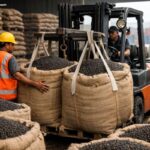 Indian Black Pepper Rallies as Supply Tightens and Stockists Chase Scarcity
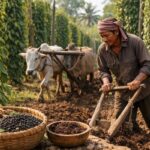 Pepper Market Snapshot IN–LK–VN: FOB Prices Hold Firm Amid Tight Supply
 Indian Coriander: New Crop Pressure Meets Tight Global Supply
 Ajwain market at a turning point as new crop meets tight old stocks
 Indian Pepper Prices Hold Firm as Vietnam Export Benchmarks Edge Higher
 Aniseed Prices Hold Steady as Egypt Faces Higher Farm Costs and Firm Indian Export Demand