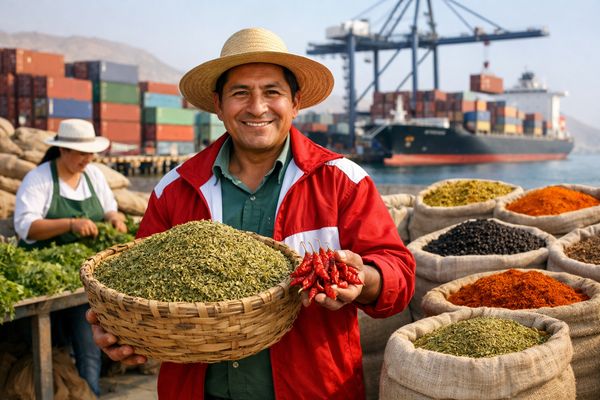
Peru has solidified its status as Latin America’s second-largest exporter of herbs and spices, with robust double-digit long-term growth and rising regional contributions led by Tacna. Strong global demand, product diversification, and quality-driven positioning are underpinning continued expansion and competitiveness versus Mexico.
Peru’s herb and spice industry has evolved into a key pillar of the country’s agro-export portfolio, driven by the internationalization of Peruvian cuisine, expanding trade agreements, and growing demand for natural, health-oriented ingredients. With exports now exceeding the equivalent of roughly EUR 556 million in 2025, the sector shows sustained momentum, supported by both traditional products like onions and paprika and dynamic regions such as Tacna. While competition from Mexico remains intense, Peru’s focus on high-quality raw materials, niche products, and value-added lines suggests further upside in global markets.
📈 Export Performance & Regional Dynamics
In 2025, Peru’s herb and spice exports reached about USD 600.9 million (≈ EUR 556 million at 1.08 USD/EUR), firmly placing the country as the second-largest exporter in Latin America and the Caribbean, behind Mexico with over USD 1.2 billion (≈ EUR 1.11 billion). This confirms Peru’s growing weight in global agricultural trade and its increasing specialization in the herb and spice segment.
Over 2000–2025, the sector recorded an average annual growth rate of around 12.3%, pointing to a structurally expanding industry rather than short-term volatility. Regionally, production and export activity is diversified across Tacna, Lima, Ica, Junín, La Libertad, and Arequipa, reducing concentration risk and supporting supply resilience.
Tacna stands out as a fast-growing hub. In 2025, the region exported herbs, spices, and condiments worth around USD 25.1 million (≈ EUR 23.2 million), up 29.7% year-on-year. Since 2000, when Tacna’s exports stood at just USD 2.7 million (≈ EUR 2.5 million), volumes have increased nearly ninefold, integrating the region more deeply into Peru’s national supply chain.
🌍 Product Mix & Market Access
Peru’s export portfolio is concentrated in onions, paprika, and ginger, all of which enjoy broad and stable international demand. These products benefit from the global popularity of Peruvian flavors and the rising use of natural seasonings in both industrial food processing and foodservice channels.
Tacna contributes a differentiated mix that includes oregano, rosemary, marjoram, paprika, dried ginger, and turmeric, as well as condiments such as soy-based sauces, cumin, and vinegar. This combination of raw spices and processed condiments helps Peru tap into both bulk commodity trade and higher-margin specialty segments.
Key destinations for Tacna’s products include Brazil, the European Union, Chile, Argentina, and Ecuador. This diversified customer base reduces dependence on any single market and aligns with Peru’s broader trade strategy built on an extensive network of agreements and favorable logistics links along the Pacific coast.
📊 Competitiveness vs. Mexico & Structural Drivers
Mexico remains the regional leader with a broader product spectrum that includes sauces, peppers, and blended spices, reinforcing its scale advantage. However, Peru is carving out a competitive niche by emphasizing high-quality raw materials, distinctive Peruvian varieties, and traceable, natural ingredients that cater to premium and health-oriented segments.
Core structural drivers for Peru’s continued expansion include: the international popularity of Peruvian cuisine, which sustains demand for authentic ingredients; consumer preference shifts toward natural and minimally processed foods; and ongoing investments in logistics and export infrastructure that shorten lead times and improve reliability.
These fundamentals suggest that Peru’s share of global herb and spice trade can keep rising, even in the face of strong regional competition. The rapid growth of regions like Tacna further strengthens the internal supply base and reduces bottlenecks.
📆 Outlook & Strategic Implications
The medium-term outlook for Peru’s herb and spice sector remains clearly positive. Rising global demand, expanding production capacity in multiple regions, and continued infrastructure investment are expected to support further growth in both volumes and value.
Strategic priorities for sustaining momentum include deeper product diversification beyond current staples, scaling value-added processing (e.g., ground, blended, and packaged spices), and maintaining strict quality and traceability standards for increasingly demanding markets, especially in the EU and premium segments in the Americas.
💡 Trading & Procurement Outlook
- Importers/Buyers: Consider medium-term contracts with Peruvian suppliers for key products such as paprika, ginger, and onions to secure volumes from a structurally growing origin with improving logistics reliability.
- Food manufacturers: Explore Peruvian-origin herbs (oregano, rosemary, marjoram) and turmeric/ginger for premium and health-focused product lines, leveraging Peru’s quality positioning and story-telling potential.
- Peruvian exporters: Prioritize value-added processing and blended products to narrow the gap with Mexico’s broader offering and capture higher margins in established markets like the EU and Brazil.
📍 Short-Term Directional View (Next 3 Days)
Given the structural nature of Peru’s herb and spice exports and the absence of acute short-term shocks in the described context, export price indications in EUR for core products (onions, paprika, ginger and key herbs) are expected to remain broadly stable over the next three days. Minor fluctuations may occur due to logistics costs and FX moves, but no significant directional shift is anticipated in the immediate term.