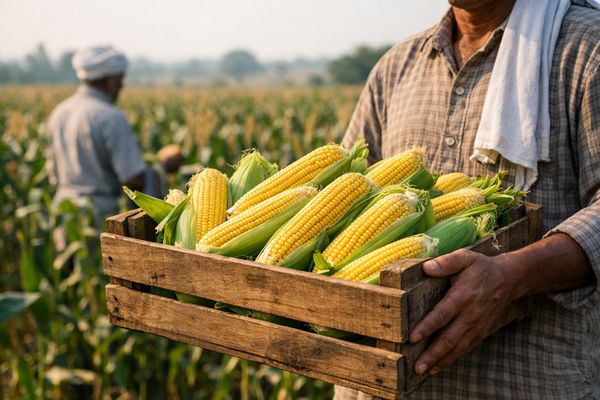
Indian corn prices are sliding well below mandated support levels as global oversupply from the US and Brazil meets delayed government procurement in India. This is creating acute farmer distress in Telangana but temporarily improving origin economics for international buyers.
Corn markets are currently dominated by abundant global supplies and policy bottlenecks in India. Farmers in Telangana, a key maize region, face mandi prices 30–35% below the official support price, triggering protests and demands for accelerated public procurement. At the same time, CBOT corn futures remain under pressure from record US and Brazilian crops, while Black Sea and EU export offers stay competitive in euro terms. For European starch, feed and ethanol users, this combination of weak Indian origin prices and soft international benchmarks offers a narrow but meaningful window to diversify supply, provided they can manage execution and policy risks.
Exclusive Offers on CMBroker

Corn
yellow feed grade, moisture: 14.5% max
98%
FCA 0.25 €/kg
(from UA)

Popcorn
expansion, 40/42
FOB 0.82 €/kg
(from AR)

Popcorn
FCA 0.75 €/kg
(from NL)
📈 Prices & Benchmarks
In Telangana’s major wholesale markets, maize is trading around $17.18–$19.32 per 100 kg, some 30–35% below the centrally set Minimum Support Price (MSP) of $25.76 per 100 kg for the 2025–26 season. This discount reflects both global oversupply and a lack of active government procurement, with local mandi quotes confirmed to be well under MSP across Khammam and other districts.
On the export side, European reference offers indicate persistently low corn values: recent quotes for yellow corn from France and Ukraine are around EUR 0.23–0.25/kg FOB/FCA, while organic starch-grade corn from India is indicated near EUR 1.35/kg FOB New Delhi, down from previous levels in recent weeks. CBOT corn futures are trading in a subdued range with high open interest, confirming a market still wrestling with heavy global stocks rather than tightness.
| Product / Origin | Location & Terms | Current Price (EUR/kg) | 1–2 Week Change |
|---|---|---|---|
| Corn, yellow feed (UA) | Odesa, FCA | 0.25 | ▲ from 0.24 |
| Corn, yellow (FR) | Paris, FOB | 0.23 | ▼ from 0.24 |
| Corn, starch, organic (IN) | New Delhi, FOB | 1.35 | ▼ from 1.40 |
🌍 Supply & Demand Drivers
The fundamental backdrop is clearly bearish. Record maize harvests in the United States and Brazil have sharply increased global export availability, capping rally attempts on futures and keeping origin basis levels under pressure. Brazilian crops are well advanced in harvest, while US balance sheets remain comfortable, reinforcing the perception of ample supplies into mid-2026.
In India, this global surplus is colliding with domestic policy delays. Cheap imported corn and healthy local production coexist in the market, pushing wholesale prices decisively below the MSP. Demand from feed compounders and starch processors remains steady but not strong enough to offset the supply overhang. As a result, the price decline is being borne mainly by farmers, particularly in Telangana and neighbouring states.
📊 Policy, Protests & Market Structure
Farmer distress in Telangana has escalated into visible street protests in Khammam and other districts, with growers demanding immediate procurement at MSP levels. The state government has requested central funding of roughly USD 430 million to procure 1.5 million tonnes of corn, but actual buying has not yet begun. In addition, existing rules cap procurement at 26 quintals per acre, a ceiling that farmer groups are pushing to abolish as it limits the benefit of support operations.
This vacuum of government buying leaves the market disorganised, with wide price variation between mandis and weak, sometimes opaque, price discovery. Nationally, corn market prices in several states are running well below the MSP, indicating that the Telangana situation is part of a broader pattern rather than a local anomaly. Without a coordinated central response, regional interventions risk being piecemeal and slow, extending the window of distressed selling at origin.
🌦️ Weather & Short-Term Outlook
Weather is not the primary driver of the current price weakness, but it will shape the medium-term path. In the coming days, key US Midwest areas are forecast to remain seasonally cool with some drier breaks after heavy spring rains, allowing planting progress to improve, while Brazil’s main corn regions are largely past their most weather-sensitive phase, with more than 65% of the crop already harvested.
For India, near-term weather in Telangana is broadly normal for late April, with no major stress event currently threatening standing maize crops. This means there is little immediate supply-side relief: barring unexpected weather shocks, the physical burden of corn on the domestic market is likely to persist into the next 2–4 weeks. Price recovery in Indian mandis therefore hinges far more on procurement decisions than on climatic factors in the short run.
📆 Market & Trading Outlook (2–4 Weeks)
- Indian domestic prices: Maize prices in Telangana and other surplus states are unlikely to recover meaningfully over the next 2–4 weeks without concrete central-government procurement action. Any announcement of funded MSP operations would be an immediate bullish trigger at origin.
- International benchmarks: CBOT corn and European export offers are expected to stay range‑bound to slightly soft as record US/Brazilian supplies dominate, though downside may be limited by already depressed flat prices and some early talk of lower US acreage.
- Basis relationships: Weak Indian farmgate prices combined with only modestly firm FOB indications (e.g. New Delhi starch-grade offers easing in EUR terms) point to a temporarily attractive basis for buyers able to secure logistics and documentation.
💼 Strategic Pointers for Market Participants
- EU starch & ethanol producers: Consider selectively increasing coverage from India on a spot-to-short‑term basis while origin prices remain depressed and MSP procurement is delayed. Prioritise suppliers in well-connected hubs and build in flexibility for potential policy shifts that could lift offers quickly.
- Feed compounders: Use the current softness in global and Indian prices to extend coverage modestly into early Q3 2026, but avoid over‑committing in case adverse weather or policy tightening later supports prices.
- Indian exporters & traders: This is an opportunity to lock in export sales from distressed regions, yet counterparty and regulatory risk are elevated. Structure contracts with clear force‑majeure and policy-change clauses, and monitor procurement announcements from New Delhi and key state capitals daily.
- Risk management: Given high open interest and constrained upside, options strategies such as buying modest call spreads on CBOT while selling limited downside may offer cost‑effective protection against a sudden policy- or weather-driven rebound.
📉 3‑Day Regional Price Indication (Directional)
- India (Telangana mandis, farmgate equivalent in EUR): Sideways to slightly weaker over the next three trading days, as protests continue but procurement has not yet scaled up.
- Black Sea (Ukraine, FCA/FOB, EUR): Mostly stable with a mild firmer bias after a small uptick in Odesa FCA offers (around EUR 0.25/kg), though competition between exporters should cap gains.
- EU (France, FOB, EUR): Slightly softer to flat near EUR 0.23/kg as export demand is steady but unspectacular and global benchmarks remain under pressure.