
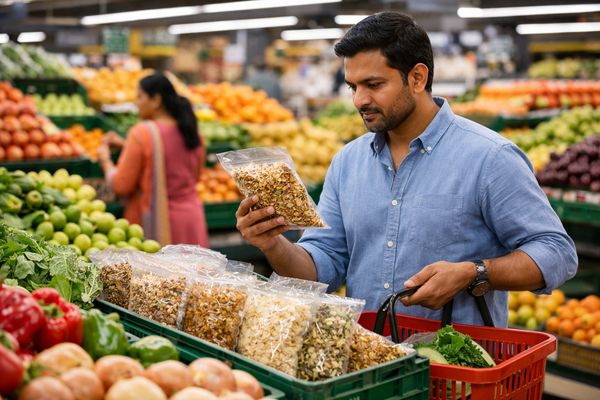
India’s latest push under the Production Linked Incentive (PLI) scheme for food processing is accelerating investment in dehydration and other value‑added segments, altering trade flows in fruits and vegetables and tightening global supply of shelf‑stable ingredients. For commodity buyers, the shift means growing Indian export capacity in dehydrated onions, garlic, potatoes and higher‑value vegetable powders, with potential implications for pricing, supplier diversification and post‑harvest loss mitigation in key importing regions.
The government reports that the PLI Scheme for Food Processing Industries (PLISFPI) has approved 165–168 projects and disbursed over ₹2,160 crore in incentives as of early 2026, supporting a 3.4 million tonne increase in processing and preservation capacity and driving a compound annual growth rate above 13% in processed agri‑food exports since 2019–20. Indian policymakers explicitly target processed fruits and vegetables and ready‑to‑eat formats, positioning dehydration as a key channel for absorbing surplus fresh output and expanding exportable volumes.
Headline
India’s PLI-Backed Dehydration Drive Boosts Vegetable Export Capacity and Reduces Post‑Harvest Losses
Introduction
India, already among the world’s largest producers of fruits and vegetables, is now doubling down on value‑added processing through the Production Linked Incentive Scheme for Food Processing Industries (PLISFPI). New government data released this week highlight rapid capacity expansion in processing and preservation, with a growing share anchored in fruit and vegetable value chains.
The policy drive is coinciding with strong export momentum in dehydrated vegetable powders and flakes destined for the Middle East, Europe and Asia, where they are used in snacks, seasonings, soups and ready‑to‑eat meals. For agricultural commodity markets, this marks a structural shift: a larger portion of India’s perishable harvest is being diverted from volatile fresh channels into shelf‑stable, tradable ingredients, potentially altering seasonal supply patterns, price behaviour and trade flows for both fresh and processed produce.
🌍 Immediate Market Impact
The expansion of PLI‑supported processing capacity—up by about 3.4 million tonnes per year since 2021—directly increases India’s ability to absorb peak‑season gluts in onions, garlic, potatoes and other vegetables into dehydration lines. This helps cap distress‑season price collapses in domestic wholesale markets while ensuring steadier export availability of powders and flakes, especially for Gulf and European food manufacturers that rely on Indian-origin inputs.
At the same time, incremental processing capacity and export incentives can tighten domestic availability of some fresh staples at the margin during tight crop years, lending mild support to local prices and potentially influencing food inflation trajectories. Policy‑driven scaling of dehydration and other preservation technologies also reduces supply volatility for global buyers, who gain access to year‑round, contract‑based volumes less exposed to immediate weather or logistics shocks than fresh shipments.
📦 Supply Chain Disruptions
On the logistics side, the policy framework is encouraging processors to integrate more closely with farmer producer organisations (FPOs) and invest in near‑farm processing, cutting turnaround times from harvest to dehydration and reducing dependence on overstretched cold‑chain infrastructure. Government documents and industry analysis emphasise value‑chain modernisation and infrastructure under schemes like PLISFPI and PMKSY, aimed at easing bottlenecks in storage, testing and export handling.
For ports and shipping, dehydrated exports are increasingly containerised, non‑refrigerated loads, which are less exposed to reefer shortages and power disruptions than fresh produce flows. However, as more mid‑scale plants come online under PLI, exporters may face temporary congestion in certification, food safety testing and customs clearance unless laboratory and regulatory capacity keeps pace with project approvals and investment commitments.
📊 Commodities Potentially Affected
- Onions (dehydrated flakes and powder) – Core backbone of India’s dehydrated export basket, with rising capacity enabling higher contracted volumes to the Middle East and Europe and smoothing seasonal price swings.
- Garlic – Similar to onions, garlic powder and granules benefit from PLI‑linked investment in processing, offering buyers a hedge against fresh‑garlic market volatility.
- Potatoes – Dehydrated potato products feed into RTE snacks and convenience foods; expanded processing can stabilise farm‑gate prices during bumper crops while lifting exportable surplus.
- High‑value vegetables and spices (ginger, chilli, okra, tomato) – Growing demand in clean‑label formulations and spice blends supports premium dehydrated formats, with PLI lowering capital barriers for mid‑scale entrants.
- Processed fruit ingredients – PLI coverage for processed fruits and RTE products bolsters capacity for dried fruit, purees and inclusions, impacting supply options for confectionery and beverage sectors.
🌎 Regional Trade Implications
The Middle East, already a major destination for Indian dehydrated staples, is set to deepen sourcing ties as additional Indian capacity comes onstream under PLI and related schemes. This supports food‑service operators and industrial blenders across the Gulf seeking to reduce exposure to fresh‑supply disruptions and extend shelf life in hot‑climate distribution.
In Europe, where residue controls and traceability requirements are stricter, APEDA and sector‑specific initiatives are steering investment toward certified, residue‑controlled supply chains, particularly for dehydrated onions, garlic and mixed vegetable powders. This may gradually shift market share toward Indian processors that can demonstrate full farm‑to‑export compliance, pressuring non‑compliant regional competitors.
Asian buyers present a mixed picture, with some markets prioritising low‑cost bulk imports and others demanding higher‑specification ingredients. The broader PLI‑driven increase in capacity could enable India to segment supply more precisely by quality tier, potentially displacing lower‑cost regional competitors in price‑sensitive segments while winning premium contracts in regulated markets.
🧭 Market Outlook
In the near term, traders can expect sustained growth in offers for Indian dehydrated vegetables as approved PLI projects ramp up utilisation and seek export offtake to lock in incentive‑linked incremental sales. Government data already show strong export momentum from PLISFPI beneficiaries, with cumulative processed‑food exports from these firms surpassing ₹89,000 crore between 2021 and 2025.
Over the next 6–12 months, pricing dynamics will hinge on how quickly new dehydration and preservation lines achieve scale, the pace of further PLI disbursements, and the trajectory of global demand for convenience foods. Traders will closely monitor certification capacity, APEDA promotional initiatives for value‑added products, and any tightening of EU or Gulf residue and labelling standards that could reprice compliant versus non‑compliant supply.
CMB Market Insight
India’s latest policy and investment push in food processing marks a structural turning point for fruit and vegetable markets: more of the crop is being captured in value‑added, exportable forms, reducing post‑harvest waste while building a deeper pipeline of dehydrated ingredients to global buyers. For commodity traders, importers and food manufacturers, this translates into a progressively more reliable Indian supply base for dehydrated onions, garlic, potatoes and higher‑value vegetable powders, albeit with a gradual rebalancing of domestic versus export availability.
Strategically, counterparties that secure early partnerships with Indian PLI‑backed processors—particularly those integrated with FPOs and equipped for stringent residue control—are likely to gain an advantage in both price stability and supply assurance. As policy‑driven capacity additions filter through to trade flows, India’s role in the global dehydrated vegetable complex is set to expand, reinforcing its position as a year‑round supplier of shelf‑stable, plant‑based ingredients.