Colorado’s San Luis Valley is confronting a record potato surplus driven by oversupply, lost processing capacity, and a soft domestic market, forcing large-scale disposal and pressuring grower margins. Despite this, derived products such as potato starch in Europe are holding relatively stable prices, reflecting localized stress rather than a global shortage.
The regional market is caught between immediate disposal logistics and a longer-term structural imbalance. High-yielding varieties, weak retail and foodservice demand, and the loss of a key processor have created more than a seasonal surplus, while warm March weather has sharply reduced storage life and quality. Local authorities are being asked to help finance and organize cull operations, but resistance to treating this as a county budget item underlines political and fiscal limits. With domestic demand unlikely to absorb remaining stocks and drought tightening 2026 water supplies, the valley faces recurring surplus risks without new processing capacity or structural demand growth.
Exclusive Offers on CMBroker

Potato starch
powder
FCA 0.85 €/kg
(from PL)
📈 Prices & Local Surplus Situation
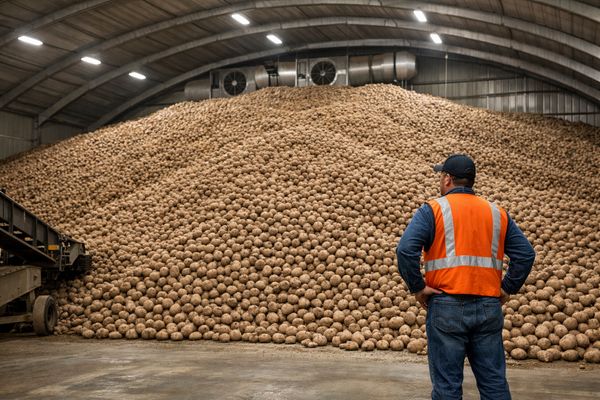
The San Luis Valley is dealing with an estimated surplus running into the tens of millions of kilograms, much of it already downgraded to cull status due to accelerated quality losses in warm March conditions. Coordinated use of roughly 300 acres (about 121 hectares) of fallow land is being organized to mechanically break down and spread unsaleable potatoes, but this will only handle part of the excess. At the same time, the European potato starch market shows modest firmness: FCA Łódź, Poland offers are around EUR 0.85/kg as of 20 April 2026, up from EUR 0.82/kg in late March, pointing to slightly tighter processed-starch margins rather than outright oversupply.
| Product | Location | Delivery terms | Date | Price (EUR/kg) |
|---|---|---|---|---|
| Potato starch (conventional) | Łódź, PL | FCA | 2026-04-20 | 0.85 |
| Potato starch (conventional) | Łódź, PL | FCA | 2026-04-13 | 0.85 |
| Potato starch (conventional) | Łódź, PL | FCA | 2026-04-07 | 0.82 |
🌍 Supply, Demand & Structural Drivers
Several overlapping forces are behind the surplus. High-yielding varieties have lifted output faster than consumption, while domestic demand from both retail and foodservice has softened, leaving more potatoes in storage for longer. Critically, the loss of the Colorado Gourmet processing facility to fire removed an important outlet for lower-grade and excess potatoes, turning what might have been a manageable surplus into a structural bottleneck. Industry voices in the valley emphasize that this is not a one-off issue, but the result of persistent supply–demand misalignment that is unlikely to resolve with a single disposal campaign.
On the demand side, there is little sign of a near-term rebound strong enough to clear existing stocks before the new crop arrives. Processors that remain in the region lack the capacity to absorb all surplus volumes, and fresh-market channels cannot easily substitute for the lost processing demand. As a result, disposal rather than marketing increasingly defines the marginal outlet for low-grade potatoes, effectively putting a floor under what can be commercialized and turning quality downgrades into direct financial losses.
📊 Logistics, Regulation & Weather Context
The disposal effort is logistically intensive. One coordinator estimates the 300-acre cull operation alone will require at least two full-time employees, a 150-horsepower tractor and a front loader to continuously transport and process waste potatoes. Compliance with the Colorado Seed Potato Act adds cost and complexity, as potatoes must be properly broken down and incorporated to mitigate disease risks. Growers are keen to remain compliant to protect neighboring operations and their own warehouses, but the regulatory framework leaves formal responsibility on individual producers even as they appeal for county-level support.
Warm March weather accelerated sprouting and decay in storage, sharply narrowing the window to find commercial outlets. Regional drought and a very dry, fire-prone spring in Colorado reinforce expectations that water availability in the Upper Rio Grande Basin will constrain planted area and yields in 2026, potentially reducing the size of next season’s surplus. However, without restoration of lost processing capacity or stronger domestic demand, even smaller crops could continue to face tight storage and disposal constraints rather than translating into sustained price strength for growers.
🧑🌾 Grower Impact & 30–90 Day Outlook
The immediate human and financial toll on growers is severe. Producers who have invested in a full growing season now face the prospect of not only forgoing revenue on unsold volumes but also paying for their destruction, including labor, fuel, machinery wear, and compliance costs. This amplifies margin pressure in what is already a low-margin crop, raising solvency concerns for smaller or highly leveraged operations. Emotional stress is also significant, as growers are forced to decimate crops they have already harvested and stored.
Over the next 30 to 90 days, the sector faces a tight race between clearing cull piles and preparing storage for the incoming new crop. If disposal operations lag and degraded potatoes remain in or near storage facilities when harvest begins, logistical congestion and biosecurity risks could intensify, potentially affecting the condition of the new crop. With no clear sign of a rapid consumption rebound, disposal rather than discounting appears to be the dominant path for managing remaining old-crop stocks in the valley this marketing year.
📆 6–12 Month Market Outlook
Looking ahead 6 to 12 months, the San Luis Valley potato market will be shaped by the balance between lower expected production and unchanged structural constraints. Anticipated water limits in the Upper Rio Grande Basin should trim planted area and yields, which might ease storage pressure and prevent a surplus of the same magnitude. Yet the enduring absence of the Colorado Gourmet processing facility means a persistent gap in regional capacity to transform surplus or off-grade potatoes into value-added products. Without replacement capacity or new demand channels, the valley risks repeating large-scale disposal cycles, albeit potentially on a smaller physical scale.
For global and European markets, localized surplus and disposal in Colorado are unlikely to significantly alter overall balance sheets, but they highlight how climate volatility and infrastructure shocks can sharply impact regional supply availability. In Europe, stable to slightly firmer potato starch prices suggest that industrial end-users still face relatively tight balance sheets and are not benefitting from the same degree of oversupply visible in fresh and processing potatoes in parts of North America. Any tightening of North American production in 2026 due to drought would only modestly affect these processed segments unless mirrored by similar constraints in key EU growing regions.
📌 Trading & Risk Management Recommendations
- Growers in surplus regions: Prioritize rapid disposal scheduling and regulatory-compliant breakdown of cull piles before new-crop storage starts; delaying increases quality risks for remaining marketable stock and raises biosecurity concerns.
- Processors and packers: Use current surplus to secure favorable raw potato supply contracts for 2026–27, but incorporate explicit clauses for quality and delivery timing given weather-driven storage risk.
- Buyers of potato starch in Europe: Consider forward-covering a portion of Q3–Q4 2026 needs while FCA Łódź prices are near EUR 0.85/kg, recognizing that drought-related yield uncertainties could later support starch values.
- Policy and industry groups: Explore incentives or partnerships to restore or replace lost processing capacity, as without such structural solutions, disposal costs will recur and undermine regional production viability.
📉 Short-Term Price Direction (3-Day View)
- San Luis Valley fresh & processing potatoes: Local spot values are expected to remain under heavy pressure in the next three days, with weak demand and urgent disposal needs keeping prices subdued despite shrinking usable stocks.
- EU potato starch (FCA PL, benchmark): Prices around EUR 0.85/kg are likely to remain broadly stable in the very short term, with no immediate trigger for either a sharp correction or spike.