
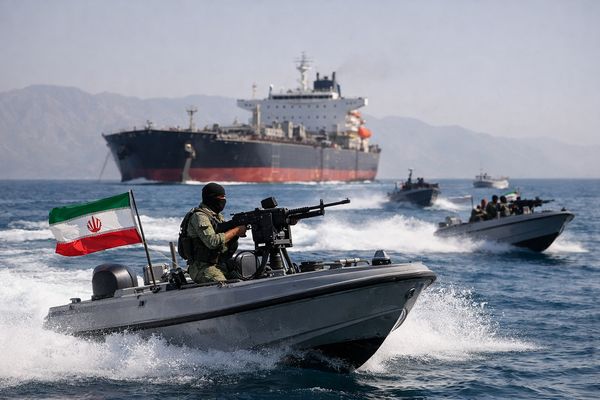
Iran’s latest seizure of two container ships in the Strait of Hormuz using fast-attack boats marks a new escalation in the 2026 shipping crisis, reinforcing the effective closure of a vital chokepoint for global commodity flows. For agricultural traders, importers and food manufacturers, the incident signals prolonged disruption to Gulf- and Indian Ocean–linked supply chains, higher freight and war-risk costs, and further delays on key routes into Europe, the Middle East and Asia.
The Revolutionary Guard’s capture of the MSC Francesca and Epaminondas on April 22, following earlier attacks on commercial vessels, highlights how Iran’s asymmetric naval tactics now center on fast boats capable of rapid seizure and harassment operations across Hormuz shipping lanes. With most conventional Iranian naval assets already degraded, maritime security specialists warn that this layered threat—combining fast craft, shore-based missiles, drones, mines and electronic interference—will be far harder to neutralize and is likely to prolong the effective blockade of the strait for months rather than weeks.
Headline
Fast-Boat Seizures in Strait of Hormuz Entrench Shipping Blockade, Driving Up Costs for Global Agri Trade
Introduction
On April 22, Iran’s Revolutionary Guard seized two foreign-operated container ships, the MSC Francesca and the Epaminondas, as they attempted to exit the Gulf via the Strait of Hormuz. The seizures followed earlier incidents in which Iranian forces fired on or struck multiple commercial vessels and brought the captured ships toward Iranian ports. Reuters and other outlets report around 40 crew members are now under Iranian control while governments seek assurances on their safety.
The incident comes against the backdrop of a wider U.S.-Israeli air war with Iran that began on February 28, after which Tehran largely blocked traffic through the Strait of Hormuz and the U.S. imposed a naval blockade on Iranian ports. Shipping data and security briefings indicate that, aside from limited Iran-approved or energy-critical movements, commercial traffic has been sharply curtailed for nearly two months. With roughly one-fifth of the world’s oil and a significant share of regional containerized trade normally transiting Hormuz, the escalation has major implications for freight markets, insurance capacity and global agricultural trade flows.
🌍 Immediate Market Impact
The confirmed fast-boat seizures significantly reduce market confidence in any near-term reopening of Hormuz to normal commercial traffic. Even as ceasefire talks and diplomatic signals fluctuate, the operational reality is that the Strait remains effectively closed to unescorted ships, and escort capacity is far below what would be needed to restore standard volumes.
War-risk underwriters, already repricing or suspending cover for Hormuz and much of the Persian Gulf, are expected to lift premiums further following the high-profile capture of two large container vessels. Private insurers had already scaled back exposure, forcing some governments to step in with political risk backstops. The latest attacks confirm to insurers that the risk profile is now structural and asymmetric, not a temporary flare-up, which is particularly negative for cost-sensitive agricultural cargoes.
📦 Supply Chain Disruptions
Port and shipping activity tied to the Gulf has been in crisis mode since late February, but the fast-boat seizures add an additional deterrent to any operators still contemplating passage. Maritime security analysts stress that commercial shipping has no practical defensive capability against coordinated fast-boat boarding operations; operators are entirely dependent on naval escorts, which remain scarce relative to demand.
Container and bulk flows linking India, Pakistan, the Gulf states and Iran with Europe and North Africa via Hormuz are being rerouted where possible via alternative hub ports and longer sea lanes, often around the Cape of Good Hope. This compounds the separate Red Sea/Suez disruptions from Houthi attacks, concentrating east–west agricultural trade into longer, more expensive routes and stretching global tonnage supply.
For time-sensitive agri-commodities such as fresh Indian produce, Pakistani grain, rice, sugar, pulses and refrigerated animal protein, extended transit times raise spoilage risk and working-capital needs. Processors and retailers in Europe and the Eastern Mediterranean are already reporting shipment delays, with some buyers seeking alternate origins or building precautionary inventories.
📊 Commodities Potentially Affected
- Grains and oilseeds (wheat, rice, corn, soy): Disruptions to shipments from India, Pakistan and Black Sea cargoes destined for Gulf and South Asian ports increase freight costs and widen regional basis differentials, especially into MENA markets.
- Rice and pulses: India and Pakistan’s exports to the Middle East and East Africa often route through Hormuz-linked services; rerouting raises landed costs and may tighten availability for lower-income food-importing countries.
- Edible oils (palm, sunflower, soybean oil): Volumes moving from Asian origin through the Indian Ocean to Gulf refineries and re-export hubs face higher insurance and fuel costs, pressuring CIF prices into the Levant and North Africa.
- Sugar: Raw and refined sugar flows from South and Central Asia to the Middle East and Mediterranean, commonly transshipped via Gulf ports, face higher freight, potentially widening white premium spreads.
- Fruits, vegetables and refrigerated meat: Longer routes and port delays raise spoilage and cold-chain risks for high-value perishables moving between South Asia, the Gulf, and European retail markets.
- Fertilizers (urea, ammonia, phosphates, potash): Gulf and Iranian producers are key suppliers to Asia and Latin America; sustained shipping constraints and risk premiums could tighten spot availability and lift fertilizer benchmarks, increasing input costs for farmers globally.
- Steel, packaging and industrial inputs for food industry: Disrupted steel and container trade through Hormuz raises costs for cans, machinery and infrastructure needed in agro-processing and logistics.
🌎 Regional Trade Implications
European, North African and Levantine buyers of South Asian and Gulf-origin commodities are among the most exposed. With many carriers halting bookings for Gulf-linked ports and live trackers showing large numbers of containerships trapped or idled around the region, importers are increasingly turning to Atlantic Basin origins—such as EU, Black Sea (where feasible), Brazil and the United States—for grains, oilseeds, sugar and meat.
This shift is likely to benefit exporters with alternative, less risky routes into Europe and MENA, including Brazilian corn and soybeans via the Atlantic, U.S. wheat and soymeal, and EU-origin grains moving intra-regionally. However, it also risks crowding on these lanes, pushing up freight rates and vessel hire costs, particularly for smaller importers lacking long-term contracts.
In Asia, large buyers in China and India may be better positioned to negotiate escorted or Iran-approved shipments for critical energy and commodity supplies, but smaller regional importers reliant on transshipment via Gulf hubs will face greater uncertainty. The risk premium on Gulf-linked trade will likely accelerate investment and policy discussions around diversification of import origins and overland alternatives where geography allows.
🧭 Market Outlook
Over the next 30 to 90 days, the persistence of Iran’s fast-boat capability and its integration into a broader asymmetric threat system make a significant resumption of normal commercial traffic through Hormuz unlikely, even if diplomatic headlines occasionally improve. Insurance markets are not expected to reopen cover at commercially viable rates until either the fast-boat threat is materially reduced or a robust, enforceable naval escort corridor is established.
For the remainder of 2026, agricultural commodity markets should assume structurally higher freight and insurance costs on routes touching the Gulf and northwestern Indian Ocean, with trade flows consolidating around longer Cape and alternative corridor options. Seasonal summer sea conditions may slightly constrain some fast-boat operations, but analysts caution that the layered threat—from missiles to drones and mines—will continue to deter unescorted traffic.
Price-wise, the impact will be felt more in regional basis and delivered-cost spreads than in outright global benchmarks, barring a major escalation. CIF prices into MENA, East Africa and parts of South Asia are likely to carry a durable risk premium, while exporters with safer routes may capture improved netbacks.
CMB Market Insight
The shift of Iran’s naval posture toward fast-boat seizures has transformed the Strait of Hormuz from a high-risk corridor into a de facto no-go zone for much of commercial shipping, despite overwhelming conventional naval power in the area. For the agricultural complex, this is less about immediate physical shortages and more about a sustained, structural increase in logistics and insurance costs for Gulf- and Indian Ocean–centric trade.
Commodity traders, importers and food manufacturers should plan for an extended period in which Hormuz remains only partially and intermittently accessible, with asymmetric threats dictating insurance capacity and routing decisions. Strategic priorities now include diversifying origins, renegotiating freight and risk-sharing clauses, and stress-testing supply chains for longer transit times and tighter vessel availability. In this environment, proactive logistics management and flexible sourcing will be as critical to margins as flat price risk management.
Related posts:
 Hormuz Crisis Deepens: Persistent Strait Disruptions Reshape Global Agri-Commodity Trade
 Iran Fully Reopens Strait of Hormuz During Lebanon Ceasefire, Triggering Sharp Oil Price Correction
 Strait of Hormuz Blockade Triggers Fuel Shock and Global Freight Rate Surge
 Strait of Hormuz Crisis and US Naval Blockade Deepen Global Energy Market Turmoil