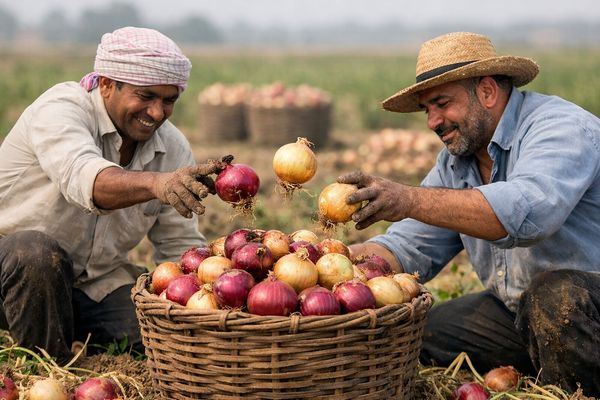
Indian and Egyptian onion prices are broadly stable, with dehydrated products from India trading within prevailing global ranges and fresh Egyptian onions entering the new export window without major weather or policy shocks. Short‑term price risk is skewed more to currency and freight costs than to immediate supply stress.
Exporters in India and Egypt are currently operating in a relatively calm market. Indian dehydrated onion suppliers continue to quote within typical 2025–2026 ranges, supported by steady demand from Europe and MENA and ample raw material availability from key producing states. Fresh Egyptian onion exports are ramping up into the April–December campaign, supported by normal seasonal conditions and the absence of new export bans, although the broader logistics cost environment in the region remains a watchpoint. Over the next few days, stable on‑farm weather in both origins should help maintain current FOB levels rather than trigger sharp volatility.
Exclusive Offers on CMBroker

Onion powder
white
FOB 1.54 €/kg
(from IN)

Onion powder
grade - B
FOB 1.27 €/kg
(from IN)

Onion
fresh
FOB 0.82 €/kg
(from EG)
📈 Prices & Market Snapshot
All prices converted to EUR using an indicative rate of 1 USD ≈ 0.93 EUR.
| Product | Origin | Location / Term | Latest Price (EUR/kg) | 1-week Move |
|---|---|---|---|---|
| Onion powder, white | India | New Delhi, FOB | ≈ 1.43 | Stable w/w |
| Onion powder, grade B | India | New Delhi, FOB | ≈ 1.18 | Stable w/w |
| Onion powder, organic | India | New Delhi, FOB | ≈ 2.43 | Stable w/w |
| Onion flakes, organic | India | New Delhi, FOB | ≈ 4.68 | Stable w/w |
| Onion, fresh | Egypt | Cairo, FOB | ≈ 0.76 | Stable w/w |
Indicative wholesale offers for Indian onion powder currently range around ₹135–180/kg for regular quality and ₹350–500/kg for organic product, implying roughly 1.25–1.67 EUR/kg for standard powder and 3.24–4.63 EUR/kg for organic at prevailing FX, broadly consistent with the above FOB quotes.
🌍 Supply, Demand & Policy Drivers
India remains a key global hub for dehydrated onion, with exporters in Gujarat and Maharashtra reporting ample access to raw onions and active demand from Europe, the Middle East and Asia. Recent trade listings for flakes and powder underscore normal export activity and no acute tightness in dehydrated capacity.
On the policy front, India’s onion exports continue to be managed through minimum export price and related tools, but the most recent major prohibitions date back to 2023–2024. No new restrictions or sharp changes have been reported in the last few days, while the government maintains buffer stocks to smooth domestic prices. This supports a moderately predictable export environment for processors, though buyers should remain alert to any fresh announcements.
In Egypt, the fresh onion export season typically runs from around April through December, with exports rebounding after the end of an earlier 2023–2024 ban that had been lifted by March 2024. Recent market commentary highlights stable vegetable and fruit prices at key wholesale markets during late February 2026, suggesting that domestic supplies are currently sufficient and not exerting unusual upward pressure on FOB quotes.
🌦️ Weather Outlook: India (IN) & Egypt (EG)
In India, the main onion‑growing belts in Maharashtra and Gujarat are entering the warmer pre‑monsoon period. Seven‑day forecasts for Nashik and surrounding districts point to seasonally hot, largely dry conditions without extreme heat spikes or heavy rainfall events that could disrupt curing or short‑term storage of rabi onions. This supports stable availability for dehydration plants over the coming week.
Egypt’s key onion regions in the Nile Delta and Upper Egypt (e.g., Beheira, Beni Suef) are also forecast to see warm, dry weather with no immediate flooding or sandstorm threats flagged in agricultural commentary. Similar herb and spice sectors in Egypt have recently reported that short‑term price risks are more related to freight and currency than to agronomic stress, a pattern likely to extend to onions under current conditions.
📊 Fundamentals & Cost Environment
Globally, Egypt remains a competitive shipper of fresh onions into Europe and parts of MENA, with export statistics for 2025 underscoring the importance of onion and allied allium exports in the country’s trade basket. However, elevated freight and insurance costs across the wider Middle East continue to weigh on FOB competitiveness, particularly for lower‑value bulk cargoes.
For Indian dehydrated onions, input costs are anchored by relatively affordable fresh onions at key mandis and by good access to dehydration capacity. Trade platforms highlight ongoing investment in high‑capacity plants with export‑oriented product portfolios (flakes, granules, powder), enabling suppliers to fill orders to Europe and the Middle East even at current price levels. This capacity backdrop helps explain why offer prices for flakes and powder have been steady over recent weeks.
📆 3-Day Price Outlook & Trading Ideas
Directional Outlook (next 3 days)
- India – Dehydrated onion powder & flakes (FOB New Delhi): Sideways; prices expected to remain within ±1–2% of current EUR/kg levels, with no weather or policy shock in sight.
- Egypt – Fresh onion (FOB Cairo): Sideways to mildly firm; export season ramp‑up may meet steady demand from Europe and MENA, but current domestic stability argues against abrupt price spikes.
Trading Recommendations
- Buyers in EU/MENA: Consider near‑term coverage for May–June shipments of Indian onion powder and flakes while FOB levels are aligned with historical averages and logistics remain the main upside risk.
- Importers of fresh onions from Egypt: Use the current stable price window to secure programs for early and mid‑season volumes, incorporating freight and insurance escalation clauses in contracts.
- Indian processors: Maintain balanced raw onion procurement; with no immediate weather threat, stagger purchases to avoid unnecessary inventory carrying costs, but remain alert to any new export‑policy signals.
Over the next three days, the base case is for unchanged EUR‑denominated FOB quotes from both India and Egypt, with any short‑term deviations more likely driven by FX moves or freight market volatility than by fundamental onion supply shocks.