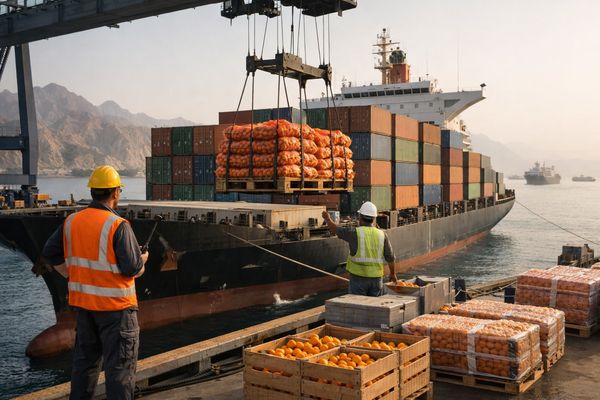
South Africa’s Citrus Exports Navigate Hormuz Disruption as Rerouting Raises Freight Costs but Preserves Middle East Supply
South Africa’s 2025 citrus export season to the Middle East is proceeding largely according to plan despite the effective closure of the Strait of Hormuz and extensive rerouting of global shipping. Export flows are being maintained via alternative corridors, though exporters face longer transit times and higher freight costs and are closely monitoring logistics risk and margin pressure.
Container carriers have broadly suspended direct Hormuz transits amid seizures and attacks on vessels, forcing agri‑food cargoes into longer, more complex routes via the Cape of Good Hope, Red Sea and multimodal landbridge solutions into Gulf markets. Yet, early South African citrus consignments have reached Middle Eastern buyers in good condition, with no reported diversion to alternative destinations so far.
Introduction
The ongoing Strait of Hormuz crisis, triggered by regional conflict and a subsequent U.S. naval blockade of Iran, has severely restricted commercial traffic through one of the world’s most important maritime chokepoints. Major container lines have halted Hormuz transits and are repositioning vessels and services around Africa and via alternative regional gateways.
Against this backdrop, South Africa’s citrus sector has opened its 2025 export campaign with a clear priority: honouring supply programs into the Middle East, a market representing roughly 19% of its annual citrus export volume. Industry sources report that shipments to Gulf and wider Middle Eastern ports are flowing via adjusted routes, with fruit quality on arrival described as satisfactory and in line with pre‑season expectations.
🌍 Immediate Market Impact
The effective closure of Hormuz and the redirection of container and bulk traffic around Africa have increased voyage durations and bunker consumption, pushing up freight rates on Middle East‑linked corridors. Market intelligence platforms report escalated spot and surcharge levels for services avoiding Hormuz, while some carriers apply emergency freight charges to cover additional routing and storage costs.
For South African citrus, these logistics frictions translate into higher per‑carton landed costs in Middle Eastern markets. However, stable demand and intact shipping capacity via alternative routes are currently preventing major volume displacement. The net result is firmer CFR price expectations and margin compression for exporters rather than an outright supply shock at destination.
📦 Supply Chain Disruptions
Port calls and direct services into Upper Gulf ports have been curtailed or rerouted, with mainline carriers embedding Cape of Good Hope loops and using Red Sea and East Mediterranean hubs coupled with overland corridors into Gulf markets. This restructuring lengthens transit times for refrigerated containers and complicates schedule reliability.
Nevertheless, shipping lines continue to accept bookings for South African citrus bound for the Middle East, indicating that refrigerated capacity remains available despite high utilisation on diverted services. Exporters are absorbing higher logistics costs and closely tracking transit times, with industry forums and enhanced market intelligence used to manage arrival windows and cold‑chain integrity across the season.
📊 Commodities Potentially Affected
- Citrus (oranges, lemons, soft citrus, grapefruit) – South African volumes to the Middle East remain on plan, but higher freight and longer voyages tighten margins and may underpin slightly higher destination prices if costs are passed through.
- Fresh fruit and vegetables via Gulf hubs – Other Southern Hemisphere and Asian exporters using Gulf transshipment face similar rerouting, raising logistics risk and potentially narrowing windows for highly perishable categories.
- Grains, rice and pulses – Rerouting of bulk and containerized agri‑cargoes into the Gulf is lengthening lead times and, in some cases, prompting diversion to alternative discharge ports, tightening nearby availability in selected Middle Eastern and East African markets.
- Fertilizers and crop inputs – With roughly one‑third of global seaborne fertilizer flows linked to the Gulf, constraints around Hormuz and higher tanker rates are feeding into global input costs, indirectly influencing farm‑level economics for fruit and other crops.
🌎 Regional Trade Implications
Middle Eastern citrus buyers are, for now, maintaining procurement programs with South African suppliers, leveraging established relationships and the early timing of the Southern Hemisphere season to secure supply. This supports South Africa’s regional market share but at the cost of higher logistics spend and working capital tied up in longer voyages.
Competing exporters in the Mediterranean and other Southern Hemisphere origins may find incremental opportunities if the disruption persists into the Northern Hemisphere marketing window or if freight economics deteriorate further for deep‑sea suppliers. At the same time, alternative trade corridors being developed between Europe, Egypt and Saudi Arabia could gradually change how agri‑food cargo is staged into Gulf markets, increasing the relevance of Red Sea gateways and inland logistics over classic Hormuz‑centric routes.
🧭 Market Outlook
Over the next one to three months, the key variables for citrus and broader agri‑food flows into the Middle East will be the operational stability of Cape and Red Sea routings and the evolution of war‑risk premiums and bunker costs. Analysts expect several weeks to months before container networks normalize even under a more favourable political scenario, implying that elevated freight and schedule volatility may persist across much of the 2025 Southern Hemisphere export window.
For South African citrus, any further escalation in freight or significant cold‑chain delays could trigger selective market re‑optimization later in the season, particularly for lower‑value fruit where freight accounts for a larger share of the delivered price. Conversely, if demand in the Middle East remains resilient and logistics performance remains manageable, exporters are positioned to deliver close to original volume targets despite the rerouting burden.
CMB Market Insight
The Hormuz crisis underscores how geopolitical chokepoint risk can rapidly reshape agri‑commodity logistics without immediately halting trade flows. South Africa’s early‑season citrus experience shows that strong buyer relationships, flexible routing options and disciplined cold‑chain management can sustain market access even as transit times and costs climb.
For commodity traders and food industry buyers, the strategic takeaway is twofold: first, Middle East‑exposed supply chains should assume structurally higher route‑specific logistics risk premiums in 2025; second, origin diversification and multimodal corridor development around the Gulf will become more important determinants of delivered price and reliability than headline FOB values alone. Positioning in citrus and other perishable categories will increasingly hinge on which origins can best convert complex routing into predictable, quality‑assured arrivals.