
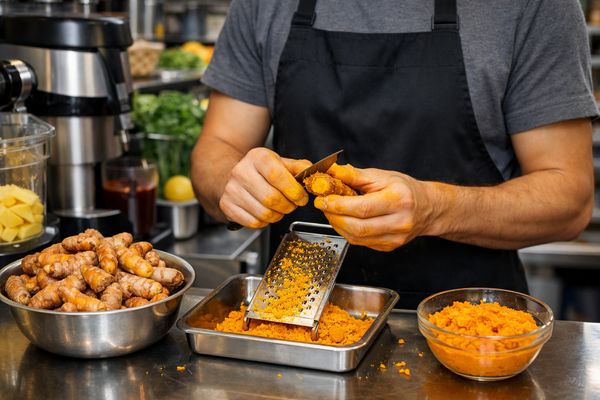
Indian turmeric remains deeply discounted versus global benchmarks, despite firm international demand and modestly softer local export offers in late April. The structural gap between farm-gate and export prices is driven more by value-chain inefficiencies than by weak fundamentals, keeping upside potential intact once supply chain reforms and processing upgrades progress.
The market is currently defined by cheap Indian origins in raw and semi-processed forms, while Vietnam and Western consumer markets command a substantial premium for processed, branded turmeric products. This divergence highlights India’s role as a volume producer rather than a value leader. For traders and processors, this creates a clear arbitrage in upgrading and branding Indian turmeric. For farmers and domestic value-chain actors, the main challenge is to capture more of the margin now realized further downstream and overseas.
Exclusive Offers on CMBroker

Turmeric whole
FOB 2.45 €/kg
(from IN)

Turmeric powder
FOB 3.30 €/kg
(from IN)

Turmeric dried
finger salem,double polished, grade A
FOB 1.57 €/kg
(from IN)
📈 Prices & Spreads
Domestic Indian turmeric prices remain well below international levels. Raw turmeric in India currently trades around $1.20–1.90/kg (≈€1.10–1.75/kg), while processed powder is at roughly $1.45–3.00/kg (≈€1.35–2.75/kg). In contrast, Vietnam reports raw turmeric around $3.00–3.60/kg (≈€2.75–3.30/kg), and processed powder in developed markets such as the EU and US reaches €5.50–11.00/kg, depending on quality and branding.
| Product / Origin | Approx. Price Range (EUR/kg) | Comment |
|---|---|---|
| Raw turmeric, India (farm/mandi) | €1.10–1.75 | Low farm-gate returns, multiple intermediaries |
| Turmeric powder, India | €1.35–2.75 | Basic processing, limited branding |
| Raw turmeric, Vietnam | €2.75–3.30 | Higher export orientation, better margins |
| Processed turmeric, EU/US retail | €5.50–11.00 | High value-add, strong health/wellness demand |
Export-oriented Indian offers in late April confirm this discount but show only marginal week-on-week moves. Organic turmeric whole FOB New Delhi is indicated around €2.45/kg (down slightly from €2.48), organic turmeric powder at roughly €3.30/kg (vs. €3.32), while non-organic grade-A dried fingers in Telangana trade in a narrow €1.42–1.57/kg band, broadly stable over the month with minor two- to three-cent fluctuations.
🌍 Supply, Demand & Value Chain
Global demand for turmeric remains robust, supported by steady usage in food processing, nutraceuticals, and wellness products. Consumption growth is strongest in value-added segments: encapsulated curcumin, organic powders, and branded spice blends. These products typically source raw or semi-processed turmeric from India but capture most of the margin close to end-consumers in high-income markets.
On the supply side, India retains its position as a leading producer and exporter, ensuring ample raw material availability. However, domestic marketing is highly fragmented. Farmers sell through mandis and commission agents, incurring fees, transport and storage costs, plus delays that increase working-capital needs. Limited access to modern processing, grading, and direct export channels prevents growers from accessing the higher global price tiers available for consistent, branded, and certified quality.
📊 Fundamentals & Structural Inefficiencies
The persistent gap between Indian farm-gate prices and international benchmarks is less a function of oversupply and more a reflection of structural inefficiencies. Multiple intermediaries, weak cold and dry storage infrastructure, and inconsistent quality management lead to discounts on Indian origin turmeric compared with more integrated supply chains in countries like Vietnam or with processors located in Europe and North America.
Value addition happens predominantly outside the farm gate and often outside India. Cleaning, polishing, grinding, blending, branding, organic certification, and retail packaging transform relatively low-priced raw turmeric into high-margin consumer products. Without stronger farmer cooperatives, integrated processing at origin, and transparent market information, Indian growers continue to capture only a fraction of the final product value despite strong global demand.
🌦️ Weather & Short-Term Outlook
In the very near term, price direction will be more sensitive to local crop expectations and logistical costs than to demand, which remains structurally solid. Any weather-related concerns affecting planting or early crop development in key Indian growing states would quickly tighten the balance sheet and narrow the discount to international benchmarks. Conversely, another season of comfortable production would prolong the current low-price environment for raw roots at farm level.
However, the dominant driver for margin distribution over the next quarters is likely to be policy and investment around processing and marketing: expansion of primary processing at farm or cooperative level, better storage, and stronger farmer–exporter linkages could gradually lift grower realizations without necessarily pushing international consumer prices sharply higher.
📆 Trading & Strategy Outlook
- Importers/Buyers (EU/US/Asia): Continue to leverage India’s structural discount for forward coverage of raw and semi-processed turmeric, especially where long-term wellness demand is secured. Prioritize suppliers that can guarantee traceability and consistent quality.
- Indian Processors & Exporters: Opportunity to move up the value chain by investing in higher-grade polishing, grinding, and branding aimed at health and organic segments, capturing part of the current overseas premium.
- Farmers & Cooperatives: Focus on aggregation, basic processing (drying, cleaning, grading) and direct marketing arrangements with exporters or large processors to reduce dependency on intermediaries and improve farm-gate prices.
- Speculative Participants: Given strong underlying demand and compressed farm-level prices, medium-term bias remains mildly bullish for upgraded and well-branded product streams, even if raw prices stay range-bound in the near term.
📉 3-Day Indicative Outlook (EUR)
- India (FOB New Delhi – organic whole): Around €2.40–2.50/kg, likely to remain stable with a slight soft bias on good availability.
- India (FOB New Delhi – organic powder): Roughly €3.25–3.40/kg, expected to trade sideways; any firming to come mainly from quality differentials.
- India (FOB Telangana – non-organic dried fingers): About €1.40–1.55/kg, seen stable in the very short term with narrow intra-day moves linked to local arrivals and freight.
Related posts:
 Indian Turmeric Inches Higher as Futures Hold Firm and Heatwave Looms
 Nigella Seeds Edging Softer as India Discounts Against Steady Egypt
 Turmeric Market Steady as Futures Settlement Looms and Exports Hold the Key
 Indian Turmeric Flat as New-Crop Pressure Offsets Firm Export Interest
 Organic dried basil market: Egypt flat, India holds premium
 Indian Turmeric Prices Edge Higher on Tight Arrivals and Summer Heat in Telangana
 Turmeric Market Under Supply Pressure But Set For Range-Bound Consolidation
 Indian Turmeric Prices Ease Slightly After Spike, Futures Stay Elevated