
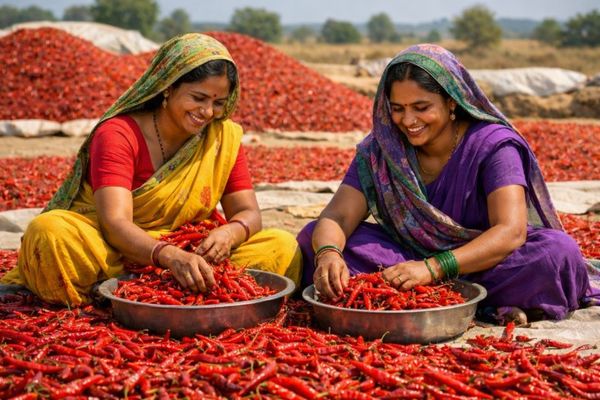
Indian chilli export prices are broadly steady into early May, with only marginal week‑on‑week moves and no clear downside break. High temperatures in key producing regions and firm underlying export demand are helping to underpin values, even as domestic spot markets digest the tail‑end of the 2024/25 harvest.
Indian chilli markets enter May in a sideways but firm pattern. FOB offers from Andhra Pradesh and New Delhi for premium organic products remain significantly above conventional material, reflecting strong export demand for value‑added chilli powder, flakes and speciality whole types. Domestic fresh green chilli prices in retail/mandi channels are also elevated, confirming that consumer demand has not yet softened materially despite summer heat. Weather forecasts for Andhra Pradesh and North India point to very hot days and warm nights over the next week, conditions that favour rapid drying and storage of existing crop but do little to improve already tight medium‑term supply expectations.
Exclusive Offers on CMBroker

Chilli dried whole
bird eye, grade a
FOB 4.65 €/kg
(from IN)

Chilli dried
powder, grade a
FOB 4.40 €/kg
(from IN)

Chilli dried
flakes, grade a
FOB 4.35 €/kg
(from IN)
📈 Prices & Spreads
Indicative Indian FOB prices (converted to EUR at ~€1 = ₹90) for early May 2026 show a stable structure between conventional and organic product, and between value‑added and whole forms.
| Product | Origin / Port | Quality | Indicative FOB price (EUR/kg) | 1‑week trend |
|---|---|---|---|---|
| Dried chilli, whole, stemless | Andhra Pradesh (IN) | Conventional, Grade A | ≈ €2.16 | Unchanged |
| Dried chilli, with stem | Andhra Pradesh (IN) | Conventional | ≈ €2.15 | Unchanged |
| Dried chilli flakes | Andhra Pradesh (IN) | Organic, Grade A | ≈ €4.35 | Unchanged |
| Dried chilli powder | Andhra Pradesh (IN) | Organic, Grade A | ≈ €4.40 | Unchanged |
| Dried whole chilli (bird’s eye) | New Delhi (IN) | Organic, Grade A | ≈ €4.65 | Unchanged |
Retail and wholesale green chilli prices in key consuming centres such as Guntur and Ramanathapuram remain elevated in rupee terms as of 1 May 2026, pointing to tight nearby supply at the consumer level even if bulk dry chilli arrivals are seasonally slowing.
🌍 Supply, Weather & Demand Drivers
Andhra Pradesh, India’s core dry chilli belt around Guntur, is currently experiencing very hot weather, with maximum temperatures around 41–42°C through 5 May and only isolated thunderstorms forecast. These conditions support rapid drying and reduce harvest‑time spoilage for remaining late crop but also increase storage and handling risks if warehouses are not well ventilated.
For North India, including Delhi, forecasts show highs near 37–34°C with potential thunderstorms and strong cells around 4–5 May, which may briefly disrupt logistics but are unlikely to materially affect the already‑harvested crop. The India Meteorological Department also flags above‑normal heatwave days in May across large parts of the country, even as rainfall is forecast to be slightly above normal, pointing to continued weather stress but not outright crop‑damaging extremes in the immediate term.
On the demand side, India’s broader spices exports continue to expand in 2026, with industry commentary highlighting strong overseas interest in chilli powder and blended products. Informal market discussions and recent buyer requests also point to active procurement for FMCG and export channels, with multiple calls for bulk red chilli volumes from both domestic and overseas buyers in April and early May.
📊 Market Fundamentals & Positioning
The domestic futures and broader spices complex is currently mixed, with other spices such as jeera under pressure due to higher arrivals and softer export demand, while turmeric is trading broadly flat. This underlines that chilli’s relative stability is more a function of its own supply/demand balance than a general bull trend in Indian spices.
Structurally, India remains the dominant global supplier of dry red chilli, with Guntur’s market yard acting as the regional benchmark for Asia. While recent official mandi data for dry red chilli are slightly older than the 3‑day window, they confirm that Guntur prices were already at high levels earlier this season, consistent with today’s firm FOB indications. Tight projected production for 2024‑25 versus the previous year, particularly in Andhra Pradesh and Telangana, keeps the forward balance snug and discourages aggressive discounting by exporters.
📆 Short‑Term Outlook & Trading View
Over the next 3–7 days, hot and mostly dry conditions in Andhra Pradesh and continued warm weather in North India should keep physical flows smooth and drying conditions favourable, while not materially changing the underlying stock situation. With export demand stable and domestic retail prices for green chilli still elevated, the risk skew for high‑quality dry chilli remains mildly to the upside.
🧭 Trading Recommendations (near term)
- Importers/Buyers: Consider covering near‑term requirements at current EUR‑denominated FOB levels, especially for organic powder and flakes, as weather and tight production estimates favour a mildly bullish bias.
- Exporters/Processors: Maintain offer discipline on premium grades; only consider discounts for large, prompt‑shipment parcels of conventional whole chilli where competition is strongest.
- Producers/Stockists in India: In view of projected heatwave days and firm export interest, holding good‑quality, well‑dried stock into late May appears reasonable, but monitor IMD heat and pre‑monsoon storm updates for storage risk.
📍 3‑Day Directional Price Indication (EUR, FOB India)
- Andhra Pradesh – Conventional whole (with/without stem): Stable to slightly firm; expected range ≈ €2.10–2.20/kg.
- Andhra Pradesh – Organic flakes & powder: Stable with mild upside bias; expected range ≈ €4.30–4.50/kg.
- New Delhi – Organic bird’s eye whole: Stable; expected range ≈ €4.60–4.75/kg with tight nearby availability.
Related posts:
 Ajwain Prices Hold Steady in Delhi as Heat Builds and Spice Demand Stays Subdued
 Indian Chilli FOB Prices Edge Higher on Tight Crop and Firm Export Demand
 Indian Green Cardamom Prices Edge Higher on Tight Supply and Firm Export Interest
 Indian Chilli Prices Hold Firm on Tight Supply and Strong Export Pull