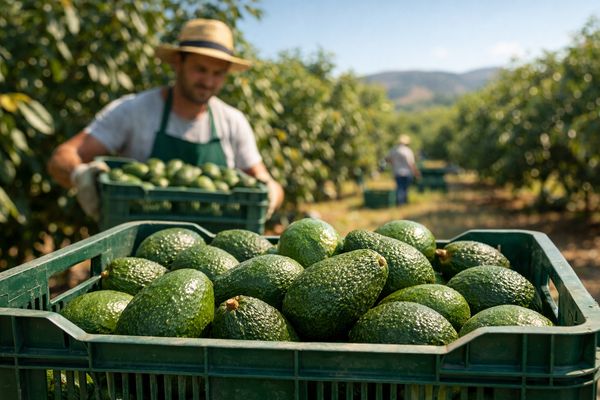
European avocado prices face downward pressure as Europe heads into a high‑volume summer marked by record Southern Hemisphere supply and a temporary oversupply of smaller fruit.
The European avocado market is moving into its main summer window with strong harvests from Peru, South Africa and Brazil converging on a still‑solid demand base. Trade participants are largely optimistic that intense retail promotion will again be able to move large volumes, but the season opens with a clear size imbalance: small Hass calibres are abundant, while large and medium sizes remain scarce. Over the next weeks, the calibre profile is expected to normalise, yet the combination of expanding Peruvian exports and robust South African and Brazilian shipments sets the stage for structurally competitive pricing across Europe.
📈 Prices & Current Market Tone
The current oversupply of small calibres (sizes 24–32) across Europe is generating short‑term price pressure, particularly on standard Hass programs. Buyers focused on value lines and bagged formats are benefiting most from this situation.
At the same time, limited availability of sizes 12–22 is supporting relatively firmer prices for large and medium fruit, especially for ripened programmes and premium retailers. This temporary two‑tier market is expected to narrow from mid‑May as larger calibres become more abundant and overall supply remains heavy through September.
🌍 Supply & Demand Dynamics
Europe will again absorb simultaneous summer supply from Peru, Colombia, South Africa and Brazil between May and September. Peru is heading into another very strong campaign, with export projections pointing to volumes at or slightly above last year’s record, and roughly two‑thirds of shipments destined for Europe.
A portion of Peruvian fruit that previously moved to North America is now anticipated to divert to Europe, intensifying competition on the continent. South Africa and Brazil also report large harvests and are already present on European shelves, adding to the supply stack.
Colombia contrasts with a more moderate season and an earlier‑than‑usual start, about five weeks ahead of its normal summer cycle. No major volume peaks are expected from Colombia, but this front‑loaded flow is likely to create a market gap for medium and large Colombian sizes later in the summer.
📊 Fundamentals: Sizes, Logistics & Trade Flows
The European market is currently long on small calibres and short on large/medium sizes. Early in the Southern Hemisphere season, around 70% of exportable fruit from Peru, Colombia and Brazil falls into the 24–32 range, explaining today’s imbalance.
Biological factors are the main driver: as orchards progress through the season in Andean regions, fruit naturally sizes up, bringing more 12–22 calibres to market in June and July. From mid‑May, a rapid shift toward larger sizes is expected, with good availability likely to persist through end‑September.
On logistics, Europe’s role as the primary destination for Peruvian Hass exports is being reinforced, while South Africa continues to focus heavily on European outlets despite ongoing shipping risks on key routes. The result is a structurally oversupplied summer market in which promotional execution and precise programme planning will be decisive for maintaining orderly trade and limiting price erosion.
🌦️ Weather & Production Outlook
Recent Peruvian harvest and export estimates for 2026 integrate lingering El Niño effects, including some fruit drop and a tighter share of commercial calibres in the north, yet overall output still points to a larger crop than last year. In practice, this means volumes remain high even if size curves in specific regions shift slightly.
South African growers anticipate a recovery versus last year’s weaker season, though shipping risks and rerouting away from the Red Sea can affect transit times and cost structures for fruit bound for Europe. Brazilian and Colombian production conditions are generally favourable, supporting the expectation of sustained export availability through the European summer window.
📆 Market Outlook (30–180 Days)
In the next 30–90 days, the calibre imbalance should progressively resolve as more large fruit comes on stream, particularly from Peru and South Africa. However, because overall supply will remain heavy, average price levels are likely to stay under pressure even as size availability improves.
Promotional activity is set to be intense, with European retailers planning frequent avocado features to clear volumes efficiently, broadly mirroring last summer’s near‑continuous campaigns. Buyers with flexible specifications are well positioned to capture attractive prices on larger calibres from mid‑May onwards.
Over a six‑ to 12‑month horizon, structural investments on the Colombian side may alter competitiveness. New packing capacity in Tamesis (Antioquia), improved export logistics via Puerto Antioquia on the Pacific coast, and two‑pass harvesting systems aimed at better size uniformity and ripening performance could support stronger positioning in high‑spec European programmes as quality demands tighten.
💼 Trading Outlook & Strategy Hints
- Short term (now–mid May): Expect continued pressure on small calibres; prioritise promotions and bagged offers to accelerate movement of sizes 24–32. Secure premiums on scarce 12–18 fruit where retail programmes require them.
- Mid‑season (mid May–September): As larger sizes become plentiful, negotiate aggressively on 14–22 calibres; diversify origins (Peru, South Africa, Brazil, Colombia) to manage quality and logistics risk.
- Procurement planning: Build flexibility into specifications and timing to capture dips in EUR‑denominated spot prices when weekly arrivals peak, especially from Peru.
- Supplier selection: For ripened and premium lines, favour suppliers offering consistent two‑harvest selection and modern packing infrastructure to minimise wastage and claims.
📍 3‑Day Directional Outlook (Key European Hubs, in EUR)
| Market | Product | Price Trend (Next 3 Days) | Comment |
|---|---|---|---|
| Northwest Europe (NL/DE) | Hass, sizes 24–32 | ⬇ slightly softer | Ongoing oversupply; promotions ramping up. |
| Southern Europe (ES/FR/IT) | Hass, sizes 18–22 | ➡ stable to ⬇ | Still relatively tight but easing as Peru and South Africa build volume. |
| UK & Ireland (EUR‑equivalent) | Hass mixed sizes | ➡ broadly stable | Retail programmes well covered; minor downside bias as arrivals increase. |