
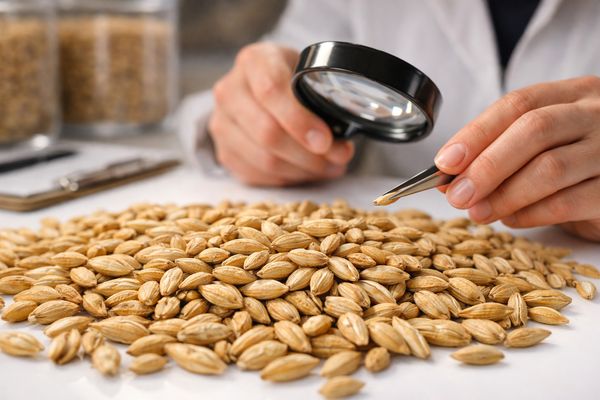
Indian barley prices are rallying sharply as a smaller crop collides with surging malt and food demand, tightening regional supply and supporting a bullish short‑term outlook.
India’s barley market has flipped decisively into a seller’s market. A smaller 2024 crop, weaker carry‑in stocks and broad-based demand from maltsters, food processors and industrial users are pushing prices higher across key producing belts. With arrivals lagging last year and no clear policy or import shock on the horizon, traders expect further gains in the coming weeks. This strength in Indian values is also relevant for European and Black Sea players, as Asia-facing demand may increasingly compare Indian offers against European and Australian origins.
Exclusive Offers on CMBroker

Barley seeds
Cattle feed
FOB 0.19 €/kg
(from UA)

Barley seeds
feed grade, moisture: 14 % max
98%
FCA 0.23 €/kg
(from UA)

Barley seeds
feed grade, moisture: 14 % max
98%
FCA 0.24 €/kg
(from UA)
📈 Prices & Spreads
From recent lows, barley prices in India have rebounded by roughly 300–350 rupees per quintal, with traders widely expecting another 200–250 rupees per quintal of upside in the next 2–4 weeks. Converted to dollars, the expected additional move of about $2.10–2.62 per quintal underlines that this is not just noise but a structurally driven rally.
In Rajasthan’s Sriganganagar line, warehouse-delivered barley has moved from 2,080 to 2,350 rupees per quintal, now roughly €23.0 per quintal, while premium-count lots are near €23.5 per quintal. Madhya Pradesh wholesale markets have tightened from about €20.8–21.3 to around €22.2–22.7 per quintal, and the Kanpur–Hamirpur–Banda belt in Uttar Pradesh is trading near €22.4–22.7 per quintal, confirming broad-based firmness across producing zones.
| Region / Origin | Product / Term | Indicative Price (EUR/kg) |
|---|---|---|
| India (Sriganganagar) | Warehouse, bulk | ≈0.23 |
| India (MP, wholesale) | Warehouse, bulk | ≈0.22–0.23 |
| India (UP belt) | Warehouse, bulk | ≈0.22–0.23 |
| Ukraine (Odesa) | Feed barley, FCA | 0.24 |
| Ukraine (Kyiv) | Feed barley, FCA | 0.23 |
| Ukraine (Odesa) | Cattle feed, FOB | 0.19 |
🌍 Supply & Demand Balance
Indian barley output is clearly smaller this season. Planted area has dropped to about 576,000 hectares, down from 610,000 hectares last year. On top of that, warm conditions in January and adverse March weather have clipped yields, leaving production estimates near 1.77 million tonnes versus 1.925 million tonnes previously – an 8% year-on-year contraction that is large enough to reset the domestic balance.
The tightening is visible in market arrivals and stocks. Deliveries into major wholesale markets are running around 32% below the same period last year, while residual stocks from the prior season are down by roughly 30–31%. With less grain coming in and less grain behind the market, buyers find themselves competing more aggressively for each incoming lot, reinforcing the rally.
📊 Demand Drivers & Industry Flows
Demand is no longer just about a single end-use sector. Maltsters serving India’s expanding beer and whisky segments are active, but they are now joined by nutritional food manufacturers, tender-based institutional buyers and a range of industrial users. This simultaneous four-way pull on a smaller crop is creating sustained upward pressure rather than a short-lived spike.
Sentiment among traders and processors is firmly bullish. Mill buyers are willing to lift bids session after session, while farmers and stockists are in no rush to sell at current levels, expecting better prices ahead. For global malt and feed chains, the risk is that persistently high Indian prices could redirect some Asian demand toward European, Black Sea or Australian origins, tightening exportable surpluses there if India becomes less competitive.
📆 Short-Term Outlook (2–4 Weeks)
Fundamentals point clearly toward continued strength in Indian barley over the next month. The projected further rise of 200–250 rupees per quintal appears well grounded in the combination of reduced acreage, weather-related yield losses, thinner stocks and still-intensifying demand. Without a visible catalyst to loosen supply, buyers are likely to accept higher replacement costs in the near term.
Key downside risks exist but are not yet material. A sudden, large import program or a surprise government intervention could cap domestic prices or even reverse part of the recent gains, but market participants currently see these as low-probability scenarios. Until such a policy or trade shock appears, the path of least resistance for prices remains upward.
🧭 Trading & Procurement Strategy
- Indian industrial and malt buyers: Consider front-loading a portion of Q2–Q3 barley needs while liquidity is still available, as further rupee-based price gains are widely expected and seller resistance is rising.
- European and Black Sea exporters: Closely monitor Indian FOB indications versus Ukrainian and EU feed/malt barley; India’s rally may open incremental opportunities into Asian destinations that typically weigh Indian origin.
- Risk management: End-users with exposure to barley in India should evaluate hedging or cross-hedging strategies in related cereals, as the current bull phase is fundamentally supported rather than purely speculative.
📍 3-Day Directional Outlook
- India – key producing belts: Steady to firmer in the next three sessions as arrivals stay thin and buyers remain active.
- Black Sea (Ukraine feed barley, FCA/FOB in EUR): Broadly stable around €0.19–0.24/kg, with a slightly supportive undertone if Indian strength starts to influence Asian tender demand.
- European malting barley: Mildly constructive tone, with regional traders watching Indian price signals and any knock-on impact on export programs.
Related posts:
 Inquiry-Led Rally in Indian Basmati Rice Tightens Window for EU and Middle East Buyers
 Canadian Wheat Tightens: Global Balance Turns Less Comfortable
 India’s Corn Rally Tightens Global Feed and Ethanol Balances
 Indian Wheat Tightens While Global Prices Stay Soft – What It Means for Europe
 Prolonged Rainfall Deficit in Poland Tightens Rapeseed and Sugar Beet Balance
 Indian Barley Turns Bullish as Tight Stocks Meet Expanding Industrial Demand
 Indian Wheat Damage Tightens Domestic Market as Global Prices Soften
 Malt Demand Lifts Indian Barley While Black Sea Prices Hold Flat