
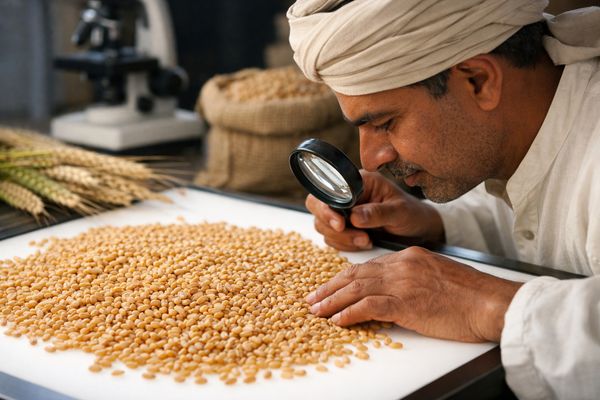
Indian wheat prices look set to stay firm in the coming weeks as weather damage crimps effective supplies, even while global futures and European export markets trade with a softer bias.
India is heading into a disappointing wheat season. Unseasonal rain and hail during the grain-filling phase have cut yields and damaged grain quality across Punjab, Haryana, Rajasthan, Uttar Pradesh and Madhya Pradesh. This is already visible in wholesale markets, where lighter, spotted kernels are pushing more lots below official procurement standards and tightening the supply of mill-acceptable wheat. At the same time, international benchmarks in Chicago and Europe are easing on improved global crop outlooks, setting up a divergence between a structurally tighter Indian market and more comfortable global balance.
Exclusive Offers on CMBroker

Wheat
protein min. 11.50%
98%
FCA 0.24 €/kg
(from UA)

Wheat
protein min. 11.50%
98%
FCA 0.25 €/kg
(from UA)

Wheat
protein min. 9,50%
98%
FCA 0.24 €/kg
(from UA)
📈 Prices & Spreads
At Lawrence Road wholesale market in Delhi, wheat has firmed to around EUR 25.80 per 100 kg this week, up from roughly EUR 24.80–25.10 in the previous session, as buyers compete for limited good-quality arrivals. The recovery comes after a short-lived soft patch when fresh harvest pressure briefly weighed on prices.
In Punjab, the current Minimum Support Price (MSP) of about EUR 25.60 per 100 kg is now close to spot wholesale levels, anchoring the domestic floor and incentivising deliveries into government procurement channels.
Internationally, CBOT soft red winter wheat is trading just above USD 6.00/bu, having slipped back into a two‑month trading channel on renewed selling and improved supply sentiment. French 11% protein wheat stands near EUR 280/t FOB Paris, slightly lower than earlier in April, indicating mild downside pressure. Ukrainian wheat offers around Kyiv and Odesa remain broadly stable near EUR 230–250/t FCA, reflecting competitive Black Sea supply.
🌍 Supply & Demand Balance
Weather damage is the dominant driver in India. Crop-cutting trials across 850 locations in Punjab show average yields dropping to 20 quintals per acre from 22 last year, a decline of roughly 9%. Some districts such as Pathankot have fallen to just 16 quintals per acre, and farmers in pockets of northern India report losses of 20–25% versus last season.
Despite these setbacks, arrivals into Punjab’s wholesale markets had reached 3.87 million tonnes by 19 April, of which 3.42 million tonnes had already been procured. This high procurement ratio, combined with weaker-than-expected on-farm yields, points to a tightening pool of freely available milling-quality grain as the season advances.
The central government had projected national wheat output at 120 million tonnes for 2025–26, up from roughly 117 million tonnes in 2024–25. Given the widespread late-season weather shock, this target is now difficult to achieve, even if final production still ends slightly above last year's level.
📊 Fundamentals & Policy Response
To keep procurement on track in the face of quality problems, authorities have relaxed norms in key producing regions. Punjab and Chandigarh now follow Haryana and Rajasthan in allowing up to 70% shrivelled grains and up to 15% broken or damaged grains in wheat delivered to state agencies. This effectively converts a chunk of otherwise non-marketable wheat into eligible stock, supporting farmer incomes but lowering the average quality of public inventories.
Nevertheless, logistical issues are slowing the movement of stocks. Only 11.9% of procured wheat had been lifted from market yards by Sunday evening, highlighting bottlenecks in transporting grain into warehouses. This creates short-term congestion and may delay the full stabilising effect of government buying on interior market prices.
On the trade side, the government has already approved 5 million tonnes of wheat exports, with a further 2.5 million tonnes recently cleared. Combined with lower effective domestic availability of high-quality wheat, these export windows limit downside for internal prices even as global benchmarks soften.
🌦 Weather & Global Context
The unseasonal rains and hailstorms in March and April have already done most of the damage in India’s northern belt, stressing crops during final ripening and leading to shrivelled kernels and spotting. Recent regional assessments continue to flag lingering moisture and cooler-than-normal conditions that delay harvest and complicate grain drying, reinforcing quality concerns rather than offering late-season yield relief.
Globally, however, weather and crop updates lean more benign. Market commentary points to improved outlooks in several major exporting regions, which is capping rallies and has seen Chicago wheat futures drift lower by a few cents in recent sessions. The result is an unusual divergence: India faces a quality-driven squeeze, while global consumers still see relatively comfortable supply at current price levels.
📆 Short-Term Outlook (2–4 Weeks)
Over the next month, Indian wheat prices are likely to remain firm to slightly higher. Quality-driven supply reduction, active government procurement at MSP, and already approved export volumes should support interior markets, especially for lots that meet higher milling standards.
Any sharper domestic rally will depend on two factors: first, how much sound grain remains in private hands after the main procurement phase; second, whether official production estimates are revised lower, catalysing more aggressive stock-building by millers and traders.
In contrast, CBOT and European futures are expected to trade range‑bound with a mild downside bias, barring a fresh weather shock in the Northern Hemisphere. Managed money has recently added to short positions as prices slipped back below USD 6.10/bu, reinforcing resistance on the upside.
💹 Trading & Procurement Strategy
- Indian millers and domestic buyers: Consider front-loading coverage for higher-protein, sound wheat over the next 2–3 weeks, as quality spreads are likely to widen once procurement peaks and good lots grow scarce.
- Exporters and European flour millers: Be cautious when booking Indian origin for quality-sensitive products; this season’s cargoes will on average show smaller, more shrivelled kernels and higher damage shares. Build in wider contractual quality tolerances and adjust blending plans accordingly.
- Speculative traders: The fundamental backdrop favours relative-value strategies: long Indian physical or regional spreads against short CBOT or MATIF futures, given India’s quality squeeze versus softer global balances. Risk management is essential in case of policy shifts on exports.
📍 3-Day Regional Price Indication (Directional)
| Market | Product / Basis | Indicative Level (EUR) | 3-Day Bias |
|---|---|---|---|
| Delhi (India) | Physical wheat, fair quality, ex-market | ≈ 258/t (25.8/100 kg) | Sideways to slightly firmer |
| Paris (France) | 11% protein wheat, FOB | ≈ 280/t | Sideways to slightly softer |
| Odesa (Ukraine) | 11.5% protein wheat, FCA | ≈ 240–250/t | Mostly stable |
| CBOT (US) | SRW futures, front month (EUR equiv.) | ≈ 205–210/t | Range-bound with mild downside |
Related posts:
 Barley Market Holds Firm as SFE Curve Stays Flat, Forward Values Soften
 Indian Wheat Mills Drive Firm Domestic Prices While Global Futures Ease
 China’s Return to Indian Broken Rice Tightens Asian Trade Flows
 Indian Wheat Prices Soften as Weak Procurement Floods Wholesale Markets
 US Corn Tightens Grip on South Korea as Disease Risks Cloud Feed Demand
 Peru’s Wheat Demand Rises as Canada Tightens Its Grip on Imports