
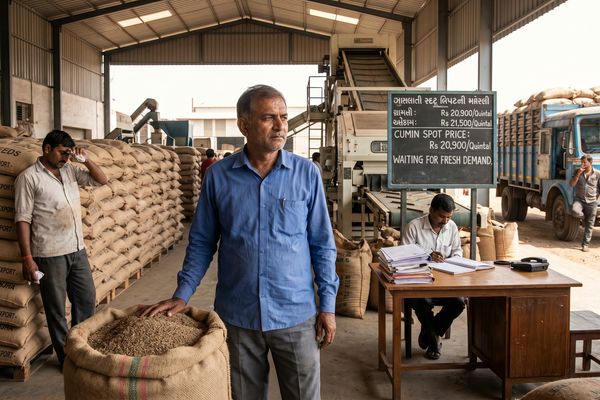
Cumin prices have shifted from a sharp recovery into a sideways consolidation, as Indian futures settlements and softer physical buying temporarily cap further gains while the fundamental backdrop remains broadly supportive.
After several weeks of rallying on lower production and quality concerns, the cumin market has moved into a wait‑and‑see phase. Physical activity in India’s key hubs is muted as traders digest recent futures contract settlements and gauge export appetite. European and Middle Eastern demand remains the decisive swing factor for the next price leg. For importers, the current pause offers a window to secure coverage before a possible renewed uptrend if foreign buying returns.
Exclusive Offers on CMBroker

Cumin seeds
whole, grade - A
FOB 4.30 €/kg
(from IN)

Cumin powder
grade - A
FOB 3.45 €/kg
(from IN)

Cumin seeds
grade - A
99%
FOB 2.20 €/kg
(from IN)
📈 Prices & Market Mood
In Delhi’s wholesale market this week, Jaipur-origin cumin traded around EUR 2,460 per 100 kg, while Shivpuri-origin was near EUR 2,580 per 100 kg. The 505 export-grade number was quoted close to EUR 2,330 per 100 kg, reflecting the premium for better, exportable quality despite overall quieter trade.
At Unjha in Gujarat, India’s benchmark cumin hub, trading remained subdued with both buying and selling limited as participants waited for clarity after futures contract settlements. Export-grade Indian cumin seeds offered FOB New Delhi currently cluster around EUR 2.00–2.20/kg, with organic whole seed closer to EUR 4.30/kg and cumin powder near EUR 3.45/kg, all slightly softer than a week earlier.
🌍 Supply & Demand Drivers
This season’s cumin production in India is lower than last year, and quality in several growing regions has been below average. These factors underpinned the recent price rally before the present consolidation, and they continue to provide a fundamentally constructive backdrop that limits downside risk in the near term.
On the demand side, the key variable is export buying. Indian exporters face a structurally tougher landscape as China’s cumin output has increased significantly. India, which used to ship about 60,000–70,000 tonnes of cumin to China annually, now contends with China exporting cumin to third-country markets, eroding India’s share and intensifying competition in price-sensitive destinations.
📊 Structural Competitiveness & Trade Flows
Between April 2025 and January 2026, Indian cumin exports fell by about 15% to 167,000 tonnes, underlining the pressure from weaker foreign buying and rising competition. This drop comes despite India’s still-dominant role in global cumin trade and emphasizes how dependent prices are on sustained export demand.
Yield differentials exacerbate India’s challenge. Average Indian cumin yields of roughly 450–500 kg per hectare are around one-third lower than Chinese levels, which are about 1.5 times higher. This cost and productivity gap is structural and unlikely to narrow quickly, meaning Indian suppliers will increasingly need to compete on quality, traceability and reliability rather than price alone.
⛅ Weather & Short-Term Outlook
Weather in India’s main cumin-growing regions is currently less dominant as a short-term driver than in pre-harvest months, but lingering concerns over quality from some areas remain a supportive factor. With the harvest outcome largely known and lower volumes confirmed, the market’s focus has shifted decisively to trade flows and futures-led positioning.
Over the next 8–10 days, clarity around futures settlements is expected to guide physical market sentiment. Should geopolitical conditions in the Middle East stabilise further and buyers there return more actively, that renewed foreign demand could quickly absorb current offers and re-ignite the uptrend from the recent lows.
📆 Trading & Procurement Strategy
- European buyers: The current consolidation, following an earlier rally, offers a reasonable entry point for staggered purchases, particularly of 505 and higher grades, before Middle Eastern and South-East Asian demand potentially strengthens.
- Indian exporters: Focus on quality differentiation and timely execution rather than volume pushing, as competition from China on lower-grade cumin narrows price spreads in many destinations.
- Middle Eastern and Asian importers: Consider advancing coverage for Q3–Q4 needs while prices are capped by short-term profit taking, especially if local inventories are not comfortable.
- Speculative participants: With fundamentals supportive but exports soft, expect a range-bound market in the very short term, with upside bias should fresh export inquiries emerge.
📉 3‑Day Price Indication (EUR)
| Market / Product | Quality / Term | Indicative Level (EUR) | Bias (3 days) |
|---|---|---|---|
| New Delhi FOB | Cumin seeds, 99% purity, conv. | ≈ 2.00–2.20/kg | Slightly softer to sideways |
| New Delhi FOB | Organic whole cumin, grade A | ≈ 4.30/kg | Sideways |
| Unjha FCA | Cumin seeds, 98–99% purity | ≈ 2.05–2.15/kg | Sideways, awaiting export cues |
Related posts:
 Cumin Market Stuck in a Demand Vacuum Despite Tightening Indian Supply
 Indian Cumin Softens Slightly as Heat Speeds Arrivals, Demand Stays Cautious
 Indian Cumin Softens Slightly as New Crop Arrivals Meet Firm Demand
 Indian cumin softens on weak domestic demand but tight supply caps downside
 Turmeric prices ease as Indian demand softens and fresh crop weighs on sentiment
 Indian Cumin Softens as New Crop Flows Meet Cautious Export Demand