
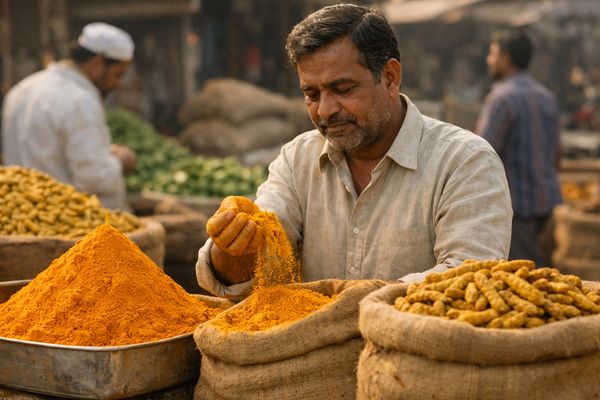
Turmeric prices in India are drifting lower as weak domestic buying and a softer futures market meet steadily rising fresh-crop arrivals, creating a mildly bearish short‑term tone for global buyers.
After recent strength, the turmeric market has shifted into consolidation with a gradual downward bias. Physical prices in key Indian hubs such as Delhi, Erode and Jaipur eased on Monday as dal mills, retailers and many exporters stayed on the sidelines instead of replenishing stocks. At the same time, FOB offers for Indian-origin turmeric in New Delhi and Telangana show only marginal week‑on‑week declines, reflecting still-elevated absolute levels and quality-driven price spreads. For European and Middle Eastern buyers, the current phase offers improved negotiation room but not yet a decisive break lower.
Exclusive Offers on CMBroker

Turmeric whole
FOB 2.45 €/kg
(from IN)

Turmeric powder
FOB 3.30 €/kg
(from IN)

Turmeric dried
finger salem,double polished, grade A
FOB 1.57 €/kg
(from IN)
📈 Prices & spreads
Physical wholesale markets in India saw broad-based softness. In Delhi, the Erode Gadda variety eased by about ₹300 per quintal to ₹15,200–₹15,300 per quintal, while the premium Salem Fali grade traded between ₹16,200 and ₹20,000 per quintal. Jaipur markets also corrected, with prices slipping by roughly ₹100 per quintal to around ₹16,300–₹17,800 per quintal, underlining that pressure is not confined to a single trading centre but reflects nationwide demand fatigue.
Converted to export-equivalent levels, current wholesale ranges translate roughly to 1.6–2.1 EUR/kg, depending on grade and location (using an indicative FX rate). Recent FOB offers from India are broadly consistent with this structure: organic turmeric whole around 2.48 EUR/kg and turmeric powder at 3.32 EUR/kg FOB New Delhi, while conventional double‑polished Salem and Nizamabad fingers are indicated near 1.44–1.59 EUR/kg FOB/FCA Telangana. These small week‑on‑week reductions confirm a gentle easing rather than a sharp correction.
| Product | Location / Term | Latest price (EUR/kg) | WoW change (EUR/kg) |
|---|---|---|---|
| Turmeric whole, organic | New Delhi, FOB | 2.48 | -0.02 |
| Turmeric powder, organic | New Delhi, FOB | 3.32 | -0.02 |
| Turmeric dried, Salem finger, conv. | Telangana, FOB | 1.59 | 0.00 |
| Turmeric dried, Nizamabad finger, conv. | Telangana, FOB | 1.44 | 0.00 |
🌍 Supply, demand & futures sentiment
The immediate driver of Monday’s decline is weak domestic demand. Dal processing mills and retail buyers are largely covering hand‑to‑mouth needs instead of building forward stocks, a pattern echoed by sluggish customer inquiries reported by traders. Exporters and stockists are present only at the margins, with no significant new export orders reported, limiting any counter‑balance to domestic softness. Given India’s dominant share of global turmeric supply, this cautious stance in Erode and Delhi quickly transmits into the cost base for European and Middle Eastern importers.
On the supply side, arrivals from Andhra Pradesh, Telangana, Maharashtra and Odisha continue at a steady pace as the fresh crop moves into wholesale channels. This keeps the market comfortably supplied relative to current offtake. Futures trading reflects this balance: recent analyses of Indian exchanges show turmeric futures slipping below short‑term moving averages with a bearish tilt, and spot prices in key centres like Nizamabad edging lower after earlier highs. Together, ample physical availability and hesitant buying are reinforcing the mild downward pressure on prices.
☀️ Weather & production backdrop
Weather developments are starting to matter for the next production cycle. Forecasts for mid‑April indicate strong heat across much of India, with an orange heatwave alert in Telangana and maximum temperatures potentially reaching 44–45°C in districts including Nizamabad, a core turmeric area. While current harvested supplies are already in the pipeline, sustained extreme heat could stress stored stocks and influence farmer decisions on the upcoming planting season.
Early seasonal outlooks for the 2026 southwest monsoon point to a risk of slightly below‑normal rainfall (around mid‑90% of the long‑period average) amid lingering El Niño concerns. For now, this remains a medium‑term watch factor rather than an immediate bullish driver: inventories and current arrivals are sufficient, but any confirmation of a weaker monsoon later in Q2 could cap downside and re‑introduce weather risk premia into turmeric prices.
📊 Fundamentals & price outlook
Fundamentally, the market appears balanced but leaning softer. Domestic consumption has not yet fully transitioned into the higher‑usage wedding and festival season, and without a visible pick‑up in export orders from Europe or the Middle East, there is little catalyst for a strong rebound. The cost‑of‑production floor in Maharashtra and Andhra Pradesh is likely to limit deep declines, especially for better grades such as Salem fingers and high‑colour lots favored by food and nutraceutical buyers.
In the short to medium term (two to four weeks), prices are therefore expected to oscillate within the current band, with a modest downward bias. FOB values for standard conventional fingers around 1.4–1.6 EUR/kg and organic whole near 2.4–2.5 EUR/kg look sustainable in the near term, though buyers may secure small discounts on larger volumes or lower grades. Upside risk would mainly arise from a surprise acceleration in export demand or a clear shift in weather expectations for the 2026–27 crop.
🧭 Trading recommendations
- European and Middle Eastern buyers: Use the current soft patch to extend cover modestly for Q2–Q3 needs, particularly for higher‑spec Salem and polished fingers. Avoid over‑buying until there is clearer evidence of monsoon risk or stronger export demand.
- Food manufacturers and blenders: Consider gradual scale‑in purchases around current levels for quality‑differentiated Indian origins, locking in colour and curcumin specifications while the market is under mild pressure.
- Producers and stockists in India: Be cautious about aggressive selling below cost‑of‑production benchmarks, especially if holding premium grades. A staggered selling strategy may help manage downside while retaining optionality in case weather or demand turns more supportive.
- Speculative participants: Near‑term charts and fundamentals favour a slightly bearish to range‑bound stance. Short positions should be managed with tight risk controls around potential weather headlines or sudden export tenders.
📆 3‑day price indication (directional)
- Indian wholesale hubs (Erode, Delhi, Jaipur): Slight downside to sideways over the next three days, with further small corrections possible if arrivals stay high and domestic buying remains thin.
- FOB India (New Delhi, Telangana): Largely stable in EUR terms with a mild softening bias, as exporters test lower offers to stimulate inquiries but stay above producer cost floors.
- Delivered Europe (CIF main ports): Mostly steady; any modest decline in Indian rupee‑denominated prices and freight could filter through with a short lag, improving buyer leverage in negotiations.