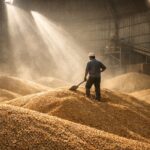
India’s barley market has shifted into a clear bull phase, with wholesale prices rebounding sharply over the last two weeks and further gains likely as tight supplies collide with broadening industrial demand.
Barley arrivals from the new crop are already winding down, but this year’s smaller acreage, weather‑hit yields and unusually low carry-over stocks mean the domestic pipeline is thin just as processors, feed users and ethanol producers step up buying. While global benchmarks remain relatively subdued, India is quietly tightening one important origin, supporting regional sentiment. Over the next month, the market is expected to trade with an upside bias rather than correcting lower, unless a surprise surge in arrivals materialises.
Exclusive Offers on CMBroker

Barley seeds
Cattle feed
FOB 0.19 €/kg
(from UA)

Barley seeds
feed grade, moisture: 14 % max
98%
FCA 0.25 €/kg
(from UA)

Barley seeds
feed grade, moisture: 14 % max
98%
FCA 0.23 €/kg
(from UA)
📈 Prices & Market Mood
Producer and wholesale prices in India have rallied by roughly $2.37–$2.97 per quintal from recent lows within just a fortnight, with traders expecting another move of about $2.37 higher in the near term. In Rajasthan’s key Sriganganagar belt, warehouse-delivered values have strengthened from around $24.70 to about $26.72 per quintal, marking a decisive shift from oversupplied to tightening conditions.
In Madhya Pradesh, wholesale quotations have lifted to roughly $25.77–$26.38 per quintal after clearing as low as $23.43–$24.02, while the Kanpur–Hamirpur–Banda corridor in Uttar Pradesh is now indicating around $25.90–$26.13 per quintal for warehouse delivery. The speed of the move, combined with expectations of further modest gains, underlines a market recalibrating to structurally tighter fundamentals rather than reacting to a temporary shock.
🌍 Supply & Demand Balance
On the supply side, this season’s barley acreage slipped to about 5.76 lakh hectares from 6.10 lakh hectares last year, as growers responded to previous seasons’ weak returns by shifting to alternative crops. Weather then compounded the tightening: unseasonably warm conditions in January followed by adverse weather in March compressed yields and pushed production estimates down to about 17.90 million tonnes, from 19.25 million tonnes previously — a drop of nearly 7%.
Crucially, carry-over stocks going into harvest were already estimated 27–28% below normal, leaving the market with little buffer. With harvest now complete in all producing states, there is no further supply cushion ahead; what reaches wholesale markets is being absorbed swiftly, often the same day, preventing the build-up of visible stocks in mandis and reinforcing the bullish tone.
📊 Demand Drivers & Industrial Pull
Demand is broadening on multiple fronts. Protein-processing industries — including nutritional supplement and health-food manufacturers — are competing directly with traditional users for available grain. At the same time, ethanol plants, animal feed compounders and public food procurement agencies are all active buyers, often through competitive tenders that keep the floor under spot prices.
This overlap of demand streams means that barley is no longer a residual feed grain in India but an actively contested raw material for both food and industrial chains. Because barley ripens ahead of wheat, its harvest and arrivals are effectively finished; industrial buyers appear keen to lock in coverage before any further appreciation, sustaining the current firm undertone.
🌐 Global Context & Ukrainian Benchmarks
Globally, barley remains an important feed and malting grain in Europe and the Middle East, and India’s tighter balance removes one potential source of competitively priced export supply from the regional matrix. European feed buyers who previously looked to South Asia for occasional volumes should note that India is now effectively prioritising domestic industrial and feed demand over exportable surpluses.
Recent Ukrainian offers provide an external price reference: feed barley from Odesa and Kyiv has been indicated around EUR 0.19–0.25 per kg (FOB/FCA) in late April, with values broadly steady to slightly firmer over the month. Converted, these levels remain competitive on a global basis, but India’s internal rally reflects local structural tightness rather than an imported price shock, meaning domestic strength can persist even if Black Sea quotations remain relatively stable.
🌦️ Weather & Short-Term Outlook
With the Indian barley harvest already completed across major producing regions, near-term weather will have limited impact on the current crop, though it will matter for subsequent planting decisions. The key driver now is the pace of arrivals versus the ongoing pull from processors and feed users, rather than any immediate climate risk.
Over the next two to four weeks, prices are expected to consolidate around current levels with a clear upside bias. Any sudden increase in arrivals or short-term profit-taking could trigger brief corrections, but structurally low stocks and strong industrial demand argue against a sustained downturn in the near term.
🧭 Trading & Procurement Outlook
- Industrial and feed buyers (India): Consider securing near-term coverage on price dips, as structurally low stocks and multi-sector demand suggest limited downside and a bias towards further modest appreciation.
- Exporters & traders: India is likely to remain a tight, domestically focused market; look to Black Sea origins such as Ukraine for competitively priced feed barley if exportable Indian volumes stay constrained.
- Producers: The current rally and firm demand backdrop improve the relative attractiveness of barley for the next planting cycle, potentially incentivising some recovery in area if price strength is sustained.
📆 3-Day Regional Price Indication (Directional, in EUR)
| Region / Market | Current Level (approx.) | 3-Day Bias |
|---|---|---|
| India – Rajasthan (wholesale, per kg, EUR) | Firm vs. recent lows (converted from c. $26.7/qtl) | Slightly upward / stable |
| India – MP & UP belts (wholesale, per kg, EUR) | Firm vs. recent lows (mid-$25–26/qtl range) | Upward bias |
| Ukraine – Odesa feed barley (FOB, EUR/kg) | c. 0.19–0.25 | Stable to slightly firm |