
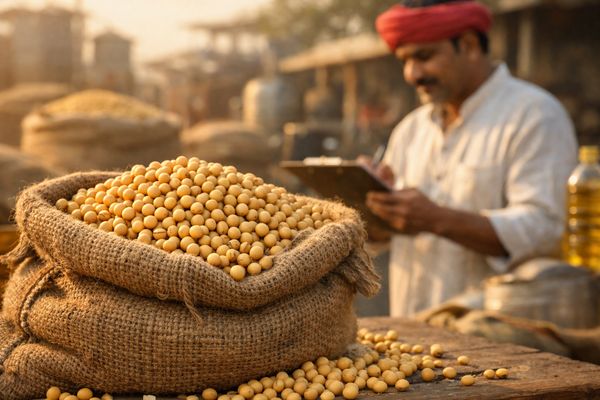
Indian soybean prices have rebounded from recent lows, supported by tighter domestic supply and a renewed geopolitical premium in the global edible oil complex, while refined soya oil prices have retreated, compressing processor margins and tempering crush demand in the near term.
Indian soybeans are trading back in a firmer range after stockists slowed selling and the government nudged up tariff values for crude soya oil imports, making external supplies marginally more expensive. At the same time, refined soya oil quotes have softened across major hubs, underscoring a disconnect between raw seed and oil values just as global vegoil markets react to the volatile Iran–US standoff around the Strait of Hormuz. Internationally, Chicago soybeans and soyoil have been buoyed by high crude oil and persistent Middle East risk, even as short-term corrections emerge when traders reassess the conflict path. This leaves the Indian complex in a cautiously constructive but headline‑sensitive posture.
Exclusive Offers on CMBroker

Soybeans
No. 2
FOB 0.59 €/kg
(from US)

Soybeans
sortex clean
FOB 0.97 €/kg
(from IN)

Soybeans
FOB 0.33 €/kg
(from UA)
📈 Prices & Spreads
Soybean plant-delivery prices in key Indian producing states (Madhya Pradesh, Maharashtra, Rajasthan) have recovered by about 500 rupees per quintal from recent lows, now stabilising around **$69.22–$70.27 per quintal**. This move reflects both a pullback in farmer and stockist selling and a reassessment of domestic availability following last season’s weather‑affected crop.
In contrast, **refined soya oil** has weakened. Delhi wholesale trade closed around **$165.72 per quintal**, with Mumbai at **$159.54**, Indore **$157.30**, Kandla port **$155.25** and Dhule **$157.30** per quintal. The simultaneous firmness in seed and softness in oil implies that crush margins are under notable pressure, discouraging aggressive processing runs despite better soybean prices.
Internationally, benchmark soybean offers converted to Euro terms show a mixed but overall steady picture. Using 1 USD ≈ 0.93 EUR, indicative FOB prices are roughly:
| Origin | Specification | Location / Terms | Price (EUR/kg) | Trend vs mid‑April |
|---|---|---|---|---|
| US | No. 2 | Washington D.C., FOB | ≈0.55 | Stable |
| India | Sortex clean | New Delhi, FOB | ≈0.90 | Stable |
| Ukraine | Standard | Odesa, FOB | ≈0.31 | Stable |
| China | Yellow | Beijing, FOB | ≈0.69–0.76 | Slightly firmer |
On futures, Chicago soybeans and soyoil have recently swung higher on the back of strong crude oil and persistent Iran‑related supply fears, before easing modestly as traders digested rain forecasts in US crop belts and short‑term de‑escalation signals in the Gulf.
🌍 Supply, Demand & Policy Drivers
Two domestic structural factors are underpinning the firmer tone in Indian soybean seed:
- Weather‑hit crop: Last season’s soybean crop in Maharashtra, Rajasthan and Madhya Pradesh suffered rainfall disruptions, trimming yields and tightening available supply into the current marketing period.
- Stockist discipline: With reduced production, stockists have deliberately moderated selling, slowing arrivals and helping prices regain lost ground.
Daily arrivals across the three main soybean states are running at roughly **125,000–150,000 bags** per day, a level consistent with a more measured marketing pace rather than distress selling. This behaviour is supportive of prices but constrains throughput for crushers that are already facing thinner oil realisations.
On the policy side, the government has raised the **tariff value for soybean crude oil imports** from **$1,224 to $1,252 per tonne**, slightly increasing the landed cost of imported oil. This adjustment indirectly supports domestic soybean seed prices by reducing the relative attractiveness of import‑heavy coverage strategies for refiners and encouraging at least some reliance on local crushing.
Globally, edible oil and oilseed demand remains closely linked to energy markets. The ongoing conflict‑driven disruption and risk premium around the Strait of Hormuz have amplified crude oil volatility and kept vegoil markets—including soybean oil—sensitive to geopolitical headlines. This external backdrop is a key justification for Indian traders assigning a higher risk premium to seed values even as domestic oil prices are soft in the latest session.
📊 Crushing Margins, Meal & Feed Dynamics
The current configuration—firm seed, softer refined oil—translates directly into compressed crushing margins. Unless meal realisations compensate, processors will be cautious about ramping up capacity utilisation.
There are early signs that **soybean meal (DOC)** is playing that compensatory role. At Kota in Rajasthan, soya DOC has **jumped by about 1,000 rupees per tonne**, trading around **$534.97–$540.21 per tonne**, supported by slower plant selling and stronger demand from feed compounders. Mustard DOC has also firmed by roughly **500 rupees per tonne** to **$241.43–$246.67 per tonne**, signalling a broader firming in protein meal values.
Because soybean meal is an internationally traded feed ingredient, India’s DOC price strength is closely followed across Southeast Asian markets. The current firmness, if sustained, would signal tightening Indian exportable surplus at a time when global protein meal markets are already wary of supply uncertainty linked to the Gulf conflict and its spill‑over into shipping costs and trade flows.
However, the refined oil leg of the complex remains a weak point. With Delhi wholesale refined soya oil down about **450 rupees per quintal** from recent highs and Kandla port values off **400 rupees**, processors are seeing less incentive to aggressively bid for seed unless oil or meal prices improve further. In the near term, this suggests crush demand will remain **measured rather than expansive**, tempering the upside for seed unless new bullish catalysts emerge.
🌦️ Weather & Geopolitics
While the latest crop is already in the pipeline, weather remains a background risk for upcoming sowing intentions and yield potential in central and western India. Early indications from seasonal outlooks suggest that rainfall patterns for central India—including Madhya Pradesh and Maharashtra—will be closely watched for any repeat of last year’s disruptions, though near‑term official forecasts focus more on late‑March and early‑April systems than on the core monsoon window.
The more immediate and powerful driver is geopolitics. Tensions between the United States and Iran—and the resulting **Strait of Hormuz crisis**—have injected a sizeable risk premium into crude oil and, by extension, into global edible oil markets. Recent trading sessions show how swiftly Chicago grains and vegoils respond to shifts in perceived war risk, alternating between rallies on escalation and pullbacks when markets price in potential diplomatic progress or weather‑related demand shifts. For Indian soybeans, this geopolitical layer is a key component of the “premium” supporting prices in the upper end of their recent range.
📆 Short‑Term Outlook & Key Risks
Overall, the **near‑term outlook for Indian soybeans is cautiously constructive**. Three elements argue for ongoing support in the **$69–$72 per quintal** band:
- Reduced domestic production and disciplined stockist selling limit downside.
- Higher tariff value for crude soya oil marginally protects local seed from import competition.
- Geopolitical and energy‑linked risk premiums continue to buoy the global vegoil complex, even if with increased day‑to‑day volatility.
Refined soya oil, by contrast, may remain under pressure in the short run. Until either **processing margins rebuild** (through higher oil prices or cheaper seed) or global edible oil markets undertake a renewed, sustained rally, refiners are unlikely to pay up aggressively for seed. This divergence between firmer seed and softer oil is likely to cap near‑term upside for soybeans, even as downside remains limited by structural supply constraints.
Key risks to the current baseline include:
- Geopolitical de‑escalation: A credible and durable de‑escalation in the Iran conflict that reopens or stabilises Hormuz shipping would erode part of the geopolitical premium embedded in crude and vegoils.
- South American supply: A sharp increase in South American soybean and product arrivals in Asia at competitive prices could pressure Indian seed and DOC values, especially if the rupee strengthens or freight normalises.
- Domestic policy shifts: Further adjustments in import tariffs, stock limits or export incentives could quickly change relative economics along the chain.
🧭 Trading Outlook & 3‑Day Directional View
Trading / hedging suggestions (short horizon, not investment advice):
- Crushers: Maintain cautious crush rates and hedge meal realisations where possible; prioritise forward sales of DOC given current strength to partially offset weak oil margins.
- Stockists / farmers: Use current firmness in the **$69–$72 per quintal** range to scale out of inventory gradually rather than in bulk, retaining some exposure to ongoing geopolitical risk.
- Feed buyers: Consider staggered coverage for soymeal needs, as sustained DOC strength and global protein meal uncertainty limit the likelihood of a sharp near‑term correction.
- Importers / refiners: Avoid over‑reliance on imported crude soya oil immediately after the tariff value hike; blend domestic seed coverage with opportunistic imports when global oil prices correct on temporary de‑escalation headlines.
3‑day directional indication (converted approx. to EUR where relevant):
- Indian soybeans (domestic, ex‑plant; ~€0.64–0.67/kg equivalent): Mildly firmer to sideways, supported by tight supply and strong meal, but capped by weak oil.
- Refined soya oil in India (~€1.45–1.55/kg at major hubs): Slightly soft to range‑bound as margins stay tight and demand is price‑sensitive.
- FOB soybeans (US, India, Ukraine, China; ~€0.31–0.90/kg): Overall range‑bound with event risk, tracking crude oil and Hormuz headlines with a slight upside bias if tensions re‑intensify.
Related posts:
 Indian Soy Complex Tightens as Rupee Slides and Palm Oil Firms
 Ukrainian Sunflower Prices Steady as Oil Demand Firms and Weather Stays Cool
 Soybeans steady as crush complex firms and China premium widens
 Soybeans Edge Lower as Oil Weakens and Meal Firms, While FOB Basis Holds
 Soybean Complex Edges Lower While Meal Firms on Feed Demand
 Soybean Oil Tightens on Biofuel Pulse While Global Soybean Prices Consolidate