
🔵 Executive Summary
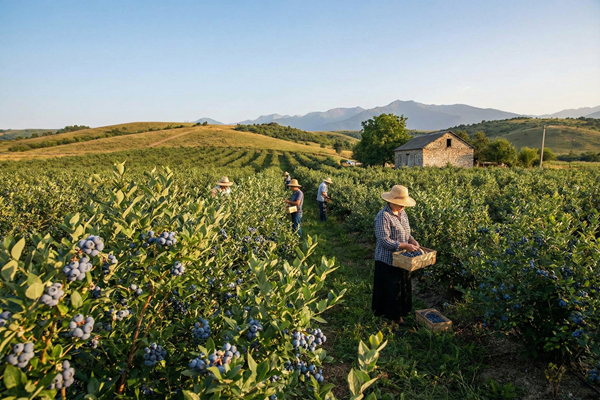
Georgian blueberry exports rose 64.5% year-on-year to reach USD 46.4 million in 2025, supported by expanding orchard acreage and higher production volumes.
Export volumes increased approximately 35%, as newly established plantations entered full production. However, export concentration remains high, with 85% of shipments directed to Russia, underscoring structural market dependence.
While diversification efforts toward Europe, the Gulf, India, and Israel are progressing, logistical and certification constraints continue to limit broader market penetration.
📊 Production & Pricing Outlook
This season, Georgian blueberries are forecast to trade at:
-
USD 4.00–5.00 per kg in international markets
Seasonal price dynamics:
-
Peak pricing: Early harvest window (June–August)
-
Gradual decline: Late-season volumes increase
-
Russia remains a key pricing influence
Expanded orchard maturation has lifted total output, reinforcing Georgia’s growing role in regional berry supply.
🌍 Export Structure & Market Concentration
Despite strong export growth, market exposure remains highly concentrated:
-
85% of exports destined for Russia
This concentration presents:
-
Currency and geopolitical exposure
-
Pricing dependency
-
Limited bargaining leverage
Market diversification is underway but constrained by structural factors.
🚛 Diversification Challenges
Expansion into alternative markets faces several hurdles:
🇪🇺 European Union
-
Certification requirements
-
Stricter packaging standards
-
Enhanced phytosanitary compliance
-
Need for expanded cold storage infrastructure
🌍 Gulf Markets
-
Active demand
-
Limited air cargo capacity restricting scale
🇮🇳 India & 🇮🇱 Israel
-
Recently opened markets
-
Positive demand signals
-
Air freight limitations constraining volume
Logistics and infrastructure remain the primary bottlenecks to scaling beyond regional markets.
🏗️ Structural Sector Development
The Georgian blueberry sector is investing in:
-
Expanded cold chain infrastructure
-
Compliance certifications
-
Modern packaging facilities
-
Market access documentation
Long-term competitiveness will depend on the ability to align with EU-grade standards and diversify shipping channels.
🧭 CMB Market Interpretation
Georgia’s blueberry industry is entering a scale-up phase driven by maturing orchards.
Key Observations:
-
Strong export value growth reflects both volume expansion and price stability.
-
Market concentration in Russia presents structural risk.
-
Infrastructure and certification are the next growth barriers.
-
Air freight dependency limits expansion into premium distant markets.
Short-Term Outlook:
Stable pricing within USD 4–5/kg range during early harvest.
Medium-Term Risk:
Over-reliance on a single market may limit pricing power.
Strategic Opportunity:
Diversification into EU and Gulf markets could enhance resilience.
📊 Risk Assessment
| Factor | Risk Level |
|---|---|
| Market Concentration (Russia) | High |
| Logistics & Air Freight Constraints | Moderate–High |
| Certification Compliance | Moderate |
| Production Expansion Stability | Positive |
| Price Volatility Risk | Moderate |
📌 Why This Matters Now
-
Orchard expansion is translating into measurable export growth.
-
Infrastructure development is becoming critical to diversification.
-
Air freight capacity constraints are limiting access to premium markets.
-
Market concentration risk remains elevated.
The coming seasons will determine whether Georgia transitions from a regional supplier to a diversified global berry exporter.
🏁 Conclusion
Georgian blueberry exports surged to USD 46.4 million in 2025, reflecting expanding production capacity and favorable pricing.
However, heavy reliance on Russia and logistical limitations pose structural challenges to long-term stability.
Sustained investment in certification, cold chain expansion, and diversified trade routes will determine whether Georgia can broaden its global footprint in the competitive blueberry market.