
🔵 Executive Summary
South Korea’s strawberry exports climbed to a record USD 72.01 million in 2025, marking a sixteen-fold increase compared to 2005 levels.
Thailand, Singapore, and Hong Kong remained the leading destinations, while export growth was supported by winter production cycles, premium quality positioning, and expanding smart farm adoption.
Despite strong overseas demand, cold weather disruptions in early 2026 tightened domestic supply and lifted retail prices significantly.
📊 Export Performance Snapshot
-
2025 export value: USD 72.01 million (record high)
-
2005 export value: USD 4.4 million
-
20-year growth: 16x expansion
NongHyup accounted for approximately 70% of total exports, generating:
-
USD 49.04 million in overseas sales
-
+7.8% year-on-year growth
South Korean strawberries continue to command a premium positioning in humid tropical markets where local production often struggles with sweetness levels.
🌍 Key Export Markets
Primary destinations:
-
🇹🇭 Thailand
-
🇸🇬 Singapore
-
🇭🇰 Hong Kong
These markets value:
-
Higher sugar content
-
Consistent winter supply
-
Premium greenhouse quality
South Korea has positioned strawberries as a high-value seasonal export rather than a mass commodity.
🏪 Domestic Market Dynamics
Strawberries ranked first in fruit sales at major retailers — E-Mart, Homeplus, and Lotte Mart — for three consecutive years (2022–2024).
Demand has expanded beyond retail into:
-
Bakery
-
Confectionery
-
Food service channels
However, supply volatility remains a factor.
Weather Impact
A cold wave in late January reduced shipments, pushing retail prices higher.
-
Average retail price: ~USD 6.03 per 100g
-
Approx. USD 8 per pound
-
+17.8% year-on-year increase
A 500g pack sold at roughly USD 8.02.
🍓 Role of Domestic Variety Development
The Seolhyang variety, developed in 2005, has been central to export expansion.
Key advantages:
-
Harvest availability from November
-
Winter supply stability
-
Strong sweetness profile
This has enabled South Korea to target high-value winter export windows.
🤖 Smart Farm Expansion Driving Growth
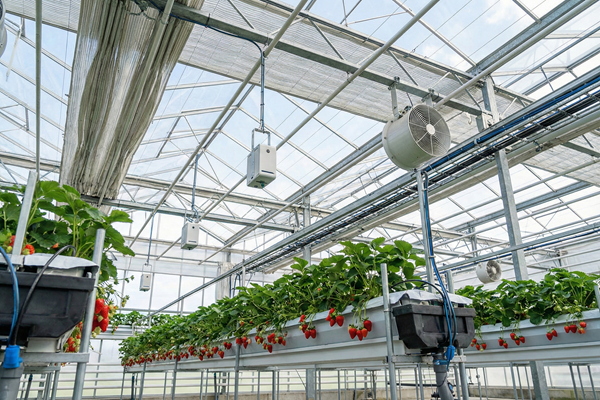
Nearly 98% of strawberries are cultivated in greenhouses, and the government is accelerating smart agriculture adoption.
Smart Farm Highlights:
-
AI-based climate control
-
Sensor-driven humidity and temperature management
-
Automated ventilation and nutrient systems
-
Remote monitoring capabilities
Participation in entry-level smart farm programs expanded from:
-
14 farms (2023)
-
To 329 farms (2025)
Productivity Gains
Smart farms applying nine core technologies can:
-
Increase output by up to 83%
-
Raise annual net profit by up to 3.5 times
💰 Investment Economics
-
Investment per 3,300 m²: ~USD 464,000
-
Payback period: 3–4 years (if yield targets met)
The model aims to attract younger farmers and increase winter-season output, when pricing is strongest.
🧭 CMB Market Interpretation
South Korea’s strawberry sector is transitioning from high-quality niche exporter to tech-driven premium producer.
Key Observations:
-
Export growth is supported by winter harvest timing.
-
Market concentration remains Asia-focused.
-
Smart farm adoption is structurally improving productivity and margin resilience.
-
Weather volatility remains a short-term price driver.
Short-Term Outlook:
Firm domestic pricing amid cold-related supply constraints.
Medium-Term Outlook:
Continued export growth if smart farm scaling sustains productivity gains.
Strategic Position:
Premium, technology-enabled berry exporter in Asia-Pacific markets.
📊 Risk Assessment
| Factor | Risk Level |
|---|---|
| Weather Sensitivity | Moderate |
| Export Market Concentration | Moderate |
| Smart Farm Capital Cost | High |
| Productivity Upside | Strong |
| Price Volatility | Moderate |
📌 Why This Matters Now
-
Winter export positioning strengthens price premiums.
-
AI-enabled greenhouse expansion is accelerating.
-
Asian premium fruit demand remains strong.
-
High capital costs require sustained productivity gains.
South Korea’s strawberry model illustrates how technology integration can transform seasonal horticulture into a premium export engine.
🏁 Conclusion
South Korea achieved a record USD 72.01 million in strawberry exports in 2025, underpinned by premium winter production, strong Asian demand, and rapid smart farm adoption.
While weather events continue to influence short-term pricing, structural investments in greenhouse automation and AI systems are enhancing output stability and profitability.
The sector’s next growth phase will depend on scaling smart farm infrastructure while maintaining quality premiums in export markets.