
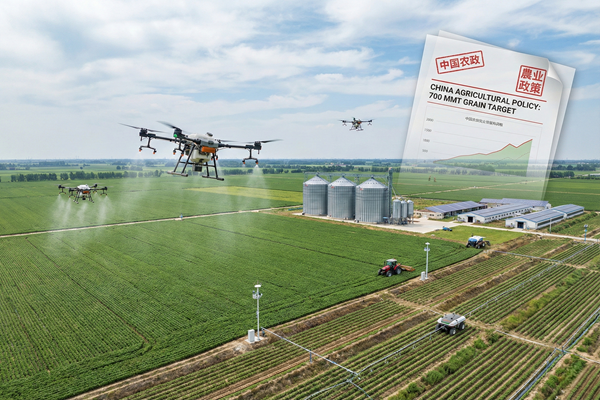
China Reaffirms Food Security While Shifting Toward Quality and Technology
China has released its 2026 No. 1 Document, the country’s annual agricultural policy blueprint, outlining priorities for agriculture and rural development as it enters the 15th Five-Year Plan period (2026–2030).
While food security remains the top priority, the focus has shifted from expanding output volume to improving quality, efficiency, and modernization. The document also introduces a significant directive to better “coordinate agricultural imports with domestic production,” signaling closer management of trade flows going forward
🌾 Grain Output Target Maintained at 700 MMT
China aims to maintain grain production at approximately 700 million metric tons (MMT), 50 MMT higher than the previous benchmark target of 650 MMT.
To achieve this, the strategy focuses on three pillars:
-
Stabilizing acreage
-
Raising yields
-
Optimizing crop structure
Provincial governments are tasked with improving per-capita yields for grains and oilseeds using high-quality farmland, improved seeds, advanced machinery, and better agronomic practices.
The policy also calls for expanded soybean production capacity and increased planting of rapeseed, peanuts, and camellia oleifera.
🛑 Farmland Protection Intensified
The document strengthens enforcement of China’s 120-million-hectare arable land “red line.”
New measures include:
-
Stricter penalties for illegal land occupation
-
Restoration of fallow land
-
Upgrading irrigation systems
-
Black soil protection projects
-
Utilization of saline-alkali and acidified land
These steps are designed to secure long-term production capacity amid land and water constraints.
🧠 “New Productive Forces”: AI and Robotics in Agriculture
For the first time, the No. 1 Document explicitly calls for transforming agriculture into a modern, large-scale industry driven by advanced technologies.
Key priorities include:
-
Accelerating biotech seed commercialization
-
Integrating artificial intelligence in farming
-
Expanding use of drones and Internet of Things (IoT) tools
-
Deploying robotics and intelligent agricultural machinery
The push signals deeper mechanization and digitization across the agricultural value chain.
🐖 Diversified Food Security Strategy
China’s definition of food security now extends beyond staple grains.
The 2026 framework includes:
-
Managing hog production capacity
-
Stabilizing beef and dairy sectors
-
Expanding silage corn and alfalfa production
-
Promoting offshore and deep-sea aquaculture
-
Supporting greenhouse and biological agriculture
In 2025, China imported approximately USD 207 billion in agricultural products, remaining one of the world’s largest agricultural importers
Despite intensifying domestic production goals, imports remain structurally important for feed materials and animal protein.
🌍 Agricultural Trade: Coordinating Imports with Domestic Output
A notable addition in 2026 is the directive to “coordinate agricultural imports with domestic production.”
This suggests that:
-
Import volumes may be managed to protect domestic producers
-
Trade flows could be adjusted to stabilize prices
-
Supply diversification will remain a priority
Officials have emphasized avoiding over-dependence on limited suppliers while strengthening globally competitive Chinese agricultural enterprises.
This policy direction could influence import patterns for soybeans, meat, dairy, fruit, and wine.
🏘️ Rural Development Focus Shifts to Living Standards
The document introduces a strategic shift: ensuring “modern living conditions” in rural areas as a core objective.
Key elements include:
-
Improved rural infrastructure
-
Enhanced public services (medical and education networks)
-
Waste management and environmental cleanup
-
Development of rural e-commerce and logistics systems
The framework also promotes land contract extensions for another 30 years and expands rural investment tools, including special treasury bonds and revitalization funds.
📈 Farmer Income and Poverty Assistance
China is moving from transitional poverty relief to standardized assistance mechanisms.
The strategy includes:
-
Supporting rural industries and processing
-
Expanding warehousing near production sites
-
Strengthening protection for migrant workers
-
Developing tourism and cultural rural industries
County-level agricultural branding and value-added processing are emphasized as key income drivers.
🔎 CMB Outlook
China’s 2026 No. 1 Document reflects both continuity and strategic evolution.
Food security remains paramount, with the 700 MMT grain output target reaffirmed. However, the deeper emphasis on quality improvement, technological modernization, and coordinated import management signals a more sophisticated policy approach.
For global exporters, especially in oilseeds, feed grains, meat, and dairy, the new language around aligning imports with domestic production suggests a potentially more calibrated and policy-sensitive trade environment.
At the same time, China’s scale and structural demand constraints ensure that agricultural imports will remain a critical component of its food system.
Implementation details over the coming months will determine how these priorities translate into trade flows.