
🔵 Executive Summary
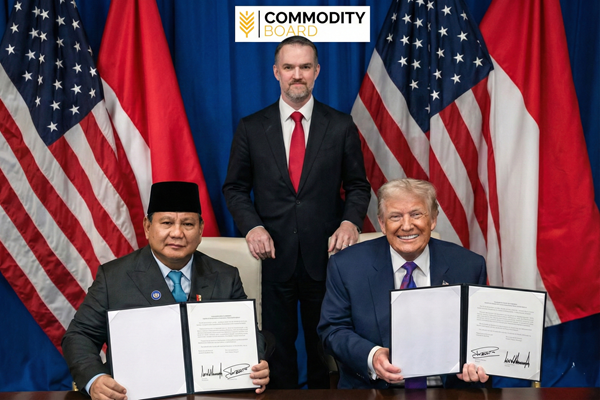
The United States and Indonesia have finalized a Reciprocal Trade Agreement granting tariff-free access for US corn, sorghum, barley, grain co-products, and ethanol into the Indonesian market.
In parallel, US tariffs on Indonesian goods will decline from 32% to 19%, while most US agricultural exports entering Indonesia will face zero duties.
The agreement represents a structural expansion of US feed grain and ethanol access into one of Southeast Asia’s most dynamic consumption markets, strengthening long-term export diversification.
🌽 Grain Access: Competitive Advantage Restored
Under the agreement:
-
US corn, sorghum, barley and co-products receive tariff-free entry.
-
Quantitative restrictions are not imposed.
-
Certain sanitary and phytosanitary (SPS) barriers will be removed.
For US exporters, this significantly improves landed-cost competitiveness in Indonesia — a market historically constrained by regulatory and procedural friction.
The absence of quota limits increases upside potential if feed demand accelerates.
🌏 Indonesia’s Structural Demand Drivers
Indonesia’s long-term demand fundamentals remain strong:
-
Population exceeding 275 million.
-
Expanding middle class.
-
Rapid growth in poultry and aquaculture production.
-
Ongoing livestock modernization.
Feed grain imports are essential to sustaining protein production growth, with corn demand rising steadily.
Indonesia is already a major importer of feed ingredients, and modernization trends suggest sustained structural demand rather than short-term spikes.
🔥 Ethanol: A Strategic Growth Pillar
A critical feature of the agreement is Indonesia’s ethanol blending roadmap:
-
E5 by 2028
-
E10 by 2030
-
Long-term trajectory toward E20
Indonesia previously relied heavily on palm-based B30 biodiesel mandates. The introduction of ethanol blending signals diversification of renewable fuel sources.
For US ethanol exporters, this creates:
-
Medium-term demand visibility
-
Policy-backed structural growth
-
Entry into a fast-growing ASEAN biofuel market
This dimension elevates the agreement beyond conventional grain trade.
📊 SPS Reforms & Market Expansion
Beyond tariff elimination, Indonesia will remove certain unjustified SPS barriers that previously restricted US grain access.
Implications:
-
Reduced regulatory friction
-
Faster cargo clearance
-
Improved contract reliability
With no quantitative caps, corn purchases could exceed initial commitment volumes if domestic feed demand strengthens.
🌍 Strategic Diversification for the US
The deal strengthens US export diversification beyond:
-
Mexico
-
Japan
-
South Korea
Indonesia provides:
-
Geographic diversification
-
Demand diversification (feed + fuel)
-
ASEAN market anchor positioning
Given ongoing global trade realignments, expanding Southeast Asian access reduces overdependence on concentrated buyers.
🧭 CMB Market Interpretation
This agreement is strategically significant for three reasons:
-
Tariff-free access enhances price competitiveness immediately.
-
Biofuel commitments create forward demand stability.
-
Regulatory alignment reduces historical trade friction.
Short-Term Outlook:
Incremental lift in US corn and sorghum shipments.
Medium-Term Outlook:
Ethanol demand growth becomes the structural driver.
Long-Term Impact:
Indonesia emerges as a stable secondary pillar in US grain export strategy.
📊 Risk Assessment
| Factor | Risk Level |
|---|---|
| Implementation Clarity | Moderate |
| SPS Adjustment Delays | Moderate |
| Indonesian Demand Volatility | Low–Moderate |
| Competitive Response (Brazil/Black Sea) | Moderate |
| Ethanol Policy Execution Risk | Moderate |
🏁 Conclusion
The US–Indonesia Reciprocal Trade Agreement establishes a tariff-free channel for key US grains and ethanol in a rapidly expanding Southeast Asian economy.
By combining feed grain liberalization with biofuel blending commitments, the agreement enhances long-term export visibility while positioning Indonesia as a strategic growth market.
For global grain markets, the development signals deeper US engagement in ASEAN trade corridors and reinforces diversification amid broader trade volatility.