
🔵 Executive Summary
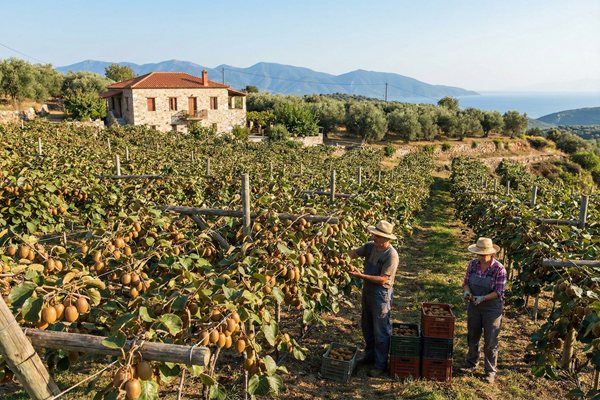
The 2025/26 Greek kiwifruit season is drawing to a close with industry participants reporting a satisfactory performance.
Stocks at A.S. Episkopis — a cooperative focused on the Hayward variety — are down to 10–15%, with remaining fruit largely consisting of larger calibers (20, 23, 25). However, due to size preferences and declining firmness typical for late-season fruit, the remaining volumes are now considered suitable only for the European market.
Exports to the United States increased earlier in the season, but shipments have now concluded, partly due to market specifications and ongoing tariff uncertainty.
📦 Stock Position & Quality Snapshot
Current Situation at A.S. Episkopis:
-
Remaining stocks: 10–15%
-
Sizes available: Mainly 20, 23, 25 (larger fruit)
-
Firmness: Within seasonal norms but not ideal for long-haul shipping
As the season advances, firmness levels become critical for distant export markets such as the United States, where longer transit times require stronger fruit condition.
🌍 Market Dynamics: Stability with Expected Uptick
Over the past 20–30 days:
-
Market conditions have remained stable.
-
Demand has been steady but not particularly strong.
Industry expectations:
-
Demand improvement anticipated from early March.
-
No immediate concerns regarding European oversupply.
The shift of remaining fruit toward intra-European destinations reflects logistical efficiency and quality alignment.
🇺🇸 US Export Performance & Tariff Uncertainty
Greek kiwifruit exports to the United States through February 20 reached:
-
18.79 million kilos in 2026
-
Compared to 16.97 million kilos on the same date in 2025
This reflects a year-on-year increase in early-season shipments.
However, ongoing tariff volatility has complicated forward planning. Rapid policy changes — including executive announcements and Supreme Court rulings — have created uncertainty over the applicable tariff regime.
Despite this, exporters report that:
-
No immediate practical market disruption has materialized.
-
Shipments to the US have already concluded for seasonal and quality reasons.
Remaining fruit does not align with:
-
US size preferences
-
Long-distance firmness requirements
Therefore, European markets will absorb the final volumes of the season.
🧭 CMB Market Interpretation
The late-season shift toward Europe is primarily quality-driven rather than tariff-driven.
Key Observations:
-
Larger calibers are less favored in certain overseas markets.
-
Reduced firmness limits long-haul export feasibility.
-
Intra-EU trade offers logistical and commercial efficiency.
-
US tariff uncertainty adds psychological pressure but has not yet altered trade flows materially.
Short-Term Outlook:
Orderly season closure with European absorption of remaining stocks.
Medium-Term Consideration:
US policy volatility continues to influence exporter sentiment, even when not directly impacting shipments.
🌱 Strategic Shift: Return to Stone Fruit
A.S. Episkopis is preparing a structural pivot:
-
Gradual shift back to peaches, nectarines, and cherries.
-
Five-year transition plan underway.
-
Collaboration with Spanish and French breeding programs for new varieties.
-
Initial plantings already completed.
The move signals portfolio diversification after four years of significant Hayward kiwifruit expansion.
📊 Risk Assessment
| Factor | Risk Level |
|---|---|
| Late-Season Oversupply (EU) | Low |
| US Tariff Volatility Impact | Moderate |
| Quality-Related Export Constraints | Seasonal |
| Demand Softness Risk | Limited |
| Strategic Crop Transition Risk | Gradual |
🏁 Conclusion
The Greek kiwifruit season is closing on stable terms, with limited stocks and orderly market absorption.
While exports to the United States increased earlier in the campaign, remaining fruit is now directed exclusively to the European market due to size and firmness considerations.
Looking ahead, strategic diversification toward stone fruit suggests a recalibration of production priorities in response to evolving market dynamics.