
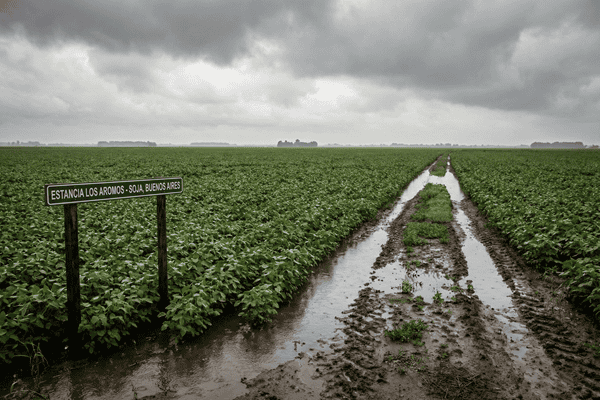
Soybean Production Stabilizes at 48 MMT
Argentina’s MY2025/26 soybean production forecast remains unchanged at 48 million metric tons (MMT) on 16.5 million hectares planted, following significant February rainfall that stabilized crop conditions after January dryness
According to field observations detailed on pages 2–4, timely precipitation across core production regions (Buenos Aires, Córdoba, Santa Fe, and Entre Ríos) reversed much of the earlier moisture stress. Cumulative February rainfall reached 100–150 mm in many areas, improving soil profiles and supporting root development.
However, regional variability persists:
-
Southern Santa Fe and northern Buenos Aires reported localized second-crop losses of up to 30%.
-
First-crop yields are largely determined and expected to be strong.
-
Second-crop soy remains more weather-sensitive entering reproductive stages.
The national average yield is forecast at 3.38 MT per hectare
Crush Remains Robust at 43 MMT
For MY2025/26, soybean crush is forecast at 43 MMT, up 1 MMT from the prior season
The increase reflects:
-
A return to more traditional trade flows
-
Reduced whole bean exports to China
-
Strong domestic processing margins
Exports for MY2025/26 are forecast at 6 MMT, down from the prior year, as more beans are directed toward domestic crushing
For MY2024/25:
-
Crush is lowered to 42 MMT
-
Exports reduced to 12.7 MMT, though still a 15-year record and triple the previous year’s level
The statistical table on page 11 confirms ending stocks for MY2025/26 at 4.35 MMT, up from the prior year’s 3.85 MMT
Sunflower Production Raised to 5.8 MMT
Argentina’s MY2025/26 sunflower production is raised to 5.8 MMT, up 500,000 MT from the previous forecast
Key drivers:
-
Planted area: 2.7 million hectares (up sharply year-over-year)
-
Yield: 2.2 MT/HA, well above the five-year average of 1.4 MT/HA
-
Harvest progress: 30% complete as of late February
As shown in the statistical table (page 11), sunflower crush is forecast at 5.38 MMT, supported by strong oil demand and improved processing margins
MY2025/26 is expected to set new records for:
-
Sunflowerseed production
-
Sunflower oil exports
-
Sunflower meal exports
India remains the dominant buyer of Argentine sunflower oil, accounting for 46% of exports in CY2025 and expected to increase its share
The EU remains the largest market for whole sunflowerseed, with exports surging to 85,330 MT in CY2025.
Peanut Area Contracts Sharply
For MY2025/26, peanut planted area is projected at 400,000 hectares, down from 532,000 hectares the previous season
The reduction reflects:
-
Lower price expectations
-
Market glut following record 2024/25 output
-
Farmer margin pressure
Despite smaller area, yields are expected to improve to 3.6 MT/HA, partially offsetting area losses (see page 12 statistical table)
For MY2024/25:
-
Production increased to 1.86 MMT
-
Exports expected at 1.10 MMT, supported by strong EU and Australian demand
Ending stocks for MY2025/26 are forecast at 985,000 MT, nearly doubling year-over-year due to slower export pace and reduced area
Key Structural Themes
1️⃣ Weather recovery mitigated soybean risk
2️⃣ Domestic crush prioritized over whole bean exports
3️⃣ Sunflower profitability encouraging acreage shifts
4️⃣ Peanut contraction following prior glut
The contrast between soy stabilization and sunflower expansion signals shifting producer economics in Argentina’s oilseed complex.
🔎 CMB Outlook
Argentina’s oilseed complex enters MY2025/26 with improving weather conditions and firm processing margins.
Soybean production at 48 MMT reflects stabilization rather than expansion, with crush remaining the central demand pillar.
Sunflower emerges as the standout crop, with record output and strong global oil demand — particularly from India — reinforcing its profitability.
Peanut area contraction signals farmer caution after last season’s oversupply.
For global vegetable oil markets, Argentina’s sunflower expansion could add incremental supply pressure, while steady soybean crush supports meal availability.
Weather remains the primary variable through harvest completion.