
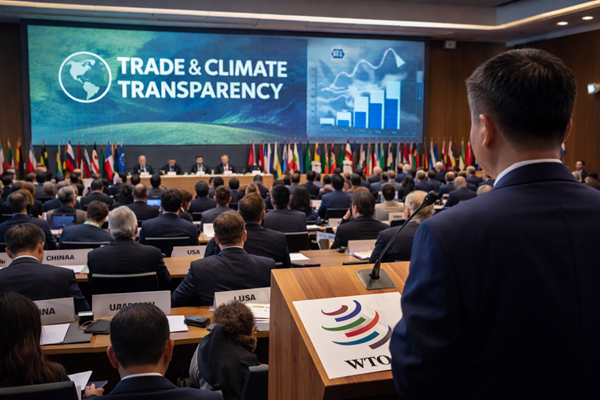
WTO Members Push for Greater Transparency on Trade and Climate Measures
CMB News | Trade Policy & Climate | February 2026
WTO members are cautiously moving toward greater transparency on trade-related climate measures, reflecting growing unease over the proliferation of carbon standards and climate-linked border measures.
At a meeting of the Committee on Trade and Environment (CTE) on 26 February, members agreed on a pilot initiative to begin voluntary information-sharing on trade and climate measures, including methodologies related to embedded carbon emissions in traded goods.
The discussion signals a recognition that climate policy is increasingly shaping trade architecture — and that fragmentation risks are rising.
A Voluntary Transparency Pilot
On a pilot basis, members agreed to start voluntary sharing of information on their climate-related trade measures beginning with the next CTE meeting in June.
Japan’s proposed template (WT/CTE/W/271) was widely viewed as a practical starting point for such transparency efforts. The template aims to provide structured information on measures affecting trade, including those requiring emissions measurement across borders.
Japan stressed that the template would not create new WTO obligations but would instead complement existing notification requirements.
The initiative reflects an emerging consensus that transparency may be the least politically contentious step forward amid widening policy divergence.
Carbon Standards Under Scrutiny
China raised concerns about the proliferation of carbon standards, warning of potential market fragmentation and rising compliance costs. It proposed mapping exercises and further thematic sessions to assess the growing complexity of carbon-related measures.
Several members echoed concerns that overlapping standards risk increasing costs, particularly for developing economies. There were calls for:
-
Greater use of international standards
-
Enhanced engagement of African and developing countries in standard-setting
-
Careful scoping of transparency exercises to avoid duplication with other WTO work
The development dimension featured prominently in discussions. Members emphasized the need to assess the impact of climate-linked trade measures on market access for developing countries and least-developed members.
Climate Policy Moves to the Core of Trade
The broader context is clear: trade and climate policy are no longer parallel discussions — they are converging.
Updates from the UNFCCC Secretariat on COP30 (Belém, 2025) and from member-led initiatives such as:
-
The Dialogue on Plastics Pollution
-
The Trade and Environmental Sustainability Structured Discussions (TESSD)
-
The Fossil Fuels Subsidy Reform initiative
illustrate how climate governance is increasingly intersecting with trade rules.
The WTO Secretariat also presented updates from its Environmental Database, highlighting growing use of trade policy tools in waste, recycling and sustainability measures.
The Bigger Picture: Transparency Before Tension
The agreement to pursue voluntary transparency may appear modest. Yet it reflects deeper structural concerns:
-
Carbon border measures are expanding
-
Embedded emissions accounting is becoming central to trade flows
-
Diverging regulatory regimes risk hardening into trade disputes
For commodity markets — particularly steel, cement, fertilizers, agriculture and energy-intensive goods — carbon accounting frameworks are moving from theoretical debate to operational requirement.
The central question is no longer whether climate measures will shape trade — but how.
Implications for Global Markets
For exporters and commodity traders, three themes emerge:
1️⃣ Compliance Costs Are Rising
Multiple carbon standards increase reporting complexity and audit requirements.
2️⃣ Market Access May Fragment
Different emissions methodologies could create parallel markets.
3️⃣ Development Tensions Are Growing
Emerging economies fear loss of competitiveness under climate-linked trade regimes.
The WTO’s transparency initiative may slow fragmentation. But it does not eliminate the underlying tension between climate ambition and open trade.
Looking Ahead
The next CTE meeting will take place during WTO Trade and Environment Week (1–5 June 2026), where members are expected to advance the pilot transparency initiative.
The debate over carbon standards and trade-related climate measures is likely to intensify ahead of the 14th Ministerial Conference.
For now, members are choosing transparency over confrontation.
Whether that is sufficient to prevent future trade friction remains uncertain.