
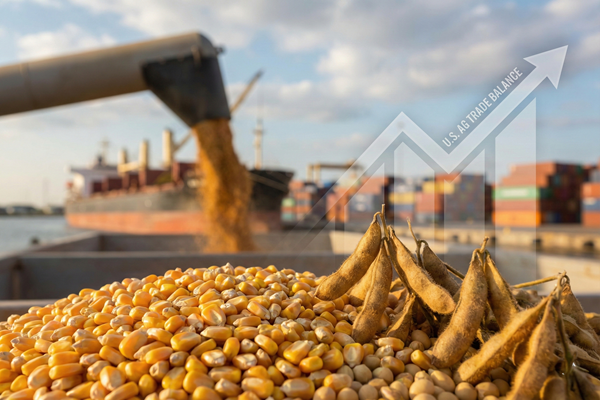
Trade Outlook: Deficit Improves but Remains Large
USDA forecasts U.S. agricultural exports at USD 174.0 billion in FY2026, revised up from the December estimate of USD 173.0 billion Imports are projected at USD 203.0 billion, reduced significantly from the earlier USD 210.0 billion forecast As a result, the agricultural trade deficit is forecast to narrow to USD 29.0 billion, compared to USD 43.7 billion in FY2025
This marks improvement, though the U.S. remains in a structurally negative trade balance for agricultural products.
Export Composition: Corn Gains, Soybeans Decline
According to the export value table (page 3):
🌽 Corn
-
FY2026 exports forecast at USD 18.5 billion, up from USD 16.9 billion in FY2025
-
Export volume projected at 82.0 million metric tons, a significant increase year-over-year
Corn is the primary driver of the export revision.
🌱 Soybeans
-
FY2026 exports forecast at USD 18.3 billion, down from USD 22.2 billion in FY2025
-
Export volume projected at 42.9 MMT, down sharply from 50.9 MMT
Lower soybean volumes reflect weaker shipments to China and stronger South American competition.
🐄 Livestock, Poultry & Dairy
-
Total sector exports forecast at USD 39.1 billion
-
Dairy exports revised upward to USD 9.8 billion
-
Pork exports stable at USD 7.3 billion
Animal protein remains resilient, helping offset oilseed softness.
🌳 Horticultural Products
-
Forecast at USD 42.1 billion, unchanged from December
Tree nuts and fresh produce remain steady export contributors.
Regional Export Outlook: Asia Slows, Western Hemisphere Leads
The regional export breakdown (page 4) shows:
-
Asia: USD 60.7 billion
-
Western Hemisphere: USD 81.9 billion
-
Europe/Eurasia: USD 17.0 billion
China’s FY2026 imports from the U.S. are forecast at USD 12.0 billion, sharply below prior peaks
Mexico remains the top single-country market at USD 31.5 billion, followed by Canada at USD 27.9 billion.
The Western Hemisphere now accounts for the dominant share of U.S. agricultural export value.
Imports: Horticulture and Tropical Products Dominate
Total agricultural imports are forecast at USD 203.0 billion
Major components (page 5):
🍎 Horticultural Products
-
USD 90.8 billion
-
Fresh fruit imports alone projected at USD 19.1 billion
☕ Sugar & Tropical Products
-
USD 35.9 billion
-
Coffee imports at USD 12.9 billion
-
Cocoa and products at USD 10.8 billion
🥩 Livestock & Meats
-
USD 26.2 billion for livestock and meats
-
Beef imports forecast at USD 14.6 billion
The U.S. trade deficit remains concentrated in high-value consumer-oriented products.
Macroeconomic Backdrop
According to the macroeconomic table (page 2):
-
China GDP growth forecast at 4.5% in 2026
-
India at 6.4%
-
Mexico at 1.5%
-
Eurozone at 1.3%
Exchange rate movements and slower global growth continue to shape export competitiveness.
Emerging markets remain critical, accounting for over 20% of U.S. agricultural exports.
Major Bulk Products
Major bulk exports (wheat, rice, coarse grains, soybeans, cotton) are forecast at USD 50.6 billion in FY2026
While bulk exports remain central, value growth is increasingly coming from higher-value consumer and processed products.
🔎 CMB Outlook
The February 2026 USDA trade outlook signals stabilization rather than expansion.
Key themes:
1️⃣ Corn drives export growth
2️⃣ Soybeans face structural competition
3️⃣ Horticultural imports widen deficit exposure
4️⃣ Western Hemisphere trade relationships strengthen
While the trade deficit narrows to USD 29 billion, the structural shift toward high-value consumer imports continues to weigh on the overall balance.
Export recovery depends heavily on:
-
Chinese demand stabilization
-
Exchange rate movements
-
Global economic growth
-
U.S. competitiveness in bulk commodities
The next update, scheduled for May 28, 2026, will provide clearer signals ahead of the 2026 harvest season.