
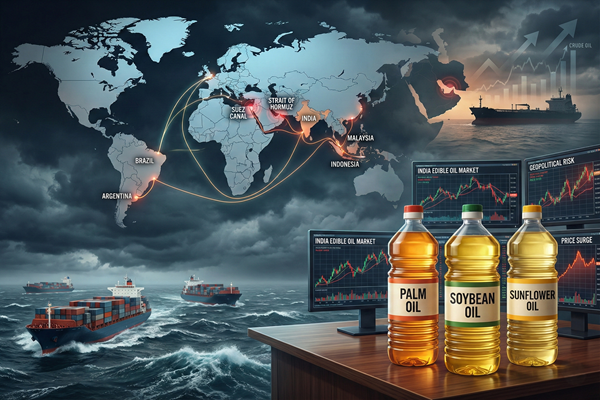
India’s edible oil and oilmeal sector has adopted a cautious stance following escalating tensions around Iran after recent US and Israeli strikes.
Market participants are closely tracking developments, as any prolonged disruption in key maritime routes could impact both edible oil imports and oilmeal exports.
Edible Oil Imports Largely Stable
According to industry sources, palm oil and soybean oil imports are currently not facing significant disruptions.
-
Palm oil is sourced primarily from Indonesia, Malaysia, and Thailand.
-
Soybean oil is imported mainly from Argentina and Brazil, typically routed via the Cape of Good Hope, limiting exposure to Middle Eastern transit risks.
However, sunflower oil shipments may be vulnerable if navigation through the Suez Canal or Strait of Hormuz is disrupted. Any diversion to longer routes could extend voyage times by approximately two weeks and raise freight costs.
Freight and Crude Oil Impact
Rising crude oil prices are another key concern. Higher energy costs generally translate into increased freight rates, which could elevate landed costs for edible oils in India.
If tensions persist, domestic edible oil prices may face upward pressure due to higher import costs.
Oilmeal Exports Face Partial Risk
On the export side, a substantial portion of Indian oilmeal shipments is directed toward Far Eastern markets, where no immediate disruption is anticipated.
However, approximately 20–30% of exports are destined for West Asia and Europe, regions that could face temporary logistical challenges.
During April–January of the 2025/26 marketing year, India exported 32.35 million tonnes of oilmeals, compared to 43.42 million tonnes in the same period last year. Of this, 4.43 million tonnes were shipped to West Asian markets.
Market Outlook
For now, the sector remains in a wait-and-watch mode. Continued geopolitical tension, crude oil volatility, and freight rate movements will be key factors influencing both import costs and export flows in the coming weeks.