
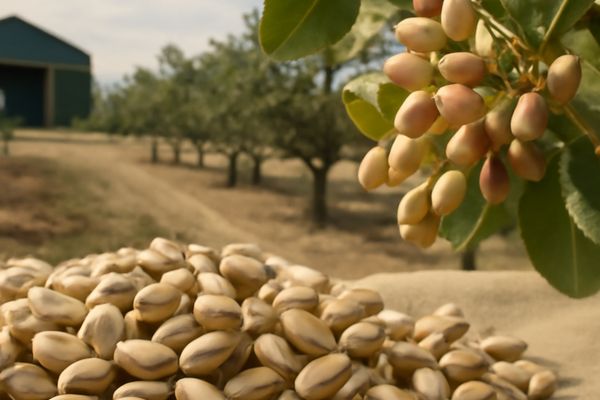


The global nuts market anchored by pistachios stands at a critical juncture, as shifting crop cycles and escalating geopolitical tensions converge to tighten supplies and drive firm prices. The expansive influence of the United States, Iran, and Turkey on global pistachio trade means that production transitions and regional disruptions resonate across international markets. This year, the U.S. and Iran enjoyed large on-year pistachio crops, while Turkey saw a limited off-year harvest.
However, this delicate balance will shift in 2026 as the U.S. and Iran cycle into off-year production, just as Turkey’s orchards ramp up yields. Iranian pistachios are beset by export obstacles—from government crackdowns to communication restrictions and now heightened regional instability—raising concerns about whether future supplies can reach global buyers without further setbacks. Meanwhile, drought has already shrunk Iran’s 2025 harvest, and the net effect is that buyers worldwide are jostling for access in a market marked by logistical challenges and few alternatives. These interlinked dynamics are expected to sustain firm pricing, potentially squeezing buyers as new supply constraints develop.


📈 Prices
| Product | Origin | Location | Closing Price (EUR/kg) | Weekly Change | Market Sentiment |
|---|---|---|---|---|---|
| Brazil nuts (supplementary) | NL | Dordrecht, NL | 6.50 | 0.00 | Stable |
Note: No direct pistachio spot prices provided; market commentary indicates firm to rising trend due to tightness.
🌍 Supply & Demand
- Pistachio global supply: 1.1–1.2 million metric tonnes (2025, in-shell).
- Major producers (2025): USA (~712,000 t), Iran (~225,000 t), Turkey (~135,000 t).
- 2026 Forecast: Crop cycle shifts: US and Iran (off-year), Turkey (on-year).
- Iranian exports: Facing restrictions from internal unrest, government crackdowns, and disrupted communications since Jan 2026; export slowdowns began even before recent military escalation.
- Drought in Iran (2025): Led to a notably smaller crop; early 2026 outlook remains uncertain due to ongoing conflict and weather.
- Logistics: Sanctions, shipping disruptions in Red Sea/Suez could affect supplies via UAE and Turkey to Asia, the Mediterranean, and India.
- Alternative supply risks: US entering off-year, sellers cautious; Turkey only recovering from a poor harvest; logistics remain problematic.
📊 Fundamentals
- USDA, Crop reports: Indicate biennial cycle creating annual volatility.
- Inventories: Major exporters running tight stocks with uncertainty about replenishment.
- Speculative Positioning: Buyers are forward-locking supply, anticipating tight markets and further disruptions.
- Substitution options: Other nut prices (like Brazilian nuts at EUR 6.50/kg) remain stable; limited impact on pistachios, as substitution is not straightforward due to unique uses and flavor.
⛅ Weather & Regional Outlook
- Iran: Ongoing drought conditions reduced the 2025 crop; little evidence of direct conflict affecting northern pistachio areas so far, but risks are increasing.
- United States: Generally favorable weather, but entering natural off-year bearing for pistachio trees—production expected to be lower in 2026.
- Turkey: Set for on-year cycle in 2026; potential for larger crop, but logistics and re-export volumes rely on regional stability.
- Trade impacts: Shipping congestion and insurance costs high due to Red Sea instability, with rerouting delays affecting global supply chains.
🌏 Global Production & Stocks Comparison
| Country | 2025 Output (tonnes, in-shell) | 2026 Cycle |
|---|---|---|
| USA | ~712,000 | Off-year expected |
| Iran | ~225,000 | Off-year expected; smaller 2025 crop, drought-impacted |
| Turkey | ~135,000 | On-year expected |
📆 Outlook & Recommendations
- Pistachio prices likely to remain steady to firm with tightening global supply.
- Buyers advised to secure forward contracts, as off-year cycles and export disruptions persist into 2026.
- Monitor weather trends and regional security, especially in Iran and transit hubs (UAE, Turkey).
- Alternative origin supplies limited—mitigate risk through diversified sourcing and strategic inventory building.
- Track evolving shipping rates and insurance, especially for Asia and Mediterranean-bound shipments.
🔮 3-Day Regional Price Forecast
- Europe (CBOT/Euronext – equivalent): Firm to slightly higher, supported by tight supply and cautious sellers (+1.0–1.5%).
- Asia (via UAE/Turkey): Risk of further disruption premiums; prices steady to stronger (+1.5–2.0%).
- US spot: Stable; upward risk as off-year crop cycle looms, sellers reluctant for large new deals.
Related posts:
 Argentina’s Pistachio Push: How a New Player is Shaking Up the Global Nuts Market
 Spain’s Pistachio Boom: Record Harvest, Regional Surge, and New Value-Added Plays
 Spain’s Pistachio Boom: Surging Production, New Market Opportunities, and Rural Revitalization
 Spain’s Pistachio Boom: Surging Harvests, New Markets & Rural Revitalization
 Bulgaria Tree Nut Market Expands as U.S. Maintains Leadership and Global Pistachio Output Rebounds
 Pistachio Market Faces Shifting Fortunes Amid 8% Global Output Drop for 2025/26
 Pistachio Power: Exports Keep US Nut Market Firm as Inventories Tighten
 Global Pistachio Production Falls 8% as U.S. Output Surges to Record 713,000 MT