
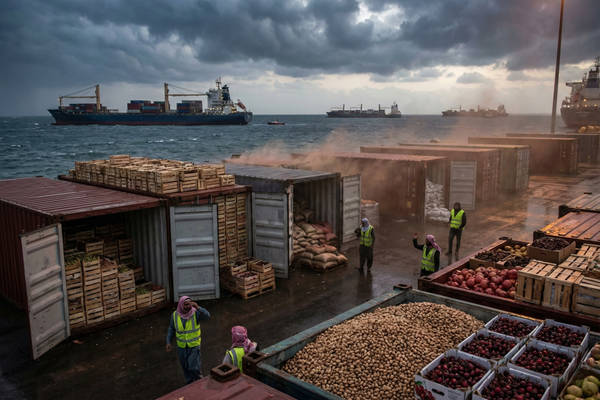


Iran has suspended all exports of food and agricultural products nationwide as geopolitical tensions in the Middle East intensify, according to the Iranian Export Confederation.
The export ban, which took effect March 3, has been communicated to all customs authorities across the country, effectively halting shipments of agricultural commodities until further notice. Authorities have not provided a timeline for lifting the restrictions.
Earlier export controls had already targeted specific agricultural commodities, but the latest directive expands the measure to cover all food and agricultural exports.
According to a government statement cited by the Tasnim news agency, shipments will remain blocked indefinitely as the government prioritizes domestic supply.
“The government has prioritised the supply of essential goods for the people,” the statement said.
Several international media organizations describe Tasnim as a semi-official news agency with links to Iran’s Islamic Revolutionary Guard Corps (IRGC).
Escalating Geopolitical Tensions
The export suspension comes as tensions rise following a breakdown in nuclear negotiations between Iran and the United States.
The second round of talks held on February 17 ended without progress. A third round of negotiations took place in Geneva on February 26 under the administration of U.S. President Donald Trump, widely seen as the final opportunity to reach a diplomatic agreement.
However, negotiations collapsed after Tehran refused to halt uranium enrichment, dismantle nuclear facilities, or accept long-term restrictions on its nuclear program.
Shortly afterward, Israel launched airstrikes, which Israeli Defense Minister Yoav Katz described as preemptive operations targeting Iranian nuclear infrastructure.
Impact on Global Agricultural Markets
Iran plays a significant role in several global agricultural supply chains.
According to the U.S. Department of Agriculture (USDA):
-
Iran accounts for approximately 18% of global pistachio production
-
The country produces around 6% of the world’s cherries
The export suspension could therefore disrupt supply chains for several high-value horticultural products, particularly in Asian and European markets that rely on Iranian pistachios.
Regional Trade Restrictions Expanding
Trade disruptions are beginning to spread across the region.
As tensions escalate, Kuwait has also announced a temporary ban on food exports.
According to the Kuwait News Agency, Minister of Commerce and Industry Osama Boodai said the decision aims to protect domestic consumers.
“The measure is intended to protect consumers and enhance market stability,” he said.
Growing Pressure on Regional Food Supply Chains
Analysts warn that if the conflict continues, additional countries could introduce similar export restrictions to safeguard domestic food supplies.
Such measures could further tighten agricultural markets across the Middle East and create price volatility in global food trade, particularly for specialty crops where supply is already concentrated among a small number of producing countries.
Related posts:
 Walnut Market Disruption: California Exports to Middle East Halt, Global Trade Shifts
 China Urges Iran to Keep Strait of Hormuz Open Amid Escalating Middle East Conflict
 MSC Halts Gulf Deliveries, Diverts Cargo to Safe Ports Amid Middle East Conflict
 China Urges Iran to Keep Strait of Hormuz Open Amid Escalating Middle East Conflict
 Middle East War Triggers Market Sell-Off as Iran Targets Gulf Energy Infrastructure
 Middle East War Sends Tanker Freight Rates Soaring, More Than Doubling on Key Routes
 Iran Threatens to Target Ships in Strait of Hormuz, Escalating Global Energy Fears
 Strait of Hormuz Crisis Sends Oil Prices Surging 8% as Middle East Escalation Threatens Global Supply