
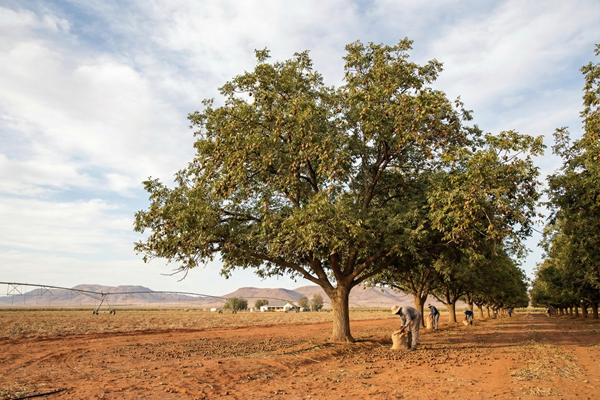


South Africa’s pecan industry expects exports to the European Union to resume in 2026, as global demand for pecans continues to rise and regulatory discussions with Brussels move forward.
Industry representatives say growing international interest in pecans was clearly visible during Gulfood 2026, where buyers from multiple regions showed increasing demand for the product.
China Dominates South African Pecan Exports
Currently, China remains the dominant destination for South African pecans, accounting for 94.7% of total exports in 2025, with most shipments exported in-shell.
According to RP Campher, agricultural economist at the South African Pecan Nut Producers Association (SAPPA), Chinese demand has grown rapidly due to expanding food applications.
“China’s overall pecan requirement has drastically increased as they have developed new products containing pecans,” Campher said.
He added that Chinese companies are also exploring opportunities to re-export pecan-based products to markets in the Middle East and Europe.
Demand in China typically peaks ahead of the Chinese New Year, when consumption of nuts rises significantly.
South Africa Seeks Market Diversification
Because of the heavy reliance on China, the South African pecan industry is increasingly focused on diversifying export markets.
Currently, only small volumes are shipped to:
-
Europe
-
The domestic South African market
Industry officials believe these markets could absorb larger shares of future production, alongside emerging markets in Asia and the Middle East.
Production Growth Expected Through 2030
South African pecan production has expanded rapidly over the past decade.
According to SAPPA:
-
Production has quadrupled over the past 10 years
-
The 2026 harvest is expected to reach 52,000–55,000 tonnes
-
Many orchards still contain young trees that have not yet reached full production
SAPPA General Manager Cobus van Rensburg said volumes will continue to increase in the coming years.
“As our volumes increase, we are actively looking at developing new markets for pecans from South Africa,” he said.
South Africa already accounted for about 16% of global pecan production in 2025.
The harvest season typically begins in May, when trees shed their leaves, with the first export shipments leaving in June.
Declining Supply in the United States and Mexico
At the same time, production challenges in the United States and Mexico are creating new opportunities for South African exporters.
According to industry representatives, the U.S. pecan crop has been shrinking due to factors such as:
-
Drought conditions
-
Hurricanes affecting orchards in Georgia
As global consumption rises, the tightening supply from traditional producers could strengthen South Africa’s position in the international market.
EU Nickel Residue Rules Halted Exports
Exports of South African pecans to the European Union have been suspended following the introduction of new EU regulations limiting nickel residue levels in pecan nuts.
The EU set a maximum residue level of 3.5 parts per million (ppm), a threshold that South African producers say is too restrictive.
Nickel is considered a natural micronutrient essential for plant physiology, and many South African soils contain naturally elevated levels of the element.
According to Van Rensburg, tests conducted on both sprayed and unsprayed nuts from orchards across the country still exceeded the EU limit.
“Even nuts from orchards that were never sprayed tested above the 3.5 ppm threshold because our soils naturally contain higher nickel levels,” he explained.
Global Industry Push for Higher Limits
Pecan industries in Argentina and the United States support South Africa’s position and have jointly submitted a proposal to the European Commission to increase the allowable residue level to 10 ppm.
This level already applies to several other nuts traded in the EU, including:
-
Chestnuts
-
Pine nuts
-
Walnuts
-
Brazil nuts
-
Cashew nuts
The proposal was scheduled for a vote at the European Commission earlier this year.
Industry leaders remain optimistic that regulatory adjustments will allow exports to resume soon.
“We anticipate being in a position to send our nuts to Europe in 2026,” Van Rensburg said.
Outlook
With global demand rising, production expanding, and supply tightening in competing regions, South Africa’s pecan sector is positioning itself for broader international growth.
If EU regulatory barriers are eased, Europe could once again become a key export destination, helping the industry diversify beyond its current heavy dependence on China.
Related posts:
 South Africa Macadamias: Tariff Tensions, Rand Strength; China’s Zero-Duty Breakthrough
 Iran Conflict Could Trigger Prolonged Commodity Rally — Here’s What Traders Must Know
 Azerbaijan’s Hazelnut Comeback Boosts 2025 Nut Markets Amid European Price Stability
 South African Agriculture Sees Relief in Possible 15% U.S. Tariff Adjustment
 South African Macadamias Face Tough Choices: Domestic Processing vs Export Shift
 Macadamia at a Crossroads: Can South Africa Keep Processing Local?
 Cashew Market 2026: Africa’s Crop Surge, Vietnam’s Export Record, and Margin Challenges
 Almonds in South Kashmir: Structural Decline, Climate Pressures & Global Competition