


CMB News | Energy Markets | March 2026
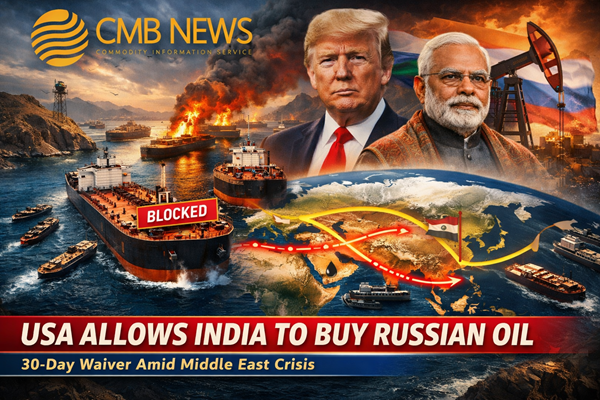
The United States has granted Indian refineries a temporary 30-day exemption to purchase Russian crude oil, aiming to stabilize global energy markets as geopolitical tensions escalate in the Middle East.
The decision was announced by U.S. Treasury Secretary Scott Bessent, who stated that the waiver is designed to ensure that already-loaded Russian oil shipments can still reach global markets. According to Washington, the measure is strictly limited and should not provide Russia with any significant additional revenue.
Background: Energy Markets Under Pressure
The move comes at a moment of extreme stress in global oil logistics.
The ongoing conflict in the Middle East has disrupted shipping routes, particularly around the Strait of Hormuz, through which roughly 20% of global oil trade normally passes. Tanker movements through the strategic waterway have slowed dramatically, creating fears of supply shortages and price spikes.
At the same time:
-
India remains one of the largest buyers of Russian crude since the start of the Ukraine war.
-
In 2024, more than one-third of India’s oil imports came from Russia.
-
The U.S. previously imposed tariffs on India to pressure New Delhi into reducing Russian energy purchases.
Those tariffs were recently lifted after India signaled it would gradually reduce dependence on Russian oil.
A Short-Term Waiver
Washington describes the exemption as a technical “bridging measure”. It allows Indian refiners to accept cargoes that were already loaded onto tankers but had not yet been delivered.
According to U.S. officials:
-
The exemption lasts 30 days.
-
It applies only to existing shipments.
-
It aims to prevent disruptions to global supply rather than support Russia.
Implications for the Oil Market
The decision highlights how geopolitical crises are reshaping global energy flows.
In the short term, the waiver could:
1. Stabilize Global Supply
Allowing these cargoes to reach India prevents an abrupt removal of several million barrels from the market.
2. Reduce Immediate Price Pressure
With shipping through Hormuz disrupted, every available cargo becomes critical for maintaining supply balance.
3. Support Asian Refining Margins
Indian refiners depend heavily on discounted Russian crude, which allows them to maintain competitive export prices for refined fuels.
However, the measure does not change the structural trend toward tighter sanctions and supply fragmentation.
Market Outlook
The oil market now faces three competing forces:
| Driver | Market Impact |
|---|---|
| Middle East conflict | Strongly bullish for oil prices |
| Temporary sanction relief | Short-term stabilizing effect |
| Shipping disruption at Hormuz | Potential supply shock |
If tanker traffic in the Strait of Hormuz remains restricted, analysts warn that oil prices could rise sharply in the coming weeks, regardless of the temporary waiver.
CMB Market Commentary
For commodity traders and industrial buyers, the situation highlights the growing fragility of global energy logistics. Even small regulatory changes — such as a 30-day waiver — can have outsized market effects when physical supply chains are already under pressure.
The coming weeks will largely depend on:
-
The security situation in the Persian Gulf
-
Whether tanker traffic through Hormuz normalizes
-
And whether further sanction exemptions are issued
Any prolonged disruption could trigger a new upward cycle in crude oil prices, with ripple effects across freight, fertilizer production, and food commodity markets.
Related posts:
 Russian Oil Cargoes Redirected to India as Middle East War Disrupts Supply
 Palm Oil Prices Hit Four-Week Highs Amid Global Oil Rally and Volatility Risks
 Oil Markets Rebound Amid Volatility: What’s Driving WTI and Brent Higher?
 Strait of Hormuz Crisis: Oil Surges as Iran Escalation Threatens Global Energy Supply
 Indian Edible Oil and Meal Market Turns Cautious Amid Iran Escalation
 Strait of Hormuz Crisis Sends Oil Prices Surging 8% as Middle East Escalation Threatens Global Supply
 Kazakhstan’s Rapeseed Oil Exports in Crisis: China Dispute Shakes Supply Chains
 Crude Oil Prices Hold Firm Amid Shallow Backwardation: WTI-Brent Spread Narrows