


CMB News | Food Supply Chain | March 2026
Germany’s bakery sector is facing increasing structural pressure, with market participants reporting declining sales volumes within the cooperative purchasing network of the BÄKO. According to industry sources, several suppliers estimate volume declines of around 10–15% in parts of the market.
In addition to declining volumes, suppliers also report significant changes in purchasing behavior. While bakeries historically ordered ingredients by the pallet, many are now placing orders only sack-wise, reflecting reduced production volumes and tighter inventory management.
At the same time, competition between regional BÄKO organizations appears to be intensifying. Market participants report that the traditional informal rule—whereby each BÄKO primarily served its own geographic territory—has begun to erode. In response to falling volumes, some distributors are increasingly attempting to win customers in neighboring regions, something that was historically avoided within the cooperative structure.
A Long-Term Structural Decline
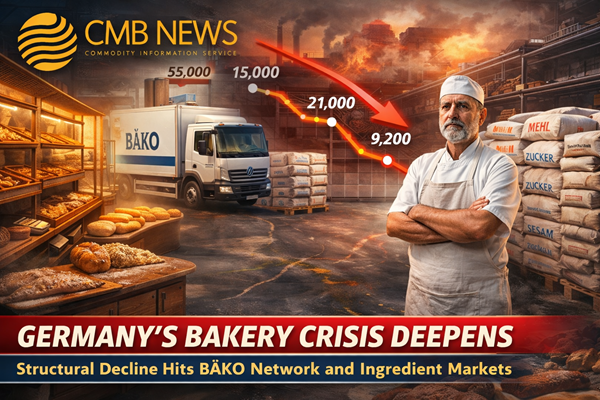
The reported market slowdown reflects a much broader structural trend in Germany’s bakery industry. Data from the Zentralverband des Deutschen Bäckerhandwerks shows that the number of bakeries has been declining for decades.
| Year | Number of Bakeries |
|---|---|
| 1950 | approx. 55,000 |
| 1990 | approx. 21,000 |
| 2000 | approx. 17,000 |
| 2010 | approx. 13,000 |
| 2020 | approx. 10,000 |
| 2024 | approx. 9,200 |
In other words, more than 80% of Germany’s bakeries have disappeared since 1950, and even within the past decade roughly one-third of businesses have vanished.
This development is commonly referred to as the “Bäckersterben”—the ongoing consolidation of Germany’s traditional bakery sector.
Market Consolidation: Fewer Businesses, Larger Chains
Despite the sharp decline in the number of bakeries, total industry turnover has remained relatively stable due to the growth of large bakery chains and industrial producers.
| Year | Sector Turnover |
|---|---|
| 2010 | approx. €12.5 billion |
| 2019 | approx. €14.9 billion |
| 2023 | approx. €17.5 billion |
The average bakery today operates significantly more outlets than in the past.
| Year | Average Branches per Bakery |
|---|---|
| 2000 | 2.3 |
| 2023 | 5.6 |
This reflects the shift from independent craft bakeries toward centralized bakery chains and industrial production facilities.
Changing Consumer Habits
Another factor contributing to the structural transformation is declining bread consumption.
| Year | Bread Consumption per Person |
|---|---|
| 1990 | approx. 80 kg |
| 2010 | approx. 60 kg |
| 2023 | approx. 52 kg |
Supermarkets and discounters have also gained significant market share through in-store baking stations.
Today’s estimated distribution of bread sales in Germany is roughly:
| Distribution Channel | Market Share |
|---|---|
| Bakeries | approx. 55% |
| Supermarkets / discounters | approx. 35% |
| Industrial / other channels | approx. 10% |
Implications for Ingredient Markets
The German bakery sector remains one of Europe’s largest consumers of baking ingredients. Each year the sector processes roughly:
| Ingredient | Annual Volume |
|---|---|
| Flour | 3.2 – 3.5 million tonnes |
| Sugar | 450,000 – 500,000 tonnes |
| Vegetable fats & margarine | around 300,000 tonnes |
| Seeds & kernels | around 200,000 tonnes |
If the market is indeed experiencing 10–15% volume declines, as reported by market participants, the potential reduction in ingredient demand could be significant.
Estimated impacts could include:
-
Flour: 300,000 – 500,000 tonnes
-
Sugar: 50,000 – 70,000 tonnes
-
Seeds & kernels: 20,000 – 30,000 tonnes
For suppliers of flour, sugar, oils, and specialty baking ingredients, this represents a notable structural shift in demand.
CMB Market Commentary
The developments within the German bakery sector highlight a broader transformation in Europe’s food supply chains.
While total consumption of baked goods remains substantial, purchasing power is increasingly concentrated in large bakery chains and industrial producers. These players typically operate with standardized recipes, centralized procurement structures, and significantly stronger negotiating power toward ingredient suppliers.
For commodity markets—from wheat and sugar to seeds and vegetable oils—the key question is therefore no longer simply how much is consumed, but increasingly who controls the demand.
As Germany’s bakery sector continues to consolidate, suppliers across the agricultural and food ingredient markets may need to adjust to a smaller number of larger buyers with significantly greater pricing power.
Related posts:
 Middle East Shipping Crisis Disrupts Food Ingredient Trade – European Suppliers Facing Delivery Problems
 Putin Threatens Early Halt of Gas Supplies to EU as Energy Markets Already Strained
 Shipping Line or Shipping Mafia? How Crisis Surcharges Are Multiplying Freight Costs in 2026
 Strait of Hormuz Crisis: Oil Surges as Iran Escalation Threatens Global Energy Supply
 Strait of Hormuz Crisis Sends Oil Prices Surging 8% as Middle East Escalation Threatens Global Supply
 Argentina Maintains 48 MMT Soybean Forecast as Rains Stabilize Crop; Sunflower Hits 5.8 MMT Record
 US Supreme Court Rules Trump’s Emergency Tariffs Unlawful, Reshaping Trade Authority