
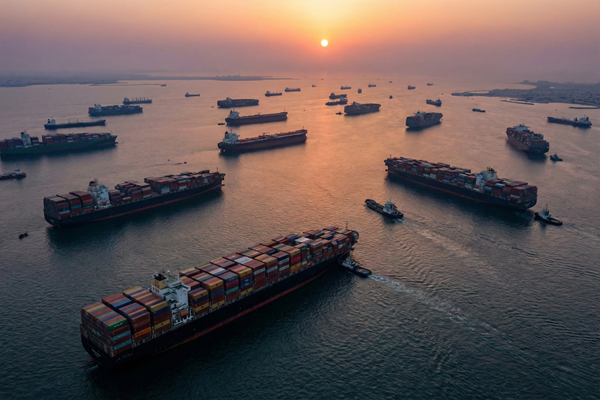


Escalating tensions in West Asia have severely disrupted Indian export logistics, leaving around 40,000–45,000 containers stranded and pushing shipping costs up to five times normal levels, according to industry estimates.
The disruption has placed $1–1.5 billion worth of export cargo at risk, with shipments stuck either in transit or at international ports, as shipping lines reroute vessels or consider returning cargo to India.
Industry sources say the crisis could trigger a broader container supply crunch, particularly affecting exporters of perishable goods and agricultural commodities.
Basmati Rice Among the Most Affected Commodities
A significant share of the stranded cargo consists of basmati rice shipments, with roughly 400,000 tonnes (4 lakh tonnes) currently caught in the disruption.
Exporters say the delays are creating logistical uncertainty and financial pressure, especially for goods that had already entered export channels.
Shipping Costs Surge
Freight rates and related surcharges have risen sharply since tensions escalated near the Strait of Hormuz, a critical global shipping corridor.
Industry data shows:
-
$800–$1,500 – average container freight cost on a normal route
-
$3,000–$5,000 – additional surcharges imposed due to the crisis
These surcharges include war-risk fees, emergency cost recovery charges, contingency charges, and peak-season surcharges, all of which are being passed on to exporters.
Containers Diverted or Returned
Exporters are currently facing two main scenarios:
-
Diversion to alternative ports, particularly in the Gulf region
-
U-turn shipments back to India
Under customs procedures such as Back-to-Town (BTT), exporters may retrieve goods from ports and redirect them to domestic markets if shipments cannot proceed.
However, such measures can still lead to significant financial losses, especially for agricultural exporters.
Gulf Ports Becoming Temporary Cargo Hubs
Industry sources say some shipments may be temporarily discharged at ports such as Khor Fakkan or Fujairah in the UAE.
From there, containers could move through bonded road transit to Jebel Ali port for final processing.
However, logistics companies warn that not all stranded containers necessarily belong to Indian exporters. Many belong to Non-Vessel Operating Common Carriers (NVOCCs) operating in the Persian Gulf region.
Shipping Industry Introduces Emergency Surcharges
Major shipping companies have already introduced crisis-related fees.
For example, French shipping giant CMA CGM imposed emergency surcharges of $2,000–$4,000 per container shortly after tensions escalated.
Industry experts say these charges are linked to higher insurance costs, security risks, and route disruptions.
In addition, war-risk insurance coverage has reportedly become harder to obtain, further complicating maritime logistics.
Freight Rates Rising for Indian Exporters
The disruption is already affecting Indian exporters across multiple sectors.
According to industry representatives, freight costs for apparel shipments have risen from about ₹200 per kilogram to around ₹280 per kilogram, reflecting a 40% increase.
Meanwhile, India’s shipping ministry is closely monitoring cargo build-up at domestic ports, where around 20,000 containers are currently awaiting evacuation.
Supply Chain Uncertainty
Shipping experts warn that if the Middle East conflict continues, the disruption could deepen, potentially leading to longer transit times, higher logistics costs, and further strain on global supply chains.
For exporters, particularly those dealing with agricultural commodities and perishables, the situation presents both operational challenges and financial risks.
Related posts:
 Insurance Costs for Ships in Strait of Hormuz Surge 12-Fold Amid Escalating Conflict
 India Turns to US LPG as Strait of Hormuz Blockade Disrupts Middle East Supplies
 Iran Suspends All Agricultural Exports Amid Escalating Middle East Conflict
 China Urges Iran to Keep Strait of Hormuz Open Amid Escalating Middle East Conflict
 MSC Halts Gulf Deliveries, Diverts Cargo to Safe Ports Amid Middle East Conflict
 China Urges Iran to Keep Strait of Hormuz Open Amid Escalating Middle East Conflict
 US–Iran War Leaves 70,000 Tonnes of Indian Basmati Stranded at Sea
 US-Iran Conflict: Around 150 Onion Containers Bound for Gulf Stranded at JNPT