
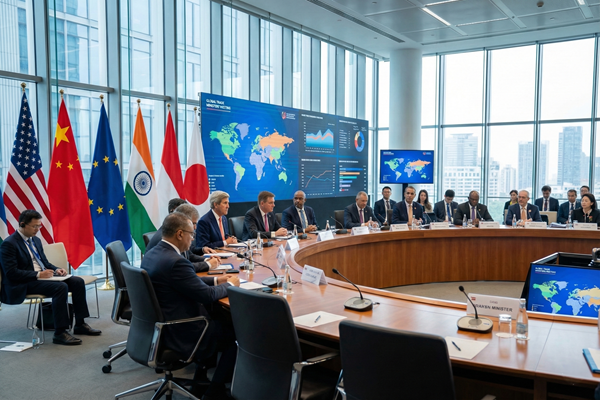


Trade ministers from 166 member countries are expected to debate WTO reforms, agriculture, dispute settlement, and the e-commerce moratorium during the 14th Ministerial Conference (MC14) of the World Trade Organization, scheduled to take place from March 26–29, 2026 in Yaoundé, Cameroon.
The ministerial conference is the highest decision-making body of the Geneva-based WTO and is held every two years.
India’s delegation will be led by Commerce and Industry Minister Piyush Goyal, according to officials.
The meeting comes at a critical time for global trade, which has recently been disrupted by sweeping tariffs imposed by the United States and by geopolitical tensions in West Asia following U.S. and Israeli attacks on Iran, affecting shipping routes and global energy supplies.
Key Issues on the Agenda
Several major policy areas are expected to dominate discussions at MC14, including:
-
WTO institutional reforms
-
Agriculture negotiations
-
Dispute settlement reforms
-
Fisheries subsidies
-
E-commerce work programme and duty moratorium
-
Investment Facilitation for Development (IFD) agreement
-
Special and differential treatment (S&DT) provisions
-
Development concerns of developing countries
Agriculture: India Seeks Permanent Public Stockholding Solution
India is expected to push strongly for a permanent solution on public stockholding (PSH) for food security programmes, an issue that has remained unresolved for more than a decade.
New Delhi has repeatedly demanded progress on:
-
Public Stockholding (PSH) rules
-
Special Safeguard Mechanism (SSM)
The SSM would allow developing countries to temporarily raise tariffs to protect farmers from import surges or sharp price declines.
However, divisions remain among WTO members.
-
The Cairns Group, including Australia and Brazil, argues that PSH programmes distort global markets and has called for fewer export restrictions.
-
The United States is seeking broader market access for its agricultural exports.
-
The European Union is advocating reductions in agricultural subsidies.
Dispute Settlement System Reforms
Reforming the WTO dispute settlement mechanism will be another key topic.
The system has been partially dysfunctional since December 2019, when the Appellate Body (AB) stopped functioning after the United States blocked appointments of new judges.
The Appellate Body acts as the final authority in the WTO’s two-tier dispute settlement system, which is often described as the organization’s “crown jewel.”
Currently:
-
More than 20 appeals are pending at the Appellate Body.
-
Countries must rely mainly on bilateral consultations or panel rulings to settle disputes.
The United States is pushing for major reforms and reportedly prefers alternatives to the current two-tier system, while many developing countries insist that restoring the Appellate Body is essential.
Debate Over E-commerce Tariff Moratorium
India is also expected to raise concerns about the moratorium on customs duties on electronic transmissions, which has been in place since 1998.
Under this rule, WTO members cannot impose tariffs on digital goods such as software, music, films, video games, and digital publications.
India has argued that the moratorium causes significant revenue losses for developing countries.
Estimates suggest:
-
Developing countries lose around $10 billion annually in potential tariff revenue.
-
India alone could be losing over $500 million per year.
New Delhi has therefore opposed extending the moratorium without reconsidering its scope.
Investment Facilitation Proposal Divides Members
Another contentious topic is the Investment Facilitation for Development (IFD) agreement.
A China-led group of 128 countries is promoting the proposal, which aims to simplify investment procedures and improve transparency.
However, India has opposed including the agreement within the WTO framework, arguing that Joint Statement Initiatives (JSIs) such as the IFD and e-commerce negotiations risk fragmenting the multilateral trading system.
The proposal would be binding only for signatory members, but differences among WTO members remain significant.
Special Treatment for Developing Countries
The debate over Special and Differential Treatment (S&DT) is also expected to intensify.
These provisions allow developing countries to:
-
Take longer timelines to implement WTO agreements
-
Receive flexibility in commitments
-
Gain expanded trading opportunities
Currently, any WTO member can self-declare as a developing country to access these benefits.
Several developed countries argue that this practice undermines negotiations, while developing nations — including India — insist that S&DT remains essential for equitable participation in global trade.
Fisheries Subsidies Negotiations
Negotiations will also continue on fisheries subsidies, where developed countries are pushing for strict limits on government support.
India maintains that major subsidizers — including China, the European Union, and the United States — should first address non-specific fuel subsidies and other forms of support before imposing restrictions on developing countries.
Outlook
The MC14 conference in Cameroon will take place against a backdrop of rising geopolitical tensions, trade fragmentation, and growing debate over the future of the WTO’s multilateral system.
With major disagreements still unresolved across multiple negotiating areas, the outcome of the ministerial meeting could shape the direction of global trade governance in the coming years.
Related posts:
 Artificial Intelligence Reshaping the Future of Indian Agriculture
 U.S. Agricultural Trade Deficit Narrows to USD 29 Billion in FY2026 as Exports Revised to USD 174 Billion
 WTO Members Push for Greater Transparency on Trade and Climate Measures
 EU Proposes Zero-Tolerance Pesticide Rule on Imports – Major Impact on Soybeans, Corn and Tree Nut Trade
 Thailand Tightens Food Import Controls in 2026 as Labeling, Registration, and E-Commerce Rules Expand
 South African Agriculture Sees Relief in Possible 15% U.S. Tariff Adjustment