
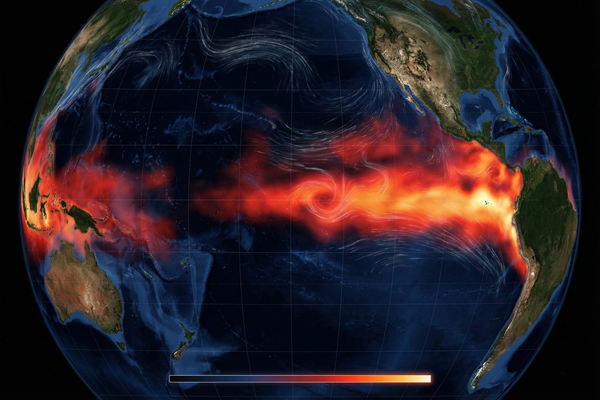


A new forecast by the European Centre for Medium-Range Weather Forecasts (ECMWF) indicates that El Niño conditions could develop by May 2026 and strengthen by August, raising concerns about global weather disruptions.
Model projections suggest a high probability that the event could intensify significantly during the year.
According to ECMWF’s 50-member ensemble forecast, there is:
-
98% probability of a moderate El Niño
-
80% probability of a strong El Niño
-
22% probability of a super El Niño
The analysis shows the equatorial and eastern Pacific Ocean warming rapidly, particularly in the critical NINO3.4 region, a key indicator used to monitor El Niño conditions.
Forecast Supports Japanese Climate Research
The ECMWF projections align with earlier assessments by climate researchers in Japan.
Swadhin Behera, Director of the Application Research Laboratory at the Japan Agency for Marine-Earth Science and Technology (JAMSTEC) and visiting professor at the University of Tokyo, previously predicted that a strong to very strong El Niño could develop as the current La Niña phase fades.
Behera’s SINTEX-F climate model also indicates the possibility of a positive phase of the Indian Ocean Dipole (IOD).
A positive IOD occurs when sea surface temperatures in the western Indian Ocean become warmer than in the eastern basin, influencing rainfall and weather patterns across Asia, Africa, and Australia.
Possibility of a Super El Niño
Another climate expert, Saji Hameed of the University of Aizu in Japan, suggested the event could potentially evolve into a super El Niño.
He noted that a scenario similar to 1997-98 could unfold if a positive IOD develops alongside El Niño.
Despite being an El Niño year, India experienced a strong monsoon in 1997-98, largely attributed to the supportive effects of the positive IOD.
Pacific Ocean Warming Accelerates
Meteorologists say the warming process in the Pacific is already underway.
Normally, trade winds blow from east to west across the Pacific, keeping warmer waters concentrated in the western region.
However, ECMWF forecasts indicate that westerly wind bursts moving in the opposite direction could weaken these trade winds and push warm water toward the eastern Pacific — a key step in the formation of El Niño.
These wind bursts are driven by Kelvin waves, which transport warm ocean water across the equatorial Pacific.
Kelvin Waves Already Strengthening the Pattern
ECMWF reported that three significant Kelvin wave events have already occurred, pushing warm waters from the western Pacific toward the eastern basin.
During La Niña conditions in 2025, warm water remained concentrated in the western Pacific, supporting rainfall in Australia, Southeast Asia, and parts of India.
The current shift toward the east indicates a transition toward El Niño conditions.
Atmospheric Support Emerging
El Niño is considered a coupled ocean-atmosphere phenomenon, meaning both ocean temperatures and atmospheric circulation patterns must align.
Scientists say atmospheric signals supporting the warming trend are now beginning to appear.
Gradual atmospheric changes are being observed between Darwin (Australia) and Tahiti, a key indicator region used to monitor El Niño development.
Madden-Julian Oscillation Could Accelerate Warming
Weather systems such as the Madden-Julian Oscillation (MJO) may further accelerate the process.
The MJO is a moving pattern of rainfall and atmospheric circulation that travels eastward around the tropics.
If a strong MJO wave arrives, it could intensify the warming of the Pacific and accelerate the development of El Niño.
However, ECMWF expects relatively weak MJO activity until around March 24, as strong Kelvin wave activity currently dominates the system.
Global Weather Implications
If a strong El Niño develops later in 2026, it could significantly influence global climate patterns, potentially affecting:
-
Monsoon rainfall in South Asia
-
Agricultural production
-
Extreme weather events worldwide
-
Global commodity markets
Meteorologists say the coming months will be critical in determining how rapidly the warming intensifies and whether the event evolves into a strong or super El Niño.
Related posts:
 Kenya Introduces Destination Inspection for U.S. Goods, Raising Compliance Costs and Port Delays
 Shipping Line or Shipping Mafia? How Crisis Surcharges Are Multiplying Freight Costs in 2026
 Iran War May Help India Manage Sugar Availability as Exports Likely to Slow
 Thailand Tightens Food Import Controls in 2026 as Labeling, Registration, and E-Commerce Rules Expand
 South African Agriculture Sees Relief in Possible 15% U.S. Tariff Adjustment
 US Court Ruling Weakens Tariff Leverage on China Ahead of Leaders’ Talks