
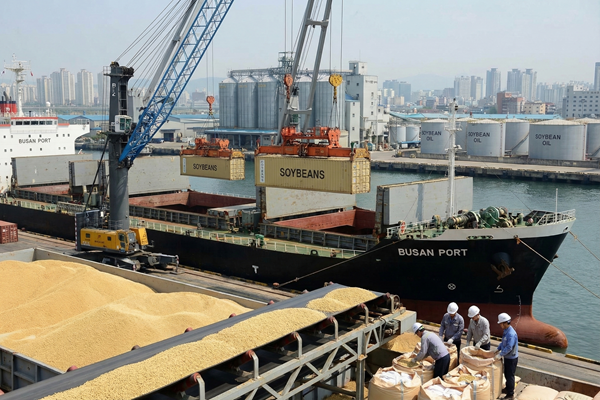


South Korea’s soybean market is expected to experience slower import growth as the government pushes policies aimed at strengthening domestic soybean production and reducing reliance on imported supplies. The shift is expected to impact soybean trade flows, crushing demand, and the edible oil market in the coming marketing year.
Declining Soybean Imports
South Korea’s soybean imports are forecast to remain just above 1 million metric tons in marketing year (MY) 2026/27, representing a 7.4 percent decline compared to MY 2024/25. The reduction reflects weaker demand for soybeans for crushing and government efforts to limit imports of food-grade soybeans.
The government announced that starting in 2026 it will limit food-grade soybean imports to the minimum quota required under WTO rules, eliminating the additional voluntary quota previously granted to local food manufacturers. This policy aims to encourage the use of domestically produced soybeans and reduce rising government stocks.
Crushing Demand Remains Weak
Soybean crushing volumes in South Korea are forecast to remain around 800,000 metric tons in MY 2026/27, significantly below the country’s annual crushing capacity of 1.1 million metric tons. The decline in crushing activity is largely driven by low crushing margins, as global prices for soybean meal remain competitive compared to domestic production.
Local processors increasingly rely on imported soybean meal rather than crushing soybeans domestically, further reducing demand for raw soybeans.
Rising Stocks of Domestic Soybeans
Government incentives introduced in recent years encouraged farmers to plant soybeans as an alternative crop to rice. As a result, soybean production reached approximately 156,000 metric tons in MY 2025/26, the highest level in two decades.
However, demand from domestic food processors has not kept pace with production, leading to growing stockpiles of locally produced soybeans. Authorities have introduced price discounts and promotional campaigns to increase consumption of domestic soybeans and reduce surplus stocks.
Soybean Meal Remains Key Feed Ingredient
Despite the decline in crushing activity, soybean meal continues to dominate as the main protein source in South Korea’s compound feed industry. The country produces around 22 million metric tons of compound feed annually, with soybean meal representing roughly 10 percent of total feed ingredients.
However, alternative feed ingredients such as distillers dried grains with solubles (DDGS) are gaining market share due to competitive pricing and government policies encouraging more sustainable feed options.
Growing Demand for Imported Edible Oils
Soybean oil remains the primary edible oil used in South Korea, with consumption expected to reach around 620,000 metric tons in MY 2026/27. Domestic production, however, remains below historical levels because of reduced soybean crushing.
To meet demand, South Korea continues to rely heavily on imported oils, including soybean and palm oil. Imports of soybean oil are forecast to remain above the recent three-year average despite slight declines expected in the coming year.
Industry sources indicate that Korean buyers are increasingly flexible in sourcing edible oils and tend to prioritize the lowest-cost suppliers, leading to more diversified import origins.
Related posts:
 Tunisia Soybean Imports to Reach 595,000 MT as Tourism-Driven Feed Demand Expands
 China Expands Vegetable Oil Exports as Domestic Consumption Weakens
 Germany’s Bakery Crisis Deepens: Structural Decline Hits BÄKO Network and Ingredient Markets
 Soybean Markets Surge: Energy Price Rally Meets Supply Slowdown
 Argentina’s Soybean Shift: Stable Crops, Wild Trade – What’s Next for Prices?
 EU Proposes Zero-Tolerance Pesticide Rule on Imports – Major Impact on Soybeans, Corn and Tree Nut Trade
 Argentina Maintains 48 MMT Soybean Forecast as Rains Stabilize Crop; Sunflower Hits 5.8 MMT Record
 South African Agriculture Sees Relief in Possible 15% U.S. Tariff Adjustment