
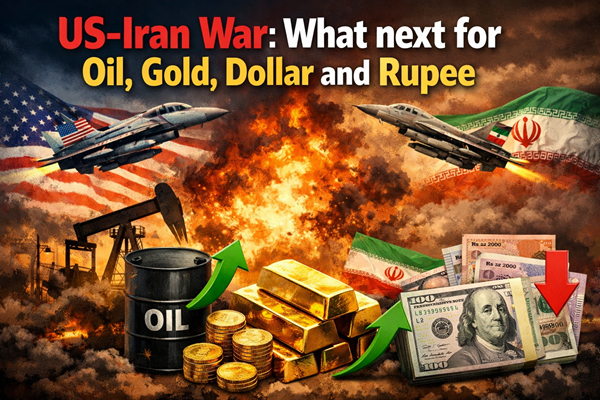


The escalation of the US–Iran conflict has triggered significant turbulence across global financial markets, pushing oil prices sharply higher while strengthening the US dollar and putting pressure on emerging market currencies such as the Indian rupee.
The United States launched attacks on Iran on March 7, triggering a surge in energy prices and shaking investor confidence worldwide. Crude oil prices rose about 28 per cent during the week, with Brent crude touching $94.65 per barrel before closing at $92.70.
Global equity markets also reacted negatively to the geopolitical shock. In the United States, the Dow Jones Industrial Average fell 3 per cent for the week, while the S&P 500 declined around 2 per cent.
Gold prices, which usually benefit from geopolitical tensions, remained volatile. The metal initially climbed about 2.7 per cent before reversing course and ending the week down roughly 2.7 per cent, reflecting mixed investor sentiment.
Meanwhile, the US dollar strengthened, with the dollar index gaining about 1.2 per cent for the week and rising over 2 per cent during intraday trading.
On the domestic front, Indian equity markets also declined. Both the Nifty 50 and Sensex fell about 3.5 per cent during the week before recovering slightly to end about 2.9 per cent lower.
The Indian rupee weakened significantly, falling 1.4 per cent and hitting a record low of 92.30 per dollar before closing the week at 91.75.
Oil: Further Upside Likely
Technical analysis suggests that oil prices may continue to rise if geopolitical tensions persist.
Brent crude has broken out of a bearish channel that had been in place since September 2023, forming a double-bottom pattern, which is considered a bullish reversal signal.
This breakout suggests that the long-term downtrend in oil prices that began in mid-2022 could now be ending.
Key technical levels indicate that immediate support lies around $89.20 per barrel. As long as prices remain above this level, analysts expect oil to move toward $98–$99 in the near term.
A correction toward $90–$88 may follow before another upward move.
If geopolitical tensions intensify, oil prices could surpass $100 per barrel, potentially climbing toward $108.
Conversely, if Brent falls below $89, it could decline toward $84 or even $80, although this scenario appears unlikely if the conflict continues.
The key takeaway for markets is that higher oil prices could translate into rising global inflation pressures.
Dollar Index: Possible Trend Reversal
The dollar index currently trades near 98.85, having largely moved within a 96–100.40 range since mid-2025.
Technical indicators suggest that a monthly close above 100.50 would signal the beginning of a bullish trend reversal.
A further move above 101.30 could push the dollar index toward 103 initially and eventually 105–106 later this year.
An interesting trend has emerged in recent years: oil prices and the dollar index have moved in the same direction since 2022, diverging from their historically inverse relationship.
If this correlation continues, a rise in Brent crude toward $108 could help push the dollar index toward the 105–106 range.
A stronger dollar typically creates pressure on emerging market currencies and commodity prices such as metals.
Gold: Mixed Signals
Gold has shown unusual behaviour during the crisis.
Although the metal initially rallied following the attack on Iran, it later reversed gains.
Strong support levels exist around $5,000 and $4,800 per ounce. As long as gold remains above $4,800, the long-term bullish trend remains intact.
However, recent price action suggests weakening momentum.
Gold could remain within a broad trading range between $4,800 and $5,600, rather than continuing its strong rally toward $5,900–$6,000.
This suggests that the US dollar may currently be the preferred safe-haven asset, partly because gold prices have already surged significantly in recent years.
Analysts also examined the gold-to-Brent ratio, which measures whether gold is outperforming oil or vice versa.
The ratio appears to have formed a top and could decline toward 48–46, indicating that oil may outperform gold in the near term.
If Brent reaches $108 while the ratio falls to those levels, gold prices could remain in the $4,970–$5,185 range.
Rupee Faces Double Pressure
For India, rising oil prices combined with a stronger dollar create a double challenge for the rupee.
Higher oil prices increase the risk of a widening trade deficit, which stood at $34.68 billion in January and could rise toward $40 billion or more.
This could also worsen India’s current account deficit (CAD), which was $13.2 billion in the October–December quarter of FY26, equivalent to 1.3 per cent of GDP.
Technical charts show the rupee currently trading within a bearish channel, with resistance near 90.50–90 per dollar.
As long as the currency remains below 91, analysts expect it could weaken toward 93–93.10 in the coming weeks.
A recovery toward 92–91 may occur if the Reserve Bank of India intervenes in the currency market.
However, from a longer-term perspective, the rupee may weaken further toward 96.50–96.70, depending on the scale of central bank intervention and global market conditions.
Outlook
The direction of global markets will largely depend on how long the US–Iran conflict lasts and whether it disrupts oil supply routes.
For now, analysts warn that investors should prepare for higher oil prices, increased inflation risks, currency volatility and uncertain commodity markets in the weeks ahead.
Related posts:
 Energy Panic: Iran War Could Send Oil to $100 and Hit Europe’s Economy Hard
 Insurance Costs for Ships in Strait of Hormuz Surge 12-Fold Amid Escalating Conflict
 Iran Suspends All Agricultural Exports Amid Escalating Middle East Conflict
 China Urges Iran to Keep Strait of Hormuz Open Amid Escalating Middle East Conflict
 MSC Halts Gulf Deliveries, Diverts Cargo to Safe Ports Amid Middle East Conflict
 China Urges Iran to Keep Strait of Hormuz Open Amid Escalating Middle East Conflict
 US-Iran Conflict: Around 150 Onion Containers Bound for Gulf Stranded at JNPT
 Iran Conflict Could Trigger Prolonged Commodity Rally — Here’s What Traders Must Know