
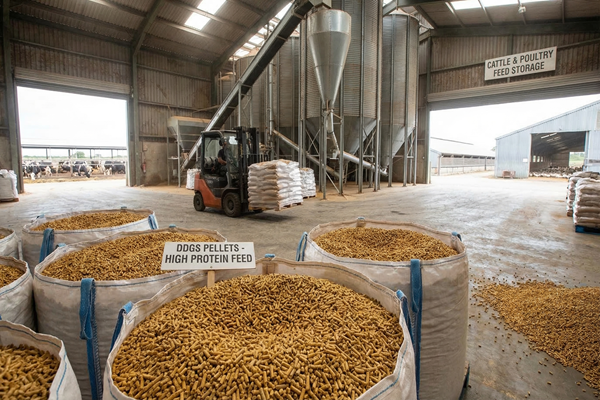


India has agreed to provide a tariff concession for imports of dried distillers grains with solubles (DDGS) from the United States under a limited quota as part of its broader trade engagement with Washington, according to Union Minister for Fisheries, Animal Husbandry and Dairying Rajiv Ranjan Singh.
In a written reply in the Lok Sabha on Tuesday, the minister said the decision was taken in view of the growing demand for animal feed in the country. However, the concession will apply only to a restricted import volume, ensuring that domestic producers are protected.
DDGS, a by-product of ethanol production from grains, is widely used as high-protein animal feed for livestock and poultry.
The minister explained that the concession would operate under a tariff rate quota (TRQ) system, similar to the mechanism used for commodities such as corn. Under this system, a limited quantity can be imported at a lower tariff rate while imports beyond the quota would face standard duties.
Singh also clarified that the government expects no adverse impact on the domestic market for feed crops, as the volume permitted under the concession will remain limited.
India and the United States announced a trade agreement on February 2, followed by a joint statement released on February 7, which outlined steps to strengthen bilateral trade relations.
Agriculture Sector Growth
The government also highlighted the strong performance of India’s agriculture and allied sectors, which currently contribute about 18 per cent to the country’s Gross Value Added (GVA).
According to Bhagirath Chaudhary, Minister of State for Agriculture and Farmers’ Welfare, the GVA of agriculture and allied activities rose from ₹20.93 lakh crore in 2014–15 to ₹48.77 lakh crore in 2023–24.
Within the sector, crop production accounts for 54.39 per cent of GVA, followed by livestock at 30.87 per cent, and fishing and aquaculture at 7.55 per cent, according to data from the National Accounts Statistics.
The livestock sector’s GVA increased from ₹5.10 lakh crore in 2014–15 to ₹15.05 lakh crore in 2023–24, while the crop sector grew from ₹12.92 lakh crore to ₹26.52 lakh crore over the same period.
Similarly, the fishing and aquaculture sector expanded significantly, with GVA rising from ₹1.16 lakh crore to ₹3.68 lakh crore.
For 2024–25, the agriculture sector recorded a 9.2 per cent growth rate, based on the First Revised Estimate of GVA, Chaudhary said.
Agricultural Land and Cropping Intensity
The government also noted that India’s agricultural land area has remained relatively stable, reflecting sustained agricultural production capacity.
According to the publication “Land Use Statistics at a Glance 2023–24,” improvements in agricultural technology and policy support have increased cropping intensity, which measures how often land is cultivated annually.
Cropping intensity has risen from 142.5 per cent in 2013–14 to 156.8 per cent in 2023–24, indicating that farmers are increasingly able to grow multiple crops on the same land within a year.
The government said the trend reflects a positive shift toward improved productivity and more efficient land use in Indian agriculture.
Related posts:
 Billions in Tariff Refunds Ahead: Food and Feed Importers Could Be Major Beneficiaries
 Panama Halts U.S. Onion Imports After Tariff Quota Filled; 11 Containers Redirected
 US Signals Tariff Increase to 15% or Higher for Selected Countries
 Ukraine Among Hardest Hit by New US Tariff Adjustments, Says EBRD
 72.5% of Guatemalan Exports to US Remain Tariff-Free After Supreme Court Ruling
 US–Indonesia Trade Deal Opens Tariff-Free Channel for Corn, Sorghum and Ethanol