
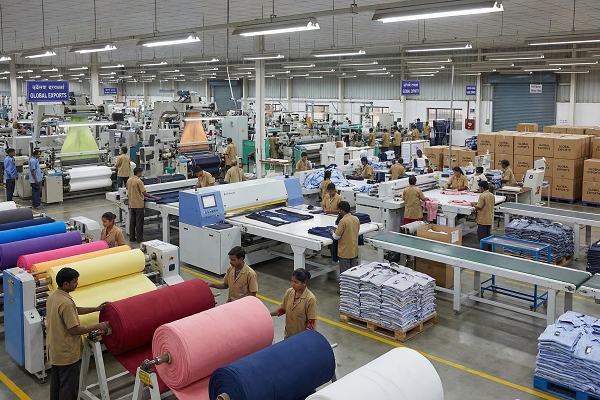


India has emerged as the largest exporter of cotton-based products to the United States in 2025, surpassing China for the first time, according to the US Department of Agriculture (USDA) global cotton market analysis.
The shift reflects changing global trade dynamics as US tariffs on Chinese goods and supply chain diversification strategies have encouraged American importers to source cotton products from alternative suppliers.
According to the USDA report, US imports of cotton products such as apparel and home textiles remained steady at around 3.3 million tonnes in 2025, roughly in line with the 15-year average.
However, the composition of suppliers changed significantly during the year.
India Takes the Lead in US Cotton Product Imports
Imports from India reached approximately 0.6 million tonnes in 2025, while shipments from China declined to about 0.5 million tonnes, allowing India to move into the top position among exporters to the US.
The decline in China’s share is largely attributed to US tariffs imposed over recent years, which ranged from 10% to as high as 125% on certain Chinese products.
Although other exporting countries also faced tariffs, the rates applied to them were less than half of the highest duties imposed on Chinese goods.
These trade conditions allowed several countries—including India, Vietnam, Bangladesh, Pakistan, Mexico, and Cambodia—to increase their presence in the US market.
Supply Chain Advantages Help India
The USDA noted that India’s vertically integrated textile supply chain has helped strengthen its competitiveness in the US market.
The integration of cotton production, yarn spinning, fabric manufacturing, and garment production within the same ecosystem enables Indian companies to meet traceability and compliance standards more efficiently.
At the same time, US companies have been gradually reducing reliance on Chinese suppliers due to regulatory and geopolitical concerns.
One major factor has been the Uyghur Forced Labor Prevention Act (UFLPA), which restricts imports linked to forced labor in China’s Xinjiang region.
In addition, concerns about geopolitical tensions and tariff uncertainty have encouraged American buyers to diversify sourcing.
As a result, US cotton product imports from China have fallen about 60% since their peak in 2010, according to USDA data.
Strong US Retail Demand Supports Cotton Trade
Despite the shift in suppliers, overall US imports of cotton products remained stable.
The USDA reported that retail sales at US clothing stores increased by about 5% in 2025, reaching a new record.
However, flat import volumes suggest that retailers relied more heavily on existing inventories during the year to minimize exposure to tariff volatility and rising costs.
Outlook for 2026 Cotton Trade
Looking ahead, the USDA expects US cotton product imports to increase in 2026, driven by low retailer inventories and continued consumer demand.
However, the report notes that trade policies will continue to influence sourcing decisions, meaning the distribution of suppliers could keep shifting.
Global Cotton Market Trends
The USDA also provided updated projections for the 2025-26 global cotton market.
-
Global cotton production is forecast to rise by 1.1 million bales to 121 million bales, mainly due to higher output in Brazil and China.
-
Global consumption is expected to decline slightly by more than 0.1 million bales to 118.6 million bales, with lower demand in Pakistan, Bangladesh, Mexico, and Vietnam, partly offset by stronger consumption in China.
-
Global cotton trade is projected to increase by 0.2 million bales to 43.9 million bales, supported by higher exports from Australia.
Meanwhile, global ending stocks are forecast to rise by nearly 1.3 million bales to 76.4 million bales, as increased inventories in India and Brazil outweigh reductions in Australia and Argentina.
With shifting trade patterns and evolving supply chains, analysts say India’s growing role in the US cotton market could reshape global textile trade in the coming years.
