
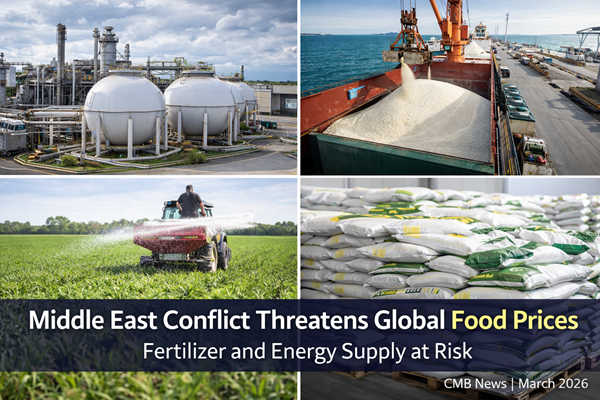


Middle East Conflict Threatens Global Food Prices via Fertilizer and Energy Supply
CMB News | Food & Agriculture Markets | March 2026
The escalating conflict in the Middle East is raising new concerns not only for global energy markets but also for the stability of global food prices. Analysts warn that disruptions to shipping through the Strait of Hormuz could ripple through agricultural supply chains, particularly by restricting access to fertilizers that are critical for global crop production.
While the Strait is widely known as one of the world’s most important oil transport routes, it also serves as a major corridor for fertilizers exported from Gulf countries. Any sustained disruption could raise farming costs, reduce crop yields, and ultimately push food prices higher worldwide.
Fertilizer Supply at Risk
Countries in the Persian Gulf are among the world’s most important fertilizer exporters. A significant share of globally traded fertilizer products must pass through the Strait of Hormuz.
Major Fertilizer Exporters in the Gulf Region
| Country | Key Fertilizer Products |
|---|---|
| Qatar | Urea |
| Saudi Arabia | Urea, ammonia |
| Oman | Nitrogen fertilizers |
| Iran | Urea, phosphates |
Together, these countries supply a substantial share of the world’s traded fertilizer. If shipping through Hormuz is disrupted, global fertilizer markets could tighten quickly.
Experts warn that this could create a chain reaction across global agriculture.
Higher Farming Costs Could Trigger Food Inflation
Agricultural economists note that fertilizer is one of the most important input costs for farmers. Any sudden increase in fertilizer prices could significantly affect crop production.
Higher fertilizer prices may lead farmers to:
- reduce fertilizer use
- delay planting decisions
- switch to lower-yield crops.
This could ultimately reduce harvest volumes and push global food prices higher.
At the same time, rising energy prices linked to the conflict are also increasing costs across the entire food supply chain.
Energy is required for:
- producing fertilizers
- powering agricultural machinery
- transporting crops
- processing food products.
Gulf Region Faces Immediate Risks
Countries closest to the Strait of Hormuz are likely to experience the earliest impacts of any disruption.
Gulf States Highly Dependent on Food Imports
| Country | Import Dependency |
|---|---|
| Qatar | Very high |
| Bahrain | Very high |
| Kuwait | Very high |
| Saudi Arabia | High |
These economies rely heavily on food imports transported through maritime routes. If shipping becomes constrained, alternative routes would be significantly more expensive.
While wealthier Gulf countries have the financial resources to import food by air or overland if necessary, poorer regional economies could face more serious supply challenges.
Sub-Saharan Africa Most Vulnerable
Beyond the Gulf region, analysts warn that Sub-Saharan Africa may be the most vulnerable region to fertilizer supply disruptions.
More than 90% of fertilizer used in Sub-Saharan Africa is imported, according to research from the University of Texas.
Regional Fertilizer Dependency
| Region | Fertilizer Imports |
|---|---|
| Sub-Saharan Africa | >90% imported |
| Southeast Asia | High |
| South Asia | High |
Staple crops such as maize, widely consumed across Africa, are particularly sensitive to fertilizer shortages.
Reduced fertilizer availability could therefore translate directly into lower yields and rising food prices.
Asia Faces Rising Agricultural Costs
Major agricultural economies in Asia could also face increasing production costs.
Countries such as:
- India
- Bangladesh
- Thailand
- Indonesia
import large volumes of fertilizer from the Gulf region.
If fertilizer shipments are delayed or become more expensive, farmers in these countries could face higher input costs during critical planting seasons.
Rice and maize production, both fertilizer-intensive crops, could be particularly affected.
Brazil Also Exposed
Brazil, one of the world’s largest agricultural exporters, may also be affected by tightening fertilizer markets.
Brazil imports roughly 85% of its fertilizer, making its soybean and maize sectors highly dependent on global supply chains.
If fertilizer shipments become disrupted during Brazil’s import season, production costs could increase significantly, potentially affecting global grain markets.
Energy Costs Add Additional Pressure
Even if fertilizer supplies remain available, rising energy costs alone could contribute to higher food prices globally.
Energy plays a crucial role throughout the agricultural value chain, from fertilizer manufacturing to food processing and transportation.
Economists note that energy costs often account for a substantial share of the final retail food price.
Outlook
The scale of the potential food price shock will largely depend on how long disruptions in the Strait of Hormuz persist.
Short-term interruptions may cause temporary market volatility. However, a prolonged disruption to shipping routes could tighten fertilizer supplies, increase agricultural production costs, and eventually translate into higher global food prices.
As the conflict continues, food markets are increasingly monitoring developments in energy and fertilizer supply chains, which could become the next major driver of global food inflation.
Source: CNBC
Related posts:
 Six Ships Attacked in Gulf and Strait of Hormuz as Middle East War Threatens Global Shipping
 Oman Evacuates Major Oil Export Port as Tanker Attacks Deepen Middle East Energy Crisis
 China Urges Iran to Keep Strait of Hormuz Open Amid Escalating Middle East Conflict
 MSC Halts Gulf Deliveries, Diverts Cargo to Safe Ports Amid Middle East Conflict
 China Urges Iran to Keep Strait of Hormuz Open Amid Escalating Middle East Conflict
 Middle East War Triggers Market Sell-Off as Iran Targets Gulf Energy Infrastructure
 West Asia Conflict Threatens Indian Tea Exports via Strait of Hormuz Risk
 Strait of Hormuz Crisis Sends Oil Prices Surging 8% as Middle East Escalation Threatens Global Supply