
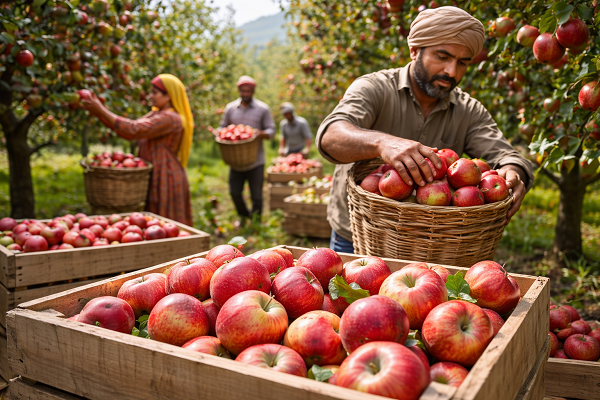


The global apple market stands at a crossroads as India and the U.S. implement a meticulously structured trade agreement to manage apple imports and protect domestic growers. The newly announced Bilateral Trade Agreement (BTA) is a paradigm of “managed integration”, combining quotas, minimum import prices, and protectionist measures to strike a balance between trade expansion and the safeguarding of India’s vital rural economy. Apple imports from the United States—one of the world’s largest exporters—will be funneled through a phased quota system, starting at 100,000 metric tons in the first year and rising to 150,000 metric tons by the third year. Beyond these limits, a hefty 50% import duty will shield Indian farmers from sudden surges of foreign supply.
Furthermore, the imposition of a Minimum Import Price (MIP) at INR 80/kg and an estimated landed price of INR 106/kg establishes a price floor, ensuring that imported apples do not undercut local prices, especially during peak domestic harvest seasons. For traders, this signals stricter regulatory oversight and new competitive thresholds, while for growers, it means heightened market protection—at least in the short term. As this agreement rolls out, market participants will need to navigate not only evolving quotas and price benchmarks but also wider trends in global apple production, currency shifts, and changing consumer preferences.
Exclusive Offers on CMBroker

Apricots dried
no: 7, sulphured (2000 ppm)
FOB 6.55 €/kg
(from TR)

Apple dried
Cubes 10-12 mm
FCA 4.30 €/kg
(from NL)

Apple dried
Cubes 5-7 mm
FCA 4.35 €/kg
(from NL)

📈 Prices
| Product | Form / Grade | Origin | Location | Terms | Price (EUR/kg) | Weekly Change | Market Sentiment |
|---|---|---|---|---|---|---|---|
| Apple dried | Cubes 10-12 mm | China | Dordrecht, NL | FCA | 4.30 | 0.00 | Stable |
| Apple dried | Cubes 5-7 mm | China | Dordrecht, NL | FCA | 4.35 | 0.00 | Stable |
| Apple dried | Cubes 8-10 mm | China | Dordrecht, NL | FCA | 4.25 | 0.00 | Stable |
Note: Recent offers for dried apple cubes from China in the EU market remain stable, with no weekly price changes reported. Prices reflect logistics, quality premiums, and subdued volatility amidst quota discussions in major fresh apple-consuming markets.
🌍 Supply & Demand
- Indian Market Restructuring: With phased quotas and minimum price thresholds, the supply of imported apples into India will be carefully managed. Initial quota set at 100,000 MT, rising to 150,000 MT by year 3.
- Protection for Domestic Growers: Key Indian regions—Jammu & Kashmir, Himachal Pradesh, North East—will benefit from import restrictions, supporting thousands of farmer livelihoods.
- Demand Outlook: Indian consumer demand for apples is expected to remain robust, especially as prices stabilize and local produce is shielded during key harvest periods.
📊 Fundamentals
- Bilateral Trade Framework: The BTA establishes volume limits (quota), high over-quota tariffs (50%), and a minimum import price (INR 80/kg, landed at INR 106/kg) for U.S. apples entering India.
- Focus on Rural Income Stability: Design aims to anchor rural incomes and gradual liberalization, rather than sudden exposure to world market price swings.
- Tree Nut Parallel: Similar quota-based regulation on imported almonds and walnuts reinforces India’s emphasis on income support for mountain farmers.
- Managed Integration Model: Uses non-GM requirements and managed quotas rather than full deregulation—market access expands slowly, carefully monitored for impact.
☀️ Weather & Crop Outlook
- India: Wetter-than-normal pre-monsoon rains in Himachal Pradesh and Jammu & Kashmir have helped tree fruit set but may complicate late-season picking if rains persist. Weather stability during peak harvest (August–October) remains crucial to avoid losses.
- United States: Favorable spring conditions in Washington and Michigan suggest a good apple crop, barring late hail or drought events.
- China: Apple supply for dried product exports remains steady, supported by mild spring with sufficient irrigation in major producing provinces.
🌏 Global Production & Stocks
| Country | 2023 Production Estimate (MT) | Stock/Inventory Trend |
|---|---|---|
| China | 43 million | Stable/Abundant |
| U.S. | 4.5 million | Rising (bigger 2024 crop expected) |
| India | 2.4 million | Variable (weather sensitive) |
| EU | 11.3 million | Slightly up (from prior year) |
📆 Trading Outlook & Advice
- Importers targeting India must closely monitor quota allocation progress and avoid over-quota shipments to sidestep the 50% duty penalty.
- Expect stable international dried apple prices but watch for rising premiums as Indian demand slowly increases with each quota expansion year.
- Domestic Indian suppliers will likely experience firmer price support as quotas and MIP restrict disruptive competition from U.S. apples.
- Watch for rapid changes in quotas or price floors as India and the U.S. review BTA terms after each quota phase.
- Supply chain participants should hedge against weather volatility in key growing regions, which may cause temporary shortages or gluts.
⏳ 3-Day Regional Price Forecast
| Market | Product | Forecast Price (EUR/kg) | Sentiment |
|---|---|---|---|
| EU (Dordrecht) | Dried Apple Cubes | 4.25–4.35 | Stable |
| India (imported, est. landed) | Fresh Apple | 1.27–1.30 (USD) | Stable to Firm (quota regime) |
| U.S. (export FOB) | Fresh Apple | 1.10–1.20 (USD) | Stable |
Market participants should prepare for a tightly regulated trade environment in India, stable dried apple prices in the EU, and moderate global inventory levels. Major surprises are unlikely in the short-term, but strategic monitoring of quota implementation and weather events is warranted.
Related posts:
 Iran Export Ban Pushes Food Prices Higher in Turkmenistan and Central Asia
 Georgia’s Apple Exports Surge: Strong Demand and Rising Prices Shape 2024 Market
 Indian Apple Market Faces Rising Prices Amid Logistics Risks and Delays
 India’s Apple Industry Faces Uncertainty Amid US Import Duty Concessions