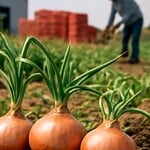


Indian celery seed export prices are trading in an unusually narrow range in mid‑March 2026, with FOB New Delhi offers for 99% whole seeds holding flat around their late‑February levels when converted into euros. Market participants report generally comfortable spot availability after last year’s larger seed-spice harvest, yet no signs of real oversupply as farmers shifted acreage mainly to more liquid crops like cumin and coriander. Recent spice-market overviews describe celery as one of the steadier seed spices, with prices described as “firm but stable” into February 2026, in contrast to the volatility seen in cumin and coriander. Domestic demand from food processors and blended masala manufacturers remained steady through the winter wedding and festival season, but export buying has turned more selective on the back of high freight costs and cautious European and Middle Eastern buyers managing inventories more tightly. On the weather side, India Meteorological Department (IMD) updates for early March indicate above‑normal minimum temperatures and emerging heat over Rajasthan, Madhya Pradesh and Gujarat, key seed-spice belts that also supply celery. While the 2025/26 celery crop is largely harvested and in warehouses, a prolonged early heatwave into April could affect late-sown pockets and seed quality for the next cycle, although this risk is still considered moderate. Export data confirm India’s dominant role in global celery seed trade, with India, China and Spain together accounting for about 70% of world exports and India alone leading with roughly half of tracked shipments. Overall, the immediate price outlook is one of sideways consolidation in a firm band, with only limited downside unless a sudden liquidation of farmer or stockist holdings occurs. Upside appears capped in the very short term by adequate pipeline stocks and cautious overseas demand.


📈 Prices & Recent Moves
Spot export indications (converted to EUR)
All explicit price data from India are originally quoted in USD/tonne; here they are converted approximately to EUR using 1 USD ≈ 0.92 EUR. Internal offer data from New Delhi are converted from USD/kg at the same rate.
| Product | Origin | Location / Basis | Date | Closing price (EUR/kg) | Weekly change (EUR/kg) | WoW % | Market sentiment |
|---|---|---|---|---|---|---|---|
| Celery seeds, whole, 99% | India | New Delhi, FOB | 2026-03-14 | 1.24 | 0.00 | 0.0% | Stable / balanced |
| Celery seeds, whole, 99% | India | New Delhi, FOB | 2026-03-07 | 1.24 | 0.00 | 0.0% | Stable |
| Celery seeds, whole, 99% | India | New Delhi, FOB | 2026-02-28 | 1.24 | -0.02 vs 2026-02-21 | -1.5% | Slightly softer |
Note: Base series 1.35 USD/kg FOB New Delhi converted to ≈1.24 EUR/kg. Earlier quote of 1.37 USD/kg (14 & 21 Feb) corresponds to ≈1.26 EUR/kg.
- From 14 February to 14 March 2026, New Delhi FOB celery seed offers eased from about 1.26 EUR/kg to 1.24 EUR/kg and have since moved sideways.
- Industry spice overviews for February 2026 classify celery as “price stable”, which matches the flat internal series.
- Nearby liquidity is described as adequate, with occasional small discounts for larger-volume parcels, but no aggressive undercutting reported on mainstream trade portals.
🌍 Supply & Demand Context
Indian & global supply
- India remains the leading global exporter of celery seeds, accounting for about 46% of tracked shipments between July 2024 and June 2025; together, India, China and Spain cover roughly 70% of world exports.
- Background sector studies by India’s National Horticulture Board and Spices Board underline that India also has a large share in celery seed oil, and that demand growth tends to be modest, so oversized acreage expansions can quickly pressure prices.
- Recent private spice market reviews note celery in India as “firm but stable,” in contrast to tighter cumin and coriander. This suggests current production is broadly aligned with export and domestic demand.
Demand trends
- Spice demand in India has been supported by structural growth in organised retail and e‑commerce, including rapid expansion of dark stores and branded spice sales, which benefits seed spices such as celery as secondary ingredients in blends.
- Global demand for Indian spices remained resilient in 2025, with agricultural exports up around 9% year‑on‑year in April–September, according to recent trade commentary. Celery remains a niche share of this basket but follows the same broad trend.
- Importers in Europe and the Middle East are reportedly buying hand‑to‑mouth, focusing on quality‑certified parcels amid tighter food‑safety scrutiny; this caps near‑term upside despite India’s dominant export position.
📊 Fundamentals & Weather (India focus)
Crop fundamentals
- Celery in India is concentrated within the wider seed‑spice belt (Madhya Pradesh, Rajasthan, Gujarat, parts of Andhra Pradesh and Maharashtra), often rotated with cumin, coriander and dill.
- Private reports for mid‑2025 indicated a 27–28% increase in Indian celery production versus the prior season, which led to a pronounced but temporary price correction last year. Current flat prices indicate that surplus has been mostly absorbed and the market has re‑balanced.
- Exportable surplus is described as “constrained outside Gujarat,” meaning the market still relies heavily on specific producing pockets rather than broad‑based oversupply.
Weather outlook – key Indian seed‑spice regions (next 3–5 days)
- IMD press releases from 6–10 March 2026 highlight above‑normal minimum temperatures across Rajasthan, Gujarat, Madhya Pradesh and adjoining states, with some areas marked as markedly above normal (>5°C).
- Separate bulletins and local reports flag heatwave to severe heatwave conditions over parts of Gujarat and adjoining western India in mid‑March.
- For celery, the main 2025/26 seed crop is largely harvested and in storage, so immediate yield risk from this early heat spike is limited. The primary concerns are: (a) potential impact on late‑sown patches and seed development for the next cycle, and (b) storage quality if warehouses are poorly ventilated.
Weather impact assessment (short term):
- Production: Neutral to slightly negative risk bias; no large‑scale losses expected for the already‑harvested crop.
- Logistics: Generally normal; heat can marginally increase handling and cooling costs but is unlikely to disrupt flows from mandis to ports.
- Price effect (next week): Minimal; current heat conditions are not strong enough on their own to trigger a weather‑driven rally in celery.
📌 Trading Outlook (Price‑Driven)
- Short‑term bias (2–4 weeks): Sideways in a narrow band. With New Delhi FOB offers static around 1.24 EUR/kg for four consecutive weeks, a breakout requires a clear new driver (weather shock, policy move, or demand surprise).
- Downside risks:
- Slow export call‑offs from Europe/MENA as buyers wait for clearer demand signals.
- Any broad softening across the seed‑spice complex (e.g., if cumin and coriander see post‑harvest pressure) could spill into celery via substitution on land and inventory rotation.
- Upside risks:
- Quality issues in competitor origins (China, Spain) or logistical disruptions that redirect demand towards India.
- Weather‑related concerns turning more acute in late March–April, particularly if heat expands and affects seed setting for the next crop cycle.
- For exporters:
- Use current stability to lock in forward sales on a staggered basis at or slightly above 1.24–1.26 EUR/kg FOB for good‑quality 99% lots.
- Avoid heavy stock accumulation purely on speculative grounds; the historical pattern for celery shows that any large acreage increase can sharply pressure prices.
- For importers (EU / MENA):
- Hand‑to‑mouth coverage remains feasible as the market is not showing strong upward momentum.
- Consider extending coverage modestly into Q2 2026 if you can secure 1.24–1.25 EUR/kg equivalent FOB on compliant lots, to hedge against potential freight and quality‑related premiums later in the year.
📆 3‑Day Regional Price Forecast (EUR)
Baseline reference: 1.24 EUR/kg FOB New Delhi on 14 March 2026 for Indian 99% whole celery seeds.
| Date | Region / Market | Reference grade | Forecast range (EUR/kg, FOB) | Expected change vs 14 Mar close | Directional bias |
|---|---|---|---|---|---|
| 2026-03-16 | New Delhi (IN) | Celery seeds, whole, 99% | 1.23 – 1.25 | 0 to -0.01 | Flat to marginally softer on quiet start to week |
| 2026-03-17 | New Delhi (IN) | Celery seeds, whole, 99% | 1.23 – 1.25 | Unchanged | Stable; no major fresh drivers expected |
| 2026-03-18 | New Delhi (IN) | Celery seeds, whole, 99% | 1.23 – 1.26 | 0 to +0.02 (upper end) | Slightly firmer if export enquiries pick up mid‑week |
These price ranges assume stable INR and freight, with no abrupt changes in broader seed‑spice sentiment or weather‑related headlines.