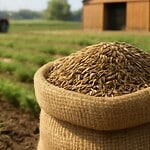


Cumin (jeera) is currently trading in a fragile balance where comfortable supplies and soft demand are offsetting each other, resulting in largely unchanged prices but a clearly weaker undertone. In major wholesale markets, benchmark cumin prices are quoted around $281 per 100 kg, indicating stability on the surface but masking a market in which buyers are only meeting immediate requirements and refraining from forward coverage. This lack of aggressive buying interest is preventing any sustained upward movement, and traders increasingly expect that, if demand does not improve, prices could drift lower in the coming weeks. The Raw Text clearly highlights that arrivals from producing regions are regular and stocks are adequate, so the market is not facing any supply squeeze; rather, the challenge is demand—both from domestic processors and from export channels that have turned more cautious. Parallel indications from recent export statistics and advisory reports point to subdued overseas interest and increased competition, reinforcing the view that India’s cumin export engine is idling rather than accelerating. At the same time, new crop arrivals and warmer-than-usual weather in key growing belts across Gujarat and Rajasthan point to a transition phase where fundamentals are tilting mildly bearish but without signs of a sharp sell-off. In this context, the base case is for a narrow trading range with a soft bias, where any short-term price strength is likely to invite hedging and farmer selling, while breaks to the downside could be moderated by lower sowing, weather risks, and India’s role as the key global supplier.
Exclusive Offers on CMBroker

Cumin seeds
whole, grade - A
FOB 4.45 €/kg
(from IN)

Cumin seeds
grade - A
99%
FOB 2.32 €/kg
(from IN)

Cumin powder
grade - A
FOB 3.60 €/kg
(from IN)

📈 Prices & Market Sentiment
Spot and Export-Oriented Price Levels (EUR)
Based primarily on the Raw Text, wholesale cumin prices in major Indian markets are hovering around $281 per 100 kg, with sentiment described as cautious and slightly weak. Translating this benchmark into euro terms (approx. 1 USD ≈ 0.92 EUR for context), this implies a reference level of roughly 2.59 EUR/kg at the wholesale market level. This aligns with the platform’s most recent FOB offers from India, Egypt and Syria, which show modest week-on-week declines and confirm the slightly bearish tone rather than a sharp correction.
| Origin / Location | Product | Specs / Terms | Latest Price (EUR/kg) | Weekly Change (EUR/kg) | Update Date | Market Sentiment |
|---|---|---|---|---|---|---|
| India – New Delhi | Cumin seeds, whole, grade A, organic | FOB | 4.45 | -0.05 | 2026-03-14 | Slightly bearish, offers easing |
| India – New Delhi | Cumin seeds, grade A, 99% purity | FOB | 2.32 | -0.03 | 2026-03-14 | Soft, buyers cautious |
| India – Gujarat (Unjha) | Cumin seeds, 98% purity | FOB | 2.20 | -0.03 | 2026-03-14 | Weak tone with steady arrivals |
| Egypt – Cairo | Cumin seeds, 99.9% purity | FOB | 4.35 | -0.05 | 2026-03-13 | Soft, tracking Indian trend |
| Syria – via NL (Dordrecht) | Cumin seed | FCA NL | 3.60 | 0.00 | 2026-03-13 | Stable but price-taker vs India |
| India – New Delhi | Cumin powder, organic | FOB | 3.60 | -0.05 | 2026-03-14 | Soft, mirroring seed market |
The Raw Text describes prices as “largely unchanged” with cautious sentiment, which is exactly what the small, consistent week-on-week declines in the EUR offers show: the market is not collapsing, but it is drifting lower as buyers negotiate small discounts and avoid building inventories.
🌍 Supply & Demand Balance
Supply: Comfortable Stocks and Regular Arrivals
- Comfortable supply: The Raw Text emphasises “adequate availability of stocks” and “regular arrivals from producing regions”. This means supply-side tightness is not the driver; instead, it is capping any rally and creating potential for mild corrections.
- India’s new crop dynamics: Recent domestic reports show that fresh crop arrivals have begun in key mandis like Unjha, with supplies expected to gather pace through March, adding to already comfortable stocks and pressuring sentiment.
- Farmer holding but not squeezing the market: Market commentary suggests that farmers still hold significant carryover stocks, but only a portion is reaching mandis. This behaviour supports prices from collapsing but, combined with new arrivals, maintains an overall “comfortable” supply situation.
Demand: Sluggish Domestic Buying and Subdued Exports
- Domestic demand: According to the Raw Text, buyers are purchasing only limited quantities to meet immediate requirements. Processors are not rushing to cover long-term needs, often because they expect better buying opportunities if prices soften further.
- Export demand under watch: The Raw Text explicitly highlights that export orders are being watched closely and that further weakening in export demand could add pressure. That aligns with trade data showing a decline in India’s cumin exports during parts of 2025, reflecting weaker overseas demand.
- Competitive landscape: Earlier in the 2024–25 cycle, India benefited from strong export demand and its status as the cheapest global supplier, but more recently, subdued enquiries and greater price sensitivity from key destinations in Europe, the Middle East and China have slowed the pace of shipments.
Net Balance
Taking the Raw Text as the core evidence, the cumin market is currently in a modest surplus or at least a very comfortable balance: ongoing arrivals and adequate stocks are meeting demand that is only lukewarm. This balance is what produces the observed pattern of stable nominal prices with a slightly weaker tone and the risk of mild declines if export or domestic buying does not pick up.
📊 Fundamentals & Global Context
Production and Export Overview
| Country / Region | Role in Market | Recent Production / Area Signals | Direction vs Prior Year | Comments |
|---|---|---|---|---|
| India (Gujarat & Rajasthan) | Largest producer & exporter | Sowing down in Gujarat by ~14%, 2026 production estimated lower than previous season, but still ample stocks due to carryover. | Lower production, but high carryover | Despite smaller crop, comfortable stocks and new arrivals weigh on prices in line with Raw Text. |
| India – Unjha (Mehsana) | Key trading hub for cumin | Over 54,000 tonnes of cumin arrivals recorded in early 2025; similar seasonal pattern expected in 2026 with arrivals concentrated Feb–Mar. | Steady arrivals | Supports the Raw Text comment that “regular arrivals” are keeping supply comfortable. |
| Egypt | Secondary exporter | Cumin cultivated as a winter crop on relatively limited but growing area; some governorates show expanding cumin acreage. | Slight expansion | FoB offers are slightly easing in EUR, mirroring Indian trend rather than setting it. |
| Syria, Turkey, Afghanistan | Regional suppliers | Output challenged by weather and geopolitical factors, keeping these origins opportunistic rather than dominant. | Mixed / constrained | Contributes to India’s continued central role, but does not prevent current mild downward pressure implied by the Raw Text. |
Stocks, Inventories and Speculative Positioning
- Stocks: The Raw Text speaks of “adequate availability of stocks”. Together with external estimates of sizeable farmer-held inventories in Gujarat and Rajasthan, this supports the idea of a relatively heavy stock overhang that dampens rallies.
- Inventories at trade level: Processors and exporters are not aggressively restocking, but current carryover and fresh arrivals allow them to meet short-term needs without price chasing—exactly the pattern described in the Raw Text.
- Speculative interest: Futures market data (e.g., on Indian exchanges) indicate long liquidation phases with open interest easing as prices slip marginally, confirming a cautious, non-bullish stance among speculative participants.
🌦 Weather Outlook for Key Cumin Regions
India – Gujarat & Rajasthan
- Current pattern: Meteorological updates show an early and intense heat build-up over western India, with Gujarat and Rajasthan experiencing heatwave-like conditions and maximum temperatures around 38–42°C in mid-March 2026.
- Crop stage: Cumin in these states is typically harvested in February–March. By mid-March, much of the crop is either harvested or in late maturity. Heat at this stage mainly affects post-harvest handling, seed quality, and moisture losses rather than yield formation.
- Yield risk assessment:
- Pre-harvest: Above-normal temperatures during flowering and grain filling could reduce yields slightly, but main weather stress this season seems concentrated toward late March.
- Post-harvest: Faster drying and higher risk of quality loss (e.g., volatile oil loss, brittleness) if storage is not well managed.
Other Origins (Egypt, Syria, Turkey)
- Egypt: Cumin is planted in winter and harvested in spring; current information suggests no major weather shock, and area in some governorates has grown.
- Syria & Turkey: Weather and geopolitical instability continue to pose intermittent risks to cumin output and logistics, but these origins remain secondary in setting global prices compared with India.
Net weather impact: For the current marketing window, weather does not materially tighten supply enough to overturn the Raw Text’s assessment of comfortable availability. If anything, the early heat confirms a fast end to the season and encourages farmers with remaining stocks to sell on any price strength.
📉 Price Drivers & Short-Term Outlook
Key Drivers (Next 2–6 Weeks)
- Sluggish demand: With buyers limiting themselves to immediate needs, the Raw Text suggests that price rallies will be self-limiting. Any uptick would likely be met by farmer and stockist selling.
- Export orders: Export demand is “under watch”; if new export tenders or large orders from the Middle East, Europe or China fail to materialise, the downside pressure from comfortable supplies could intensify.
- New crop arrivals: As arrivals from Gujarat and Rajasthan continue through March, local mandis see enough physical flow to prevent tightness, consistent with the Raw Text view of regular arrivals and comfortable supply.
- Competing origins & currency: Egypt and Syria FoB quotes in EUR are slightly easing, meaning importers have multiple origins with modest discounts available. Currency moves (INR vs EUR) will modulate how competitive Indian offers remain, but the primary direction from the Raw Text is still mildly downward due to demand, not FX.
Baseline Outlook
Anchored in the Raw Text, the base scenario is for range-bound trade with a slightly weaker tone. Prices around the equivalent of ~2.6 EUR/kg at the wholesale benchmark are likely to see mild further downside rather than a sharp rebound unless there is a clear improvement in either export demand or domestic processor buying.
🧭 Trading Outlook & Recommendations
For Importers (EU, Middle East, North America)
- Consider staggered purchasing over the next 4–6 weeks rather than front-loading large volumes, as the Raw Text signals potential for mild declines if demand remains weak.
- Use current offers from India (around 2.2–2.3 EUR/kg for conventional seeds FOB and 3.6–4.5 EUR/kg for organic or premium grades) as negotiating benchmarks, seeking small discounts citing the documented soft sentiment.
- Maintain quality diversification across India, Egypt and Syria, but keep India as core origin given its comfortable stocks and central role in price discovery.
For Exporters & Traders in Producing Countries
- Avoid over-aggressive bullish positions in the short term; the Raw Text’s reference to a “slightly weaker tone” and risk of mild declines suggests limited upside without a demand shock.
- Focus on turnover and cash flow by pricing competitively rather than holding large unsold inventories in expectation of a near-term rally.
- Monitor export tenders and price signals from key buying regions closely; any surprise improvement in export demand could justify incremental stock holding, but this is not yet visible in current reports.
For Domestic Processors (India)
- Maintain a just-in-time plus safety buffer procurement strategy. The Raw Text implies no imminent supply crunch, so there is little need to chase the market.
- Take advantage of soft spots on days when arrivals are heavy and prices slip to incrementally extend coverage by 1–2 months.
📆 3-Day Regional Price Forecast (EUR)
Forecast horizon: 2026-03-17 to 2026-03-19. These are directional, short-term views derived mainly from the Raw Text’s assessment of a narrow range with a weaker tone, complemented by current EUR offer levels. All figures are indicative spot-equivalent assessments.
| Region / Hub | Product | 2026-03-16 Close (Indicative, EUR/kg) |
Forecast Range Next 3 Days (EUR/kg) |
Direction | Comment |
|---|---|---|---|---|---|
| India – New Delhi (export-oriented) | Cumin seeds, grade A, 99% purity, FOB | 2.32 | 2.28 – 2.34 | Slightly lower / flat | Comfortable arrivals, soft demand; scope for small discounts. |
| India – Gujarat (Unjha) | Cumin seeds, 98% purity, FOB | 2.20 | 2.16 – 2.22 | Slightly lower | New crop plus heat-accelerated marketing; buyers not aggressive. |
| Egypt – Cairo | Cumin seeds, 99.9% purity, FOB | 4.35 | 4.30 – 4.40 | Flat / slightly lower | Following Indian benchmark; no strong independent driver. |
| Syria – via NL (Dordrecht) | Cumin seed, FCA | 3.60 | 3.55 – 3.65 | Mostly flat | Smaller origin; prices track India and Egypt. |
Overall, consistent with the Raw Text, the cumin market is expected to remain in a narrow band over the next few days, with a bias to mild softening rather than sustained gains, as long as both domestic and export demand remain lacklustre and arrivals continue at a regular pace.