
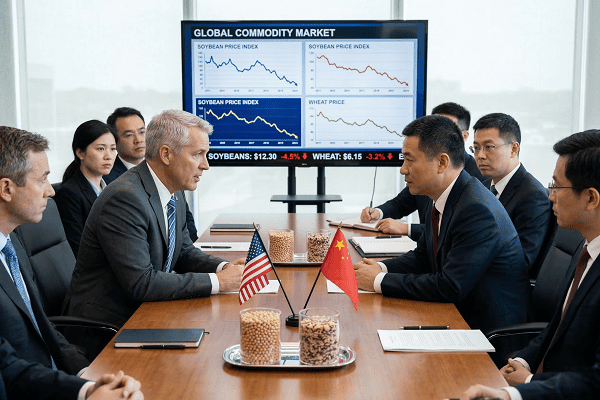


China signaled it may increase purchases of US agricultural products during trade talks in Paris, but uncertainty over negotiations and geopolitical tensions pushed soybean prices lower, highlighting market volatility.
Chinese negotiators showed openness to buying more poultry, beef and grains from the United States during the first day of discussions, according to a Reuters report.
The talks, led by US Treasury Secretary Scott Bessent and Chinese Vice Premier He Lifeng, were described as frank and constructive.
China signals higher purchases of US agricultural products
China’s willingness to buy more US agricultural products could support American farmers and global commodity markets.
China remains the world’s largest buyer of agricultural imports, especially soybeans and grains, making trade discussions between the two countries critical for global markets.
The proposed purchases include key farm commodities such as meat and row crops.
US pushes for broader trade commitments
US officials also raised several additional trade demands during the negotiations.
Washington urged China to increase purchases of:
-
Boeing aircraft
-
American coal
-
crude oil
-
natural gas
Officials also discussed concerns about the supply of critical minerals, which are important for US industries such as aerospace and technology.
Both sides explored the idea of creating formal platforms to manage trade and investment relations.
Trump warns over Hormuz issue
US President Donald Trump said he may delay a planned summit with Chinese President Xi Jinping if Beijing does not help address disruptions in the Strait of Hormuz.
The Strait remains a critical global trade route, especially for energy shipments.
Trump’s statement added uncertainty to the outlook for US-China trade relations.
Soybean prices fall on trade uncertainty
Commodity markets reacted quickly to the uncertainty surrounding the talks.
Chicago soybean futures fell 2.7% to below $12 per bushel, reflecting concerns over a possible delay in trade agreements with China.
China is the largest global importer of soybeans, so any delay in trade negotiations can directly impact prices.
Market participants said agricultural commodities remain highly sensitive to developments in US-China relations.
Market outlook
Analysts say progress in trade talks could support global agricultural markets, especially for US exports.
However, geopolitical tensions and uncertainty over trade agreements may continue to create volatility in commodity prices.
Traders will closely monitor developments ahead of a potential Trump-Xi summit, which could shape the next phase of US-China trade relations.
Related posts:
 Mexico Tightens Tariff Policy on Rice While Extending Anti‑Inflation Food Decrees: Mixed Signals for Global Grain Trade
 China May Boost Purchases of US Farm Products After Trade Talks
 US Tariff Relief Sparks Export Rush — but Uncertainty Still Clouds China–US Trade
 Turkey Becomes Key Hub for Global Vegetable Oil Trade as Imports Surge
 Crop Prices Fall as Trump Signals Possible End to Iran War
 Tunisia Soybean Imports to Reach 595,000 MT as Tourism-Driven Feed Demand Expands
 South Korea’s Soybean Imports Decline as Government Promotes Domestic Production
 Soybeans Market Rallies on Oil Strength, but China Demand Uncertainty Looms