



Crude oil futures have sharply corrected from their early-March spike but remain at elevated levels, with the WTI April 2026 contract settling at about USD 94.4/bbl and Brent May 2026 at roughly USD 100.9/bbl on 16 March 2026. The forward curves for both benchmarks are steeply backwardated from near USD 100/bbl front-month levels towards around USD 60/bbl for long-dated WTI (2033–2036), signalling tight short‑term supply and expectations of much looser balances later in the decade. The pullback of 2–4% across the front of the curve on 16 March reflects some easing of immediate risk premium after the recent Strait of Hormuz crisis, but price risk remains skewed to the upside in the near term.
The market is digesting several overlapping drivers. On the supply side, OPEC+ has chosen to maintain its existing quota framework and pause planned production hikes through at least March 2026, reinforcing a structurally tight prompt balance even as non‑OPEC supply continues to grow. At the same time, geopolitical risk around the Strait of Hormuz has added a hefty risk premium, with Brent having traded briefly as high as around USD 120–125/bbl in early March before easing back above USD 100/bbl as flows partially normalised. On the demand side, the IEA, EIA and OPEC all still see global oil consumption rising in 2026, but at a slower pace than in previous recovery years, as EV penetration, efficiency gains and a softer macro backdrop moderate growth. This combination of near‑term supply insecurity and medium‑term demand deceleration is clearly reflected in the pronounced backwardation shown in the WTI and Brent curves.
📈 Prices & Curve Structure
WTI futures (NYMEX) – snapshot as of 16 March 2026
The Raw Text shows a strongly backwardated WTI curve. The April 2026 contract settled at USD 94.43/bbl (−4.53% vs previous day), May 2026 at USD 93.33/bbl (−3.76%), and June 2026 at USD 89.31/bbl (−3.55%). By December 2026, prices decline to USD 75.10/bbl, and by March 2027 to around USD 72.19/bbl. Far-dated contracts fall steadily towards roughly USD 58–57/bbl by 2035–2036, with daily percentage changes of only about +0.03–0.04%, highlighting a stable, low‑volatility long end.
This structure indicates a market that is tight in the short term—front-month prices near USD 95–100/bbl following the Hormuz shock—but where traders expect substantial additional supply and/or slowing demand growth to bring prices closer to marginal production costs over the long run. The very high trading volumes (e.g. 362,969 contracts for WTI April 2026; 311,329 for May 2026) underline significant repositioning in the front months, consistent with a recent volatility shock and subsequent risk‑premium correction.
Brent futures (ICE) – snapshot as of 16 March 2026
In the Brent complex, the Raw Text shows front‑month May 2026 settling at USD 100.90/bbl (−2.22% day‑on‑day) and June 2026 at USD 96.59/bbl (−2.40%). July 2026 closes at USD 92.22/bbl, and by December 2026, Brent is down to USD 80.57/bbl. Similar to WTI, the curve then gradually declines into the low‑70s and high‑60s across 2027–2030 and stabilises around USD 69–69.5/bbl by 2032–2033.
The Brent curve is likewise in firm backwardation, but at a consistently higher absolute level versus WTI, reflecting Brent’s role as the global seaborne benchmark and the elevated geopolitical risk premium after disruptions around the Strait of Hormuz. According to EIA’s March 2026 Short‑Term Energy Outlook, Brent is expected to remain above USD 95/bbl for the next two months before softening below USD 80/bbl in Q3 2026 and around USD 70/bbl by year‑end, broadly consistent with the downward slope embedded in the ICE forward curve.
Indicative front‑month prices in EUR (converted)
Using an indicative FX rate of 1 EUR = 1.08 USD (approximate mid‑March 2026 market levels), we convert the key nearby settlements from the Raw Text to EUR. These are indicative and rounded.
| Contract | Exchange | Settlement (USD/bbl) | Settlement (EUR/bbl) | Daily change (%) | Sentiment |
|---|---|---|---|---|---|
| WTI Apr 2026 | NYMEX | 94.43 | ≈ 87.44 | −4.53% | Short‑term bearish correction in tight market |
| WTI May 2026 | NYMEX | 93.33 | ≈ 86.42 | −3.76% | Risk premium easing |
| WTI Jun 2026 | NYMEX | 89.31 | ≈ 82.70 | −3.55% | Curve starts to roll downhill |
| Brent May 2026 | ICE | 100.90 | ≈ 93.43 | −2.22% | Elevated but softening |
| Brent Jun 2026 | ICE | 96.59 | ≈ 89.44 | −2.40% | Backwardation maintained |
🌍 Supply & Demand Fundamentals
OPEC+ policy and supply discipline
OPEC+ met on 1 February 2026 and decided to maintain existing production quotas and pause planned increments for March 2026, citing seasonal demand patterns and ongoing uncertainty. This maintains a floor under prices and reinforces the tightness seen in the front of both the WTI and Brent curves. The backwardation between May and December 2026 in Brent (from about USD 101 to USD 81/bbl) is consistent with expectations that current voluntary cuts will not be permanent.
IEA analysis indicates global oil supply is projected to rise by around 2.4 mb/d in 2026 to approximately 108.5 mb/d, with growth split between OPEC and non‑OPEC producers. However, the Raw Text curve suggests that the market still believes the near‑term risk environment (including Hormuz) will limit the effective availability of some of that capacity, especially medium‑sour barrels priced off Brent. This gap between forecasted potential supply and priced‑in effective supply is a key driver of the current risk premium.
Global demand outlook
Recent IEA and ICIS reporting suggests that oil demand growth in 2026 is expected to slow versus 2025, with global demand growth in the range of 0.7–0.9 mb/d, compared with higher rates in post‑pandemic years. Demand growth is increasingly concentrated in non‑OECD Asia, particularly China and India, while OECD demand plateaus or declines as EV adoption and efficiency gains accelerate.
The slower demand trajectory is consistent with the long-dated portion of the WTI curve, which trades down towards roughly USD 58/bbl by 2035–2036. Market participants appear to assume that incremental demand growth beyond the late 2020s can be met at relatively modest cost, and that policy‑driven decarbonisation will cap long‑run demand. Nonetheless, the very steep spread between front‑month WTI (~USD 94/bbl) and 2030s WTI (~USD 60/bbl) underscores the expectation of short‑term tightness even amid a structurally moderating demand path.
Inventories and trade flows
Cross‑agency comparisons from the IEF show that OPEC has the most optimistic view on 2026 demand growth (~1.4 mb/d), while the IEA and EIA project more modest increases around 0.7–0.9 mb/d, leading to differing expectations for stock changes. Given current forward spreads, the market is pricing for some inventory drawdown or, at minimum, constrained stock builds over 2026, especially if OPEC+ maintains quotas longer than currently assumed.
The recent Strait of Hormuz crisis saw temporary disruptions to transits through the chokepoint, pushing Brent briefly to levels above USD 120/bbl in early March before receding. This episode likely drew down floating storage and contributed to a spike in prompt differentials, which the Raw Text now shows unwinding via lower front‑month prices and slightly flatter nearby spreads, although backwardation remains robust.
📊 Curve Shape, Spreads & Market Sentiment
Backwardation and term structure
The WTI curve displays classic near‑term scarcity pricing: from April 2026 at USD 94.43/bbl, prices decline by nearly USD 20/bbl to December 2026 at USD 75.10/bbl, and by over USD 35/bbl to the mid‑2030s around USD 58–60/bbl. This steep backwardation provides a strong roll yield for short‑dated length and disincentivises long‑term storage. Refiners and physical buyers are incentivised to draw down inventories rather than carry barrels forward at a loss.
Brent exhibits a similar pattern, with May 2026 at USD 100.90/bbl and December 2026 at USD 80.57/bbl. The nearby Brent‑WTI spread (e.g. May 2026 Brent vs April 2026 WTI) is roughly USD 6–7/bbl in favour of Brent, reflecting seaborne exposure to Middle East risk and quality/logistics differences. The spread gradually narrows further out, with long‑dated Brent only modestly above WTI, consistent with the view that current geopolitical premiums will not fully persist into the 2030s.
Volume and positioning
The Raw Text indicates very high volumes in front‑month WTI and Brent (e.g. 362,969 contracts in WTI April 2026; 405,235 in Brent May 2026), compared with very low volumes in far‑dated contracts. This implies that speculative and hedging flows are heavily concentrated in the 2026–2027 segment of the curve, where geopolitical and policy uncertainty is highest. Open‑interest data from newswire futures summaries confirm large recent reductions in net length as prices corrected from their early‑March spike.
Market sentiment is therefore cautiously bullish in the very near term—supported by OPEC+ discipline and residual Hormuz risk—but increasingly neutral to mildly bearish further out, in line with agency forecasts of slowing demand growth and expanding non‑OPEC supply capacity.
🌦️ Weather & Geopolitical Outlook
Weather impacts on demand and supply
Oil demand is seasonally influenced by heating and cooling needs as well as transport patterns. The 2025–26 winter in the Northern Hemisphere has been milder than average in several OECD regions, tempering heating oil demand, while periodic severe cold snaps in North America caused short‑lived spikes in product consumption and minor disruptions to upstream operations.
Looking into spring and early summer 2026, most medium‑range meteorological forecasts indicate near‑normal temperatures in major OECD consuming regions, implying that weather alone is unlikely to generate large additional demand shocks in the coming three months. However, the upcoming Atlantic hurricane season poses a recurring upside risk for U.S. Gulf Coast production and refining, which could briefly tighten regional balances and support WTI and gasoline cracks if severe storms hit key infrastructure.
Strait of Hormuz and Middle East tensions
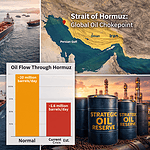
The dominant non‑weather factor remains geopolitical risk in the Middle East. The 2026 Strait of Hormuz crisis—triggered by intensified conflict involving Iran and regional powers—briefly disrupted tanker traffic and threatened a significant share of global seaborne crude flows, sending Brent above USD 100/bbl for the first time in four years and up to about USD 126/bbl at the peak. While traffic has partially resumed and some of the risk premium has faded, the situation remains fragile.
Any renewed escalation or physical damage to key export terminals could rapidly re‑inflate the front of the Brent curve and widen the Brent‑WTI spread. Conversely, a durable diplomatic de‑escalation would likely accelerate the risk‑premium unwind implied in the EIA forecast (Brent below USD 80/bbl in Q3 2026) and could flatten backwardation sooner than currently priced.
🌍 Global Production & Stock Comparisons
Agency data compiled by the IEF indicate that by 2026, global oil supply is forecast to reach about 108.5 mb/d, with notable contributions from U.S. shale, Brazil, Guyana, and continued recovery in some OPEC members. OPEC+ remains responsible for a large share of flexible spare capacity, which is central to price formation given current geopolitical risks.
On the demand side, the IEA expects non‑OECD countries, led by China, India, and Southeast Asia, to account for all net growth in 2026, with OECD consumption slightly declining. As a result, stocks are likely to build modestly in base‑case scenarios if OPEC+ eventually relaxes current quotas, but the scale and timing of those builds will hinge on the duration of the Hormuz risk premium and the strength of the global macroeconomy.
These balances provide fundamental justification for the Raw Text curve: tight nearby pricing due to constrained effective supply and risk premiums, transitioning to much lower forward prices consistent with a world of higher non‑OPEC supply, slower demand growth, and ample spare capacity by the early 2030s.
📆 Short‑Term Market Outlook
Base‑case view (next 1–3 months)
- Prices: Front‑month WTI is likely to trade in a broad EUR 80–95/bbl equivalent band, with Brent in a EUR 85–100/bbl band, as markets weigh residual Hormuz risk against gradual normalisation of flows.
- Curve: Backwardation should remain pronounced, though a partial flattening is possible if OPEC+ signals looser policy or if demand data underperform expectations.
- Volatility: Implied volatility is expected to stay elevated relative to 2025 averages, particularly around geopolitical headlines and key data releases (IEA, OPEC, EIA).
Medium‑term view (late 2026 onward)
- Agency forecasts imply that by Q4 2026, Brent could approach EUR 65–75/bbl, consistent with the downward slope visible in the Brent and WTI curves and with projected supply growth outpacing demand.
- Further into the 2030s, long‑dated WTI around USD 58–60/bbl (≈ EUR 54–56/bbl) reflects expectations of lower‑margin, slower‑growing demand and increasing competition from alternative energy.
💡 Trading Outlook & Recommendations
- Producers (hedgers): The steep backwardation offers attractive opportunities to layer in hedges for 2027–2030 at significantly lower prices than spot. Consider a structured hedge programme selling forward WTI/Brent in the USD 70–75/bbl zone (≈ EUR 65–70/bbl) while retaining some upside near term via collars or call spreads, to benefit from residual geopolitical risk premium.
- Refiners: Use the backwardated curve to secure prompt crude while limiting long‑term commitments. Lock in near‑term crude purchases selectively on price dips (such as the 3–4% correction seen on 16 March) and hedge product cracks against potential volatility from further Hormuz disruptions.
- Commercial consumers (airlines, transport, industry): For jet fuel and diesel exposure, consider a staged hedging strategy extending through early 2027, using Brent- or WTI‑linked swaps or options. Given the high uncertainty, option‑based structures (floors with limited upside caps) provide protection against renewed spikes while maintaining some benefit from the downward trend projected by agencies.
- Speculative traders: The risk‑reward currently favours selectively buying dips in the front of the curve with tight risk management, while expressing a medium‑term bearish view via spread trades (long deferred, short nearby) to capture a potential flattening if geopolitical tensions ease faster than expected.
- Spread & arbitrage strategies: Monitor the Brent‑WTI spread and calendar spreads in both benchmarks. Elevated Brent premiums relative to WTI offer opportunities for spread trades that could profit if U.S. exports increase and global seaborne tightness moderates.
🔮 3‑Day Regional Price Forecast (indicative, in EUR)
Based on the Raw Text settlements, current volatility patterns, and recent agency outlooks, the following table provides an indicative three‑day forecast in EUR for the main prompt contracts. These are directional estimates for analytical purposes, not precise price targets.
| Date | Contract | Region | Forecast close (EUR/bbl) | Bias | Comment |
|---|---|---|---|---|---|
| 18 Mar 2026 | WTI Apr 2026 | NYMEX | ≈ 86–89 | Slightly bearish | After 16 Mar correction, consolidation with mild downside as risk premium further unwinds. |
| 18 Mar 2026 | Brent May 2026 | ICE | ≈ 92–95 | Neutral to slightly bearish | Geopolitical news‑flow dependent; baseline assumes no fresh escalation in Hormuz. |
| 19 Mar 2026 | WTI Apr 2026 | NYMEX | ≈ 86–90 | Range‑bound | Technicals and options flows likely to cap both upside and downside absent new shocks. |
| 19 Mar 2026 | Brent May 2026 | ICE | ≈ 92–96 | Range‑bound | Backwardation remains but intraday volatility tied to Middle East headlines. |
| 20 Mar 2026 | WTI Apr 2026 | NYMEX | ≈ 85–91 | Two‑sided | Weekly data releases (stocks, macro) could move prices either way within a broad band. |
| 20 Mar 2026 | Brent May 2026 | ICE | ≈ 91–97 | Two‑sided | Risk premium remains in place; large moves possible on any change in Hormuz situation. |
Overall, the Raw Text futures curves for WTI and Brent clearly signal a market that is tight today and in the coming quarters, but increasingly comfortable about supply adequacy and demand moderation over the medium term. Trading and hedging strategies should therefore differentiate sharply between short‑term geopolitical risk and the structurally softer long‑run fundamental picture embedded in long‑dated prices.
Related posts:
 Strait of Hormuz Blockade Could Trigger Global Economic Shock, Argus Economist Warns
 Oil Markets Caught Between War Premium and Political Pressure: Brent, WTI and Gasoil React Nervously to Iran Conflict
 Crude Oil Futures Surge: Volatility, Curve Shifts & Market Drivers Unpacked
 Oil Markets Rebound Amid Volatility: What’s Driving WTI and Brent Higher?