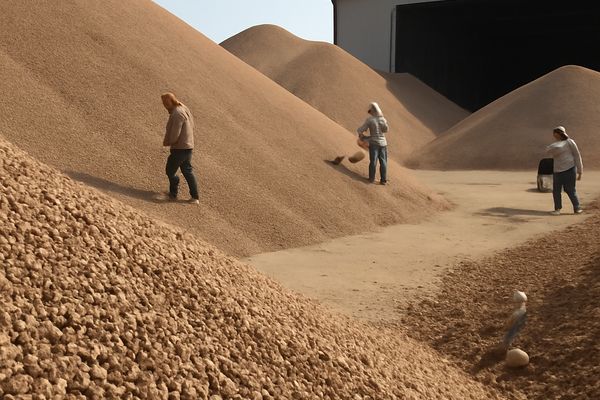
Desi chana (chickpeas) markets in India are trading with a clear soft tone as weak buying from mills and traders meets comfortable new-crop arrivals. Prices are holding above key support but the bias remains downward unless demand improves or export interest emerges.
The current phase is characterized by slow trading, soft sentiment and weak but controlled price erosion. Domestic demand is insufficient to absorb steady arrivals, while the absence of a strong export pull limits any upside momentum. Internationally, FOB values for Indian and Mexican chickpeas have eased in recent weeks, broadly aligning with the weaker undertone seen in Indian mandis. For now, the market is in a waiting pattern, with buyers sidelined and sellers reluctant to cut aggressively as long as support levels hold.
Exclusive Offers on CMBroker

Chickpeas dried
count 42-44, 12 mm
FOB 1.30 €/kg
(from MX)

Chickpeas dried
count 75-80, 8 mm
FOB 0.83 €/kg
(from MX)

Chickpeas dried
count 60-62, 8 mm
FOB 0.85 €/kg
(from IN)
📈 Prices & Short-Term Trend
In major Indian mandis, desi chana is quoted around the equivalent of roughly EUR 62–64 per 100 kg in key centers, while broader all-India averages hover closer to about EUR 57–59 per 100 kg, depending on region and quality. This confirms that prices have not collapsed but are clearly trading on the weaker side of recent ranges.
FOB offers reflect the same easing trend. Converted into EUR, recent indicative values are roughly EUR 1.19/kg for Mexican large chickpeas (42–44 count) and around EUR 0.79–0.89/kg for Indian chickpeas across 8–12 mm grades, all down a few cents over the past month. The mild but persistent decline underscores a market under pressure rather than in free fall.
| Origin | Specification | Location / Term | Latest Price (EUR/kg) | 1-Month Change (approx.) |
|---|---|---|---|---|
| India | Desi chana, mandis (avg.) | Ex-mandi | ~0.58 | Softer, near support |
| India | Chickpeas dried 42–44, 12 mm | FOB New Delhi | ~0.89–0.91 | Down a few cents |
| Mexico | Chickpeas dried 42–44, 12 mm | FOB Mexico City | ~1.19–1.21 | Down a few cents |
🌍 Supply & Demand Dynamics
The dominant driver of the current soft phase is weak buying interest. Traders and dal mills are notably cautious, preferring to wait for lower levels rather than building forward coverage. This buyer strike slows turnover in mandis and amplifies the effect of any fresh arrivals on prices.
On the supply side, new-crop arrivals continue at a steady pace, keeping the physical pipeline comfortably supplied. With no major weather or crop shock in the short term and inventories adequate, there is little fundamental justification for a strong rally. At the same time, there is no aggressive selling panic, which helps explain the gradual, orderly nature of the decline.
Export demand remains limited and is not providing the additional pull needed to tighten domestic balance sheets. As long as the market is driven almost entirely by domestic consumption and mill demand remains hesitant, upside will likely be capped and any short-covering rallies may be shallow and short-lived.
📊 Market Sentiment & Fundamentals
Sentiment across the desi chana complex can be described as “soft but controlled.” Market participants characterize trading as slow, with low activity and buyers standing aside in anticipation of better entry levels. This environment supports a mild bear bias, yet without the hallmarks of a disorderly sell-off.
Fundamentally, the market is anchored by a support area close to about EUR 55–56 per 100 kg equivalent, where value buying is expected to re-emerge. Above this floor, the scope for sustained rallies appears limited in the short run unless there is a notable shift in domestic demand or a pickup in export inquiries. The structure therefore favors a sideways-to-soft trajectory rather than a sharp break lower, assuming no external shock.
📆 Short-Term Outlook
In the short term, prices are likely to remain under mild pressure, with the path of least resistance marginally lower. The key upside trigger would be a clear improvement in mill buying or a sudden strengthening of export demand, either of which could quickly stabilize mandis and lift values off current levels.
Absent such triggers, the market is expected to trade in a weak, rangebound pattern with gradual erosion possible but major downside constrained near established support. Market participants should monitor any policy decisions, import/export adjustments, or weather-related concerns in competing pulses that could indirectly support chickpea prices by shifting demand.
🧭 Trading Outlook & Strategy
- Buyers (mills, processors): Consider staggered, scale-down coverage close to identified support zones rather than aggressively chasing further downside, as the market is weak but not collapsing.
- Producers & stockholders: Avoid heavy selling into already soft conditions unless cash needs dictate; use modest rallies or basis improvement to liquidate portions of stocks.
- Traders: Focus on short-term range trading, selling into minor up-moves and covering near support, while keeping risk tight given the possibility of sudden demand-led rebounds.
📉 3-Day Directional View (Key Markets)
- Indian mandis (desi chana): Slightly weaker to steady; mild downside bias but supported near recent lows.
- FOB India (8–12 mm chickpeas): Mostly steady to marginally softer, with limited fresh export buying.
- FOB Mexico (large chickpeas): Stable to slightly easier, tracking cautious global demand and softer competing origins.