
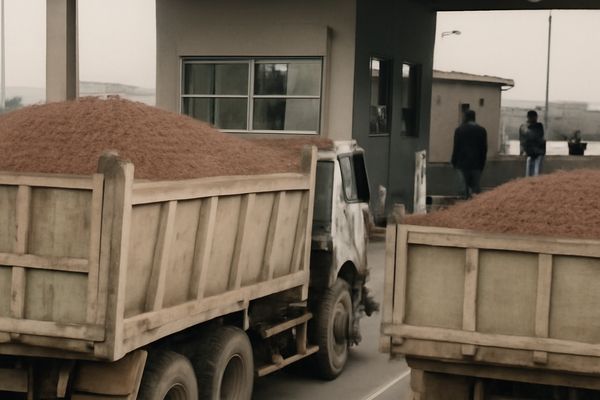
Chinese red adzuki beans face mild downside pressure into late March–early April from new-crop supply in Thailand and Myanmar, but shrinking farmer stocks and seasonal demand ahead of the Dragon Boat Festival point to a gradual price rebound from late April into May.
Market sentiment is cautious in the short term: exporters report that while domestic farmer inventories are declining and raw grain costs still offer some support, the arrival of new Southeast Asian supply is capping the upside for red adzuki. At the same time, broader Chinese bean prices (kidney, mung) show only modest week‑on‑week moves, suggesting consolidation rather than a sharp correction. As traders look toward holiday-driven demand in May, attention is shifting to inventory levels and replacement costs as the key supports for a medium-term recovery.
Exclusive Offers on CMBroker

Mung beans
organic
99.5%
FOB 1.56 €/kg
(from CN)

Mung beans
3.8 mm up
99.5%
FOB 1.48 €/kg
(from CN)

Kidney beans
small, black, organic
99.5%
FOB 1.10 €/kg
(from CN)
📈 Prices & current market tone
FOB Beijing prices in mid‑March (all converted to EUR/t equivalent for comparison) indicate a broadly stable to slightly softer environment across major Chinese beans. Organic red adzuki is quoted around EUR 1.39/kg, up marginally from EUR 1.37/kg a week earlier, while conventional red adzuki stands near EUR 1.32/kg, also edging higher. By contrast, several kidney bean categories eased slightly over the same period, and organic mung beans softened by roughly EUR 0.01/kg, pointing to limited follow‑through buying after earlier gains.
| Product (CN, FOB Beijing) | Latest price (EUR/kg) | w/w change (EUR/kg) |
|---|---|---|
| Adzuki beans, red, organic, 5.0 mm up | 1.39 | +0.02 |
| Adzuki beans, red, 5.0 mm up | 1.32 | +0.02 |
| Mung beans, organic | 1.56 | −0.01 |
| Mung beans, 3.8 mm up | 1.48 | −0.01 |
| Kidney beans, dark red | 1.28 | +0.01 |
This price pattern underscores that red adzuki is currently better supported than many other bean segments, but the author feedback makes clear that upside is limited near term. Exporters expect imported new-crop adzuki from Thailand and Myanmar to add competitive pressure at the end of March and in early April, potentially trimming domestic offers despite still-firm farmgate costs.
🌍 Supply & demand drivers
According to market participants, farmer-held adzuki stocks in China’s main producing regions are already in decline. This tightening of on-farm supply, combined with existing trader inventories acquired at relatively high cost, creates a latent floor under domestic prices. However, as Thai and Myanmar new-crop adzuki arrive, buyers gain short‑term alternatives, which may force Chinese sellers to narrow offers to remain competitive, especially on export business.
On the demand side, the most important seasonal factor is the build‑up of consumption ahead of the Dragon Boat Festival in early June. Industrial users and wholesalers typically begin restocking red adzuki from late April to May for traditional food products, lifting spot demand. Exporters therefore anticipate that once the first wave of Southeast Asian supply is absorbed and farmer stocks fall further, this festival-related restocking will help shift the balance from mild oversupply to a tighter, more supportive market structure.
🌦️ Weather outlook in key Chinese bean regions
In the short term, weather across key northern bean-producing areas is transitioning from winter to early spring. In Heilongjiang (Harbin), conditions remain cool but are set to warm from around 0°C to the mid-teens over the next week, while Inner Mongolia (Hohhot) is forecast to see gradually rising daytime temperatures from high single digits to the mid‑teens.
These conditions are broadly seasonal and, at this stage of the calendar, have limited direct impact on current adzuki price formation, which is dominated by inventory and trade flows rather than new-crop prospects. Unless there is a pronounced shift toward adverse weather later in spring, weather is likely to remain a secondary driver compared with import dynamics and holiday demand.
📊 Fundamentals & timeline
- Late March – early April: Farmer residual adzuki stocks decline, but imports from Thailand and Myanmar increase, adding mild downward pressure to Chinese red adzuki prices despite support from domestic raw grain costs.
- Late April – May: With farmer stocks further reduced and trader inventory costs acting as a strong floor, prices are expected to gradually stop falling and begin a moderate rebound.
- Pre‑Dragon Boat Festival: Restocking demand for traditional products using red adzuki intensifies, underpinning a firmer price tone if import flows normalise and no new bearish shocks emerge.
📆 Trading outlook & 3‑day price indication
- Short term (next 2–4 weeks): Expect a slightly softer to sideways market for Chinese red adzuki as Southeast Asian new-crop arrivals cap rallies. Buyers can be patient but should monitor import pace closely.
- Medium term (late April–May): Gradual stop to the downtrend and a mild rebound are likely, driven by lower farmer stocks and stronger pre‑festival demand. End‑users should consider forward-covering a portion of Q2 needs on dips.
- Risk management: Traders holding high-cost stocks may face margin pressure if imports are heavier than expected; a staggered selling strategy and selective hedging via diversified bean positions can help manage this exposure.
For the next three trading days, FOB Beijing prices for red adzuki (around EUR 1.32–1.39/kg), organic mung (about EUR 1.56/kg) and dark red kidney beans (around EUR 1.28/kg) are expected to trade in a narrow range with a slight downward bias for adzuki if imported offers are aggressive. A clearer upward impulse is only likely closer to late April as domestic availability tightens and festival-related demand becomes more visible.
Related posts:
 Chickpea Market Softens: Indian Desi Chana Under Demand Pressure
 Kabuli Chickpeas Under Pressure: Soft Market, Steady Supply, Limited Upside
 Lentils under Pressure: How Cheap Rajma Signals a Softer Pulse Market
 Cautious Mill Buying Puts Imported Urad Under Pressure While Lentils and Arhar Hold Steady in India’s Pulse Market
 Lentil Market 2026: Supply Grows, Weak Demand Pressures Prices—But Will Rebound Arrive?